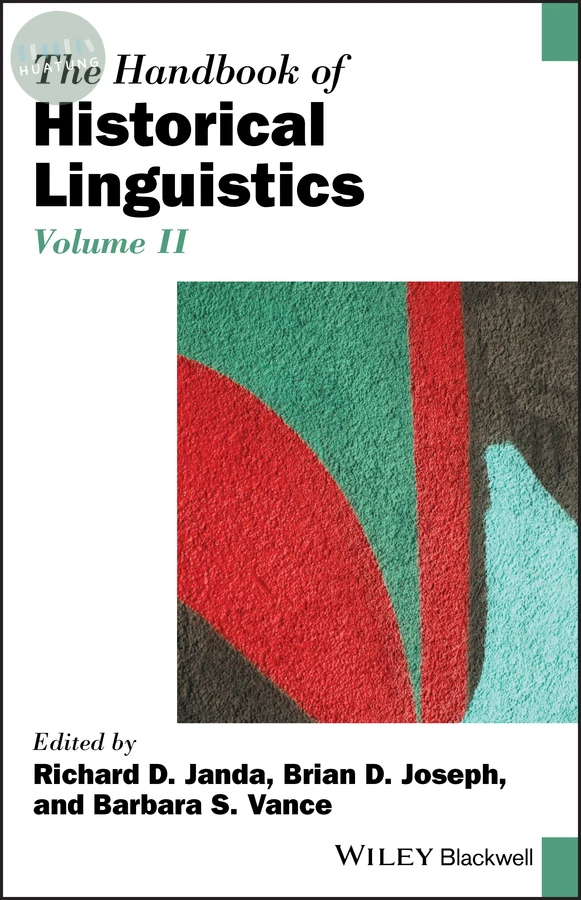

The Handbook of Historical Linguistics, Volume II
$6076元 定價: $6751 9折 可訂購
簡介
“The first volume of the Handbook of Historical Linguistics is the best-worn handbook among many in my office and even though it’s almost 20 years old, I still consult it often. Still, historical linguistics is a very different field today than it was in 2003 and this new volume fully reflects and engages with the state of the art. It’s a completely new book, a worthy successor, and I look forward to wearing out this second volume.”
Joseph Salmons, University of Wisconsin–Madison, USA “This is an important resource for right now and far into the future. In its breadth and depth it has everything we could ask for and more, a comprehensive survey in 24 chapters written by the world’s foremost scholars. It unites time-honored fundamentals of historical linguistics and progressive lines of ongoing research.”
Lyle Campbell, University of Hawai‘i at Mānoa, USA This brand-new, second volume of The Handbook of Historical Linguistics is a complement to the well-established first volume, initially published in 2003. It includes extended content allowing uniquely comprehensive coverage of the study of language(s) over time. Though it adds fresh perspectives on several topics previously treated in the first volume, this Handbook focuses on extensions of diachronic linguistics beyond those key issues. This Handbook provides readers with studies of language change whose perspectives range from comparisons of large open vs. small closed corpora, via creolistics and linguistic contact in general, to obsolescence and endangerment of languages. Written by leading scholars in their respective fields, the chapters of this Handbook cover new topics such as the origin of language, the evidence from language for reconstructing human prehistory, the relevance of the study of present-day language for studying language in the past, and the benefits of linguistic fieldwork for historical investigation. Unique to this volume is a chapter that discusses in detail a large number of highly specific predictions as to the future of a widely spoken language-variety, thereby focusing long-term attention on thirty changes in the lexicon, phonology, morphology, and morphosyntax of North American English. The Handbook of Historical Linguistics, Volume II, is an ideal book for undergraduate and graduate students in linguistics, researchers, and professional linguists, as well as all those interested in the history of particular languages and the history of language more generally.
目錄
About the Editors ix
About the Contributors xi
1 Introduction: Some Things Old, Some Renewed, Some on Borrowing – Here, Previewed 1
Richard D. Janda, Brian D. Joseph, and Barbara S. Vance
Part I Change Within and Across Core Components of Language 5
2 The Expanding Universe of the Study of Sound Change 7
Frans Hinskens
3 Tonogenesis: Register > Tones > Tone Realignment 47
Graham Thurgood
4 Historical Morphology – Overview and Update 63
Brian D. Joseph
5 Theory and Data in Historical Syntax: A Case Study from Old French 88
Barbara S. Vance
Part II On the Variety of Methods and Foci Available for the Study of Language Change 123
6 Dialect Convergence and the Formation of New Dialects 125
Peter Trudgill
7 Formal Syntax as a Phylogenetic Method 145
Cristina Guardiano, Giuseppe Longobardi, Guido Cordoni, and Paola Crisma
8 Typological Approaches and Historical Linguistics 183
Na’ama Pat‐El
9 Inferring Linguistic Change from a Permanently Closed Historical Corpus 196
Kazuhiko Yoshida
10 Studying Language Change in the Present, with Special Reference to English 214
Laurie Bauer
11 Bayesian Phylolinguistics 226
Simon J. Greenhill, Paul Heggarty, and Russell D. Gray
12 Eliciting Evidence of Relatedness and Change: Fieldwork‐Based Historical Linguistics 254
Edward J. Vajda
13 Using Large Recent Corpora to Study Language Change 272
Terttu Nevalainen
Part III Causation and Linguistic Diachrony: What Starts, Shoves, Shifts, Shapes, and/or Spreads Language Change? 291
14 The Phonetics of Sound Change 293
Alan C. L. Yu
15 What Role Do Iconicity and Analogy Play in Grammaticalization? 314
Olga Fischer
16 Spread across the Lexicon: Frequency, Borrowing, Analogy, and Homophones 343
Betty S. Phillips
17 Language Acquisition, Microcues, Parameters, and Morphosyntactic Change 357
Marit Westergaard
18 Theorizing Language Contact: From Synchrony to Diachrony 375
Yaron Matras
Part IV Changing Perspectives in the Study of Linguistic Diachrony 393
19 Genetic Creolistics as Part of Evolutionary Linguistics 395
Salikoko S. Mufwene
20 Historical Change in American Sign Language 423
Ted Supalla, Fanny Limousin, and Betsy Hicks McDonald
21 Language Change in Language Obsolescence 447
Alexandra Y. Aikhenvald
22 Narrative Historical Linguistics: Linguistic Evidence for Human (Pre)history 468
Malcolm Ross
23 A Comparative Evolutionary Approach to the Origins and Evolution of Cognition and of Language 500
Mónica Tamariz
24 Perturbations, Practices, Predictions, and Postludes in a Bioheuristic Historical Linguistics 523
Richard D. Janda
Subject Index 651
Language Index 677
Name Index 685