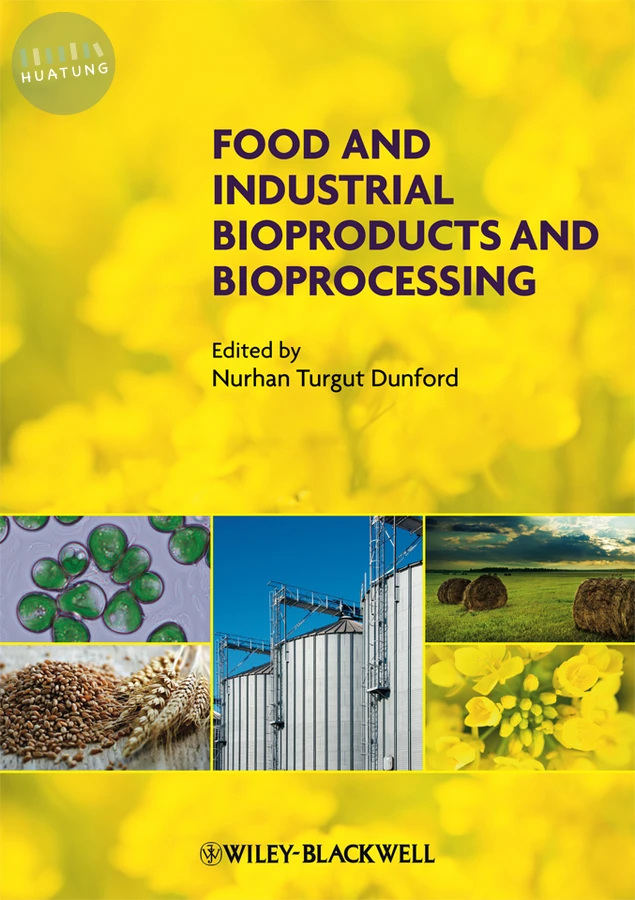
Food and Industrial Bioproducts and Bioprocessing
$7689元 定價: $8543 9折 可訂購
簡介
Food and Industrial Bioproducts and Bioprocessing describes the engineering aspects of bioprocessing, including advanced food processing techniques and bioproduct development. The main focus of the book is on food applications, while numerous industrial applications are highlighted as well. The editors and authors, all experts in various bioprocessing fields, cover the latest developments in the industry and provide perspective on new and potential products and processes. Challenges and opportunities facing the bioproduct manufacturing industry are also discussed. Coverage is far-reaching and includes: current and future biomass sources and bioprocesses; oilseed processing and refining; starch and protein processing; non-thermal food processing; fermentation; extraction techniques; enzymatic conversions; nanotechnology; microencapsulation and emulsion techniques; bioproducts from fungi and algae; biopolymers; and biodegradable/edible packaging. Researchers and product developers in food science, agriculture, engineering, bioprocessing and bioproduct development will find Food and Industrial Bioproducts and Bioprocessing an invaluable resource.
目錄
Preface xi Contributors xiii
Abbreviations xvii
1 Traditional and Emerging Feedstocks for Food and Industrial Bioproduct Manufacturing 1
Nurhan Turgut Dunford
1.1 Introduction 1
1.2 Grain crops 2
1.3 Oil and oilseeds 13
1.4 Lignocellulosic biomass 24
1.5 Conclusions 25
2 Recent Processing Methods for Preparing Starch-based Bioproducts 37
George F. Fanta, Frederick C. Felker and Randal L. Shogren
2.1 Introduction 37
2.2 Annealing and heat–moisture treatment 40
2.3 High-pressure treatment 41
2.4 Microwave processing 46
2.5 Processes using ultrasound 50
2.6 Processing using supercritical fluids 56
2.7 Extrusion processing 63
2.8 Processing by steam jet cooking 67
2.9 Conclusions 71
3 Protein Processing in Food and Bioproduct Manufacturing and Techniques for Analysis 85
Joyce Irene Boye and Chockry Barbana
3.1 Introduction 85
3.2 General properties of proteins 86
3.3 Protein separation processes in food and bioproduct manufacturing 87
3.4 Calculating protein yields and recovery 101
3.5 Processing effects on yield and protein quality 101
3.6 Conclusion 108
4 Advancements in Oil and Oilseed Processing 115
Nurhan Turgut Dunford
4.1 Introduction 115
4.2 Oilseed pretreatment 116
4.3 Oil extraction 119
4.4 Oil refining 127
4.5 Conclusions 137
5 Food-grade Microemulsions As Nano-scale Controlled Delivery Vehicles 145
Natasha Berry, Rickey Yada and Dérick Rousseau
5.1 Introduction 145
5.2 Winsor classification/phase behavior 146
5.3 Theories of microemulsion formation 147
5.4 What makes microemulsions thermodynamically stable? 148
5.5 Methods of microemulsion formation 148
5.6 Polydispersity 149
5.7 Composition 149
5.8 Factors affecting phase behavior 151
5.9 Parameters that modify microemulsion structure 152
5.10 Characterization techniques 154
5.11 Applications 158
5.12 Conclusions 160
6 Emulsions, Nanoemulsions and Solid Lipid Nanoparticles as Delivery Systems in Foods 167
Umut Yucel, Ryan J. Elias and John N. Coupland
6.1 Delivery systems in foods 167
6.2 Structure of emulsions 168
6.3 Localization of BLI in emulsions 169
6.4 Emulsions as delivery systems 172
6.5 Crystallization in emulsions 174
6.6 Localization of BLI in solid lipid nanoparticles 178
6.7 Conclusions 180
7 Fermentation 185
Mark R. Wilkins and Hasan Atiyeh
7.1 Introduction 185
7.2 Fermentative pathways 186
7.3 Microbial growth 188
7.4 Reactor design 189
7.5 Fermentation schemes 194
7.6 Fermentation Products 195
7.7 Separation 199
7.8 Future application areas and emerging developments 200
8 Fungal Cell Factories 205
Sue A. Karagiosis and Scott E. Baker
8.1 Fungi and fungal biotechnology 205
8.2 Historical perspective 206
8.3 Industry 208
8.4 Genomics and the future 213
8.5 Conclusions 215
9 Microalgae: A Renewable Source of Bioproducts 221
Susan I. Blackburn and John K. Volkman
9.1 Introduction 221
9.2 Microalgae and their global importance 221
9.3 Cultured microalgae 223
9.4 Algal culture collections 224
9.5 Microalgal production systems 225
9.6 Historical natural foods 228
9.7 Live feedstocks for aquaculture 228
9.8 Bioproducts 229
9.9 Pharmaceuticals 235
9.10 Microalgae in cosmetics and skin care 236
9.11 Microalgae bioproducts: Future potential 236
10 Bioprocessing Approaches to Synthesize Bio-based Surfactants and Detergents 243
Douglas G. Hayes
10.1 Bio-based surfactants: Overview 243
10.2 Feedstocks for bio-based surfactants 244
10.3 Industrial bio-based surfactants 246
10.4 Advantages of bioprocessing to prepare bio-based non-ionic surfactants 248
10.5 Preparation of bio-based surfactants via enzymes in non-aqueous media 249
10.6 Preparation of biosurfactants via fermentation 258
10.7 Conclusions 261
11 Biopolymers 267
Oguz Turünc and Michael A. R. Meier
11.1 Introduction 267
11.2 Carbohydrate-based polymers 267
11.3 Fat- and oil-based polymers 277
11.4 Conclusion 286
12 Lignocellulosic Biomass Processing 293
Fei Yu and Jonathan Y. Chen
12.1 Introduction 293
12.2 Availability of lignocellulosic biomass 293
12.3 Processing 297
13 Recent Developments in Non-thermal Processess 313
Fernando Sampedro and Howard Q. Zhang
13.1 Introduction 313
13.2 Recent advances in non-thermal technologies 314
13.3 Future trends 325
14 Enzymes as Biocatalysts for Lipid-based Bioproducts Processing 333
Ling-Zhi Cheong, Zheng Guo, Sergey N. Fedosov, Bena-Marie Lue, Ram C.R. Jala, Gündüz Güzel, and Xuebing Xu
14.1 Introduction 333
14.2 Enzyme characteristics 333
14.3 Enzyme kinetics in industrial applications 334
14.4 Enzymes in industrial applications 338
14.5 Conclusions and future trends 351
References 353
Index 359
A color plate section falls between pages 222 and 223