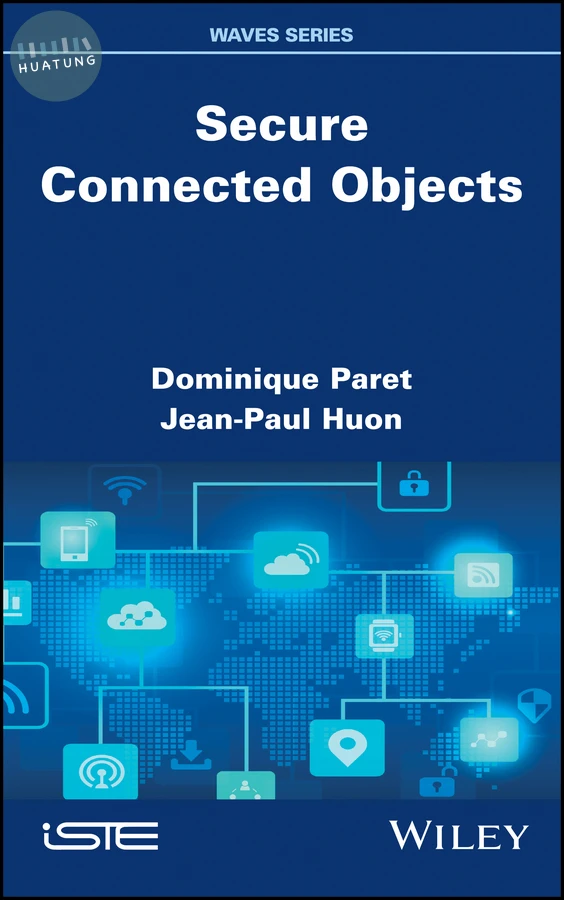
Secure Connected Objects
$5182元 定價: $5758 9折 可訂購
簡介
In this book, the authors focus on the concrete aspects of IoT (Internet of Things): the daily operation, on the ground, of this domain, including concrete and detailed discussion of the designs, applications and realizations of Secure Connected Things and IoT. As experts in the development of RFID and IoT technologies, the authors offer the reader a highly technical discussion of these topics, including the many approaches (technical, security, safety, ergonomic, economic, normative, regulations, etc.) involved in Secure Connected Objects projects.
This book is written both for readers wishing to familiarize themselves with the complex issues surrounding networking objects and for those who design these connective "things".
目錄
Foreword xi
Preface xiii
Acknowledgements xv
Preamble xvii
Part 1 Introduction – The Buzz about IoT and IoE 1
Chapter 1 Introduction 3
1.1 Definition of communicating- or connected Things 3
1.1.1 Connected Things – Communicating Things 3
1.1.2 Definition of the IoT 4
1.1.3 Internet of X 5
Chapter 2 The (Overly) Vast World of IoT 9
2.1 2011–2016: the craze for the term “Connected Thing” 9
2.1.1 The catch-all 9
2.1.2 Fashion, buzz and “bubble” 10
2.1.3 “Hype” cycle for innovations 11
2.2 The true goal of this book 14
Chapter 3 Why a Connectable Thing? 15
3.1 Examples of connectable things 15
3.1.1 Home care for the elderly 16
3.1.2 In the automotive industry 19
Part 2 Constraints Surrounding an IoT Project 21
Chapter 4 Aspects to be Taken into Consideration 23
4.1 Aspects pertaining to the concrete realization of Connected Things 23
4.1.1 Financial and marketing aspects 24
4.1.2 Technical and industrial aspects 24
4.1.3 Regulatory and normative aspects 24
4.1.4 Security aspects 24
4.1.5 Cost aspects 24
Chapter 5 Financial and Marketing Aspects 27
5.1 Economic aspects 27
5.1.1 Saleable / buyable 27
5.2 Ergonomic aspects 29
5.2.1 Mechanical form and design vs ergonomics 29
Chapter 6 Technical and Industrial Aspects 31
6.1 Technical aspects 31
6.1.1 Life cycle of a new product 31
6.1.2 Techno-economic feasibility 32
6.1.3 Design 32
6.1.4 Industrialization, manufacturing process and quality assurance 32
6.2 Energy aspects 32
6.2.1 Power supply to the Thing 33
6.3 Industrial aspects 39
Chapter 7 Regulatory and Normative Aspects 41
7.1 Regulatory aspects and recommendations 41
7.1.1 Radiofrequency regulations 42
7.2 Health-related recommendations 43
7.2.1 Exposure of the human body to electromagnetic fields 44
7.2.2 Specific Absorption Rate (SAR) 44
7.3 Societal regulations and individual freedoms (privacy) 45
7.3.1 The various data needing to be protected 45
7.3.2 Loi Informatique et Libertés 45
7.3.3 Mandate 436, PIA and RFID and IoT applications 46
7.3.4 GDPR – General Data Protection Regulation 49
7.3.5 Privacy by design 51
7.4 Environmental regulations and recycling 53
7.4.1 Electronic waste treatment 53
7.4.2 Regulation and organization of the chain 54
7.4.3 Labeling of electrical and electronic equipment 54
7.5 Normative aspects 55
7.5.1 ISO/AFNOR 55
7.5.2 IEEE 56
7.5.3 ETSI 56
Chapter 8 Security Aspects 59
8.1 Security aspects 59
8.1.1 The weak links 60
8.1.2 Possible solutions 62
8.1.3 Definition and choice of security target 63
8.1.4 Concepts of security levels applied in IoT 64
8.1.5 True security – the “Secure Element” 67
8.1.6 Cryptography 70
8.1.7 Symmetric and asymmetric encryption 71
8.1.8 Consumer Things, IoT, security… and the Cloud 75
8.2 Judging the quality of security 80
8.3 Some thoughts about security, privacy and IoT 81
8.4 Vulnerabilities and attacks in the IoT chain 82
8.4.1 Attacks on the software layer 83
8.4.2 Attacks on the board or Thing 84
8.4.3 Attacks on the integrated circuits 84
8.4.4 Security standards 85
Part 3 Overall Architecture of the IoT Chain 87
Chapter 9 Communication Models in IoT 89
9.1 Communication models in IoT 89
9.1.1 OSI model 89
9.1.2 TCP/IP model 92
9.1.3 By way of conclusion 98
Chapter 10. Overall Architecture of an IoT System 101
10.1 Overall architecture of a CT and IoT solution 101
10.1.1 Description of the complete chain 102
10.2 From a more technological point of view 102
10.2.1 Architecture and overview of an IoT chain 102
10.2.2 The “base station/gateway” 106
10.2.3 The “Cloud” zone 109
10.2.4 The “User” zone 110
10.3 The very numerous protocols involved 113
Part 4 Detailed Description of the IoT Chain 117
Part 4A From the User (The Outside World) to the Thing 119
Chapter 11 From the Outside World to the Thing 121
11.1 Connection of the Thing to the outside world 121
11.1.1 Using sensors 121
11.1.2 Using wired connections 122
11.1.3 Using RF links 122
11.1.4 Very Short Range (