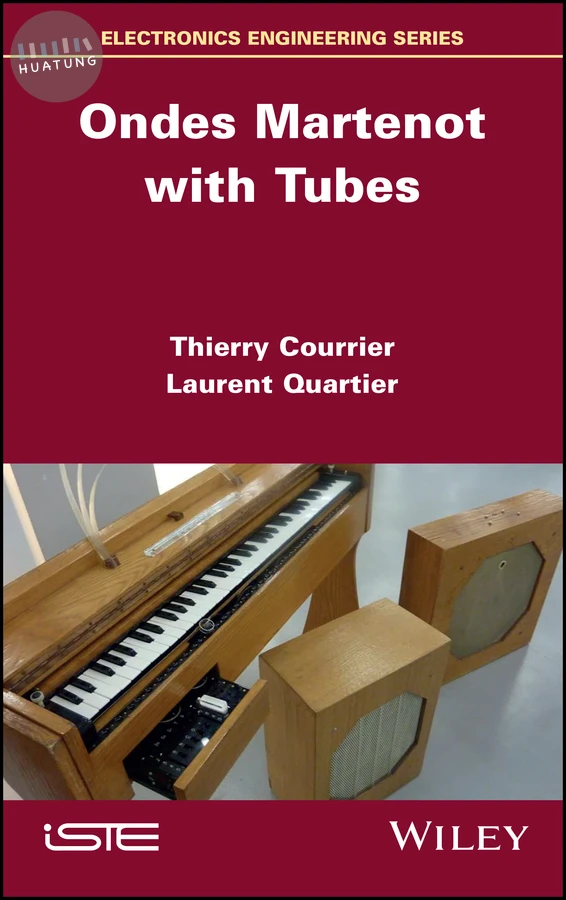

Ondes Martenot with Tubes
$4951元 定價: $5501 9折 可訂購
簡介
The Ondes Martenot is one of the precursors of electronic musical instruments, and is today considered, with the desire for a return to analogue, as a cult instrument. This book, which is the result of several years of research, sheds light on the intrinsic functioning of the Ondes Martenot.
Based on the study of numerous prototypes, the authors trace the historical evolution of the different techniques used: additive, multiplicative and relaxation syntheses. Often, the analysis of the functioning of these instruments demonstrates atypical technological choices, underpinned by a logic that places artistic creation at the forefront. Several models and simulations are built, so as to understand the functioning of each of the different sub-assemblies (keyboard, ribbon, intensity key, timbre filter...). At the end of the book, the complete construction of an Onde (copy of model no. 208) is described in detail. This practical realization of a facsimile is an opportunity to explore the knowhow of the electronic luthier Maurice Martenot.
目錄
Foreword xi
Hugues GENEVOIS
Photo Credits xiii
Introduction xv
Chapter 1 Ondes 1928 1
1.1 Presentation 1
1.2 Principle of operation 3
1.3 The diagram 4
1.4 Construction of a model of the “1928” ondes 8
1.4.1 The box 8
1.4.2 Construction 9
1.4.3 The tuning capacitor controlled by a wire 10
1.4.4 The intensity key 14
1.5 Tests 18
1.5.1 Energy sources 18
1.5.2 The wiring 18
1.5.3 Tuning capacitor calibration 20
1.5.4 Adjusting the instrument 21
1.6 Perspectives of evolution 22
Chapter 2 Ondes No. 15 (1930) 23
2.1 Introduction 23
2.2 Presentation 23
2.3 Organization of the instrument 24
2.4 The heterodyne system + mixer-preamplifier + amplifier 27
2.4.1 General organization 27
2.4.2 Heterodynes 31
2.4.3 The mixer-preamplifier 34
2.4.4 The amplifier 35
2.5 The drawer 37
2.6 The diffuser 41
2.7 Power supplies 43
2.8 Trials 48
2.8.1 Preparations 48
2.8.2 Measurements 53
2.8.3 Measurement results 55
Chapter 3 Ondes No. 169 (1937) 63
3.1 Presentation of the instrument 63
3.2 Organization of the instrument 63
3.3 The heterodyne system + mixer + LF audio amplifier+ power amplifier 65
3.3.1 General organization 65
3.3.2 Heterodynes 67
3.3.3 The mixer–amplifier 79
3.3.4 The amplifier 81
3.4 The drawer 88
3.4.1 Description 88
3.4.2 Circuit diagram 89
3.4.3 Functional study 94
3.4.4 The intensity key 96
3.5 The diffuser 101
3.6 The power supply module 108
3.7 Model 112
3.7.1 Presentation 112
3.7.2 Realization 112
3.7.3 Tests and measurements 121
Chapter 4 Model ‘47 125
4.1 Presentation 125
4.2 Synoptic diagram 125
4.3 Operation analysis 125
4.3.1 Heterodynes 125
4.3.2 The mixer 130
4.3.3 First LF 131
4.3.4 The T9 timbre 136
4.3.5 LF power stage 137
4.3.6 Power module 142
4.4 The intensity key, ribbon capacitor and keyboard 142
Chapter 5 Ondes No. 208 (1953) 145
5.1 Introduction 145
5.2 Functional descriptions 146
5.2.1 The unit 146
5.2.2 The block diagram 150
5.2.3 Mechanical/electrical arrangement 150
5.3 Operation analysis 153
5.3.1 Oscillators 153
5.3.2 The fixed-frequency oscillator 154
5.3.3 The variable-frequency oscillator 157
5.4 The ribbon capacitor 161
5.4.1 General provisions 161
5.4.2 Sizing 164
5.4.3 Comments 179
5.5 Keyboard inductors 180
5.5.1 General provisions 180
5.5.2 Sizing 182
5.5.3 The register change 188
5.6 The mixer 190
5.7 1st LF 193
5.8 LF power stage 196
5.9 Timbre filters 198
5.10 Diffusers 209
5.11 Power supply 209
Chapter 6 Building an Ondes with Vacuum Tubes 213
6.1 Introduction 213
6.2 The electrical schematic 213
6.3 The chassis 214
6.4 The wiring 217
6.5 Special devices 217
6.5.1 The high register tuning capacitor 217
6.5.2 The diapason capacitor 218
6.5.3 The variable tuning inductor of the low register 219
6.5.4 Capacitors for timbre 7 219
6.5.5 HF inductors 220
6.6 The LF output transformer 225
6.7 Generic components 225
6.8 The drawer 225
6.8.1 Introduction 225
6.8.2 The box 225
6.8.3 Switches 227
6.8.4 The quarter-tone control buttons 228
6.8.5 The T8 timbre control knob 230
6.8.6 The power control knob 231
6.8.7 The needle block 232
6.8.8 The intensity key 232
6.8.9 The wiring 232
6.9 The keyboard/ribbon system 234
6.9.1 Introduction 234
6.9.2 The ribbon capacitor 234
6.9.3 The keyboard 241
6.10 The accessories 248
6.10.1 Command buttons 248
6.10.2 Other accessories 250
6.11 Calibration and tuning 254
6.11.1 Introduction 254
6.11.2 Ribbon capacitor calibration 254
6.11.3 Calibrating the keyboard coils 256
6.11.4 Tuning setting 257
6.11.5 The tuning procedure 259
6.12 Some photographs of ondes 2208 260
Chapter 7 Manufacture of the Leather Bag of the Intensity Key and the Ribbon 263
7.1 The intensity key 263
7.2 The mercury key 264
7.2.1 Description 264
7.2.2 Operating constraints 264
7.2.3 Realization 266
7.3 The powder key, first version 268
7.3.1 Abandonment of the mercury key 268
7.3.2 Description 268
7.3.3 Operating constraints 269
7.3.4 Realization 269
7.4 The powder key, second version 270
7.4.1 Description 270
7.4.2 Operating constraints 271
7.4.3 Realization 271
7.5 The powder key, third version 272
7.5.1 Description 272
7.5.2 Operating constraints 272
7.5.3 Realization 273
7.6 The powder key, fourth version 275
7.6.1 Description 275
7.6.2 Operating constraints 276
7.6.3 Realization 276
7.7 Other powder bags 277
7.7.1 Introduction 277
7.7.2 The pedal 277
7.7.3 The knee lever 278
7.8 Intensity key and gesture control 280
7.9 Manufacturing a powder bag 282
7.9.1 Introduction 282
7.9.2 Problem 283
7.9.3 Manufacturing the mixture 283
7.9.4 Manufacturing the powder bag 285
7.10 Ribbon manufacturing 288
7.10.1 Introduction 288
7.10.2 Problem 291
7.10.3 Ribbon manufacturing 291
Chapter 8 Transistorization 297
8.1 Introduction 297
8.2 The support 297
8.3 The problems of transistorization 299
8.4 Compatible transistor experimental ondes 301
8.4.1 Introduction 301
8.4.2 Diagram of the HF sub-assembly 301
8.4.3 The LF subset 302
8.4.4 Power supplies 303
8.5 Tests 304
References 305
Index 307