簡介
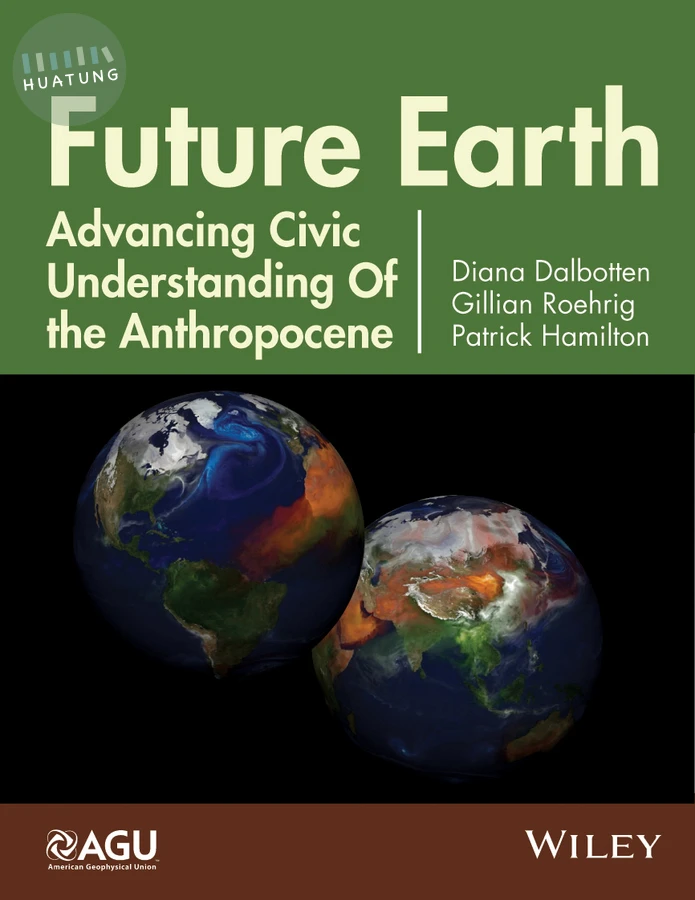
Earth now is dominated by both biogeophysical and anthropogenic processes, as represented in these two images from a simulation of aerosols. Dust (red) from the Sahara sweeps west across the Atlantic Ocean. Sea salt (blue) rises into the atmosphere from winds over the North Atlantic and from a tropical cyclone in the Indian Ocean. Organic and black carbon (green) from biomass burning is notable over the Amazon and Southeast Asia. Plumes of sulfate (white) from fossil fuel burning are particularly prominent over northeastern North America and East Asia. If present trends of dust emissions and fossil fuel burning continues in what we call the Anthropocene epoch, then we could experience high atmospheric CO2 levels leading to unusual warming rarely experienced in Earth's history. This book focuses on human influences on land, ocean, and the atmosphere, to determine if human activities are operating within or beyond the safe zones of our planet's biological, chemical, and physical systems.
Volume highlights include:
Assessment of civic understanding of Earth and its future
Understanding the role of undergraduate geoscience research and community-driven research on the Anthropocene
Effective communication of science to a broader audience that would include the public, the K-12 science community, or populations underrepresented in the sciences
Public outreach on climate education, geoscience alliance, and scientific reasoning
Future Earth is a valuable practical guide for scientists from all disciplines including geoscientists, museum curators, science educators, and public policy makers.
目錄
Contributors vii
Preface ix
Acknowledgments xi
1. Welcome to the Anthropocene
Patrick Hamilton 1
2. The Anthropocene and the Framework for K–12 Science Education
Fred N. Finley 9
3. Teacher Professional Development in the Anthropocene
Devarati Bhattacharya, Gillian Roehrig, Anne Kern, and Melinda Howard 19
4. Climate Literacy and Scientific Reasoning
Shiyu Liu, Keisha Varma, and Gillian Roehrig 31
5. Evaluation and Assessment of Civic Understanding of Planet Earth
Julie C. Libarkin 41
6. Community-Driven Research in the Anthropocene
Rajul E. Pandya 53
7. Geoscience Alliance: Building Capacity to Use Science for Sovereignty in Native Communities
Nievita Bueno Watts, Wendy Smythe, Emily Geraghty Ward, Diana Dalbotten, Vanessa Green, Mervyn Tano, and Antony Berthelote 67
8. New Voices: The Role of Undergraduate Geoscience Research in Supporting Alternative Perspectives on the Anthropocene
Diana Dalbotten, Rebecca Haacker-Santos, and Suzanne Zurn-Birkhimer 77
9. Shaping the Public Dialogue on Climate Change
William Spitzer 89
10. Opportunities for Communicating Ocean Acidification to Visitors at Informal Science Education Institutions
Douglas Meyer and Bill Mott 99
11. City-Wide Collaborations for Urban Climate Education
Steven Snyder, Rita Mukherjee Hoffstadt, Lauren B. Allen, Kevin Crowley, Daniel A. Bader, and Radley M. Horton 103
12. On Bridging the Journalism/Science Divide
Bud Ward 111
Index 121
Color plate section is located between pages 88 and 89.