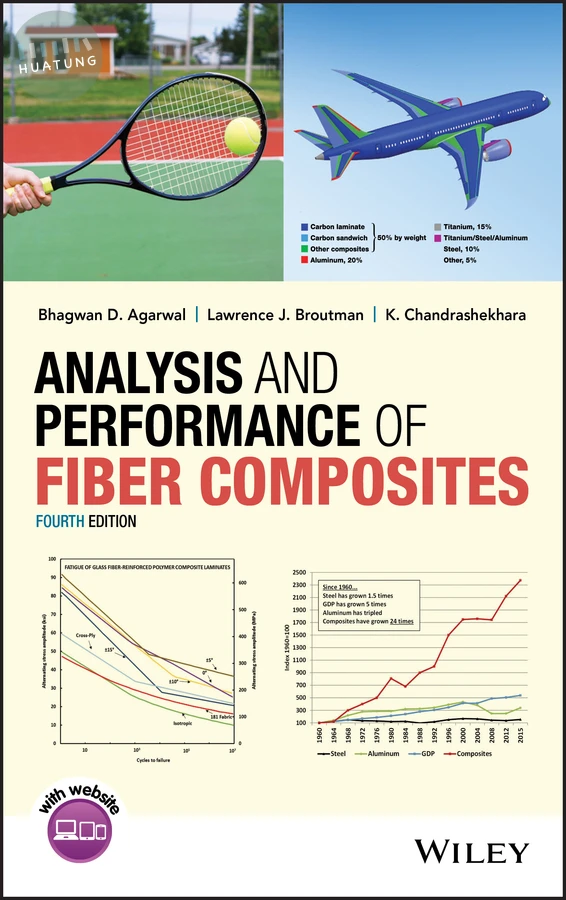

Analysis and Performance of Fiber Composites
$5215元可訂購
簡介
Updated and expanded coverage of the latest trends and developments in fiber composite materials, processes, and applications
Analysis and Performance of Fiber Composites, Fourth Edition features updated and expanded coverage of all technical aspects of fiber composites, including the latest trends and developments in materials, manufacturing processes, and materials applications, as well as the latest experimental characterization methods.
Fiber reinforced composite materials have become a fundamental part of modern product manufacturing. Routinely used in such high-tech fields as electronics, automobiles, aircraft, and space vehicles, they are also essential to everyday staples of modern life, such as containers, piping, and appliances. Little wonder, when one considers their ease of fabrication, outstanding mechanical properties, design versatility, light weight, corrosion and impact resistance, and excellent fatigue strength. This Fourth Edition of the classic reference�the standard text for composite materials courses, worldwide�offers an unrivalled review of such an important class of engineering materials.
Still the most comprehensive, up-to-date treatment of the mechanics, materials, performance, analysis, fabrication, and characterization of fiber composite materials available, Analysis and Performance of Fiber Composites, Fourth Edition features:
Expanded coverage of materials and manufacturing, with additional information on materials, processes, and material applications
Updated and expanded information on experimental characterization methods�including many industry specific tests
Discussions of damage identification techniques using nondestructive evaluation (NDE)
Coverage of the influence of moisture on performance of polymer matrix composites, stress corrosion of glass fibers and glass reinforced plastics, and damage due to low-velocity impact
New end-of-chapter problems and exercises with solutions found on an accompanying website
Computer analysis of laminates
No other reference provides such exhaustive coverage of fiber composites with such clarity and depth. Analysis and Performance of Fiber Composites, Fourth Edition is, without a doubt, an indispensable resource for practicing engineers, as well as students of mechanics, mechanical engineering, and aerospace engineering.
Visit the Companion Website at: https://www.wiley.com/WileyCDA/Section/id-830336.html
目錄
Preface xv
About the Companion Website xvii
1 Introduction 1
1.1 Definition 1
1.2 Classification 2
1.3 Particulate Composites 2
1.4 Fiber-Reinforced Composites 5
1.5 Applications of Fiber-Reinforced Polymer Composites 7
Exercise Problems 15
References 16
2 Fibers, Matrices, and Fabrication of Composites 17
2.1 Reinforcing Fibers 17
2.1.1 Glass Fibers 19
2.1.2 Carbon and Graphite Fibers 25
2.1.3 Aramid Fibers 29
2.1.4 Boron Fibers 30
2.1.5 Other Fibers 31
2.2 Matrix Materials 33
2.2.1 Polymers 33
2.2.2 Metals 44
2.3 Fabrication of Fiber Composite Products 45
2.3.1 Fabrication with Thermosetting Resin Matrices 45
2.3.2 Fabrication with Thermoplastic Resin Matrices 59
2.3.3 Sandwich Composites 61
2.3.4 Fabrication with Metal Matrices 63
2.3.5 Fabrication with Ceramic Matrices 64
Suggested Reading 65
3 Micromechanics of Unidirectional Composites 67
3.1 Introduction 67
3.1.1 Nomenclature 68
3.1.2 Volume and Weight Fractions 68
3.2 Longitudinal Loading: Deformation, Modulus, and Strength 70
3.2.1 Model 70
3.2.2 Deformation under Small Loads 71
3.2.3 Load Sharing 74
3.2.4 Behavior beyond Initial Deformation 76
3.2.5 Failure Mechanism and Longitudinal Strength 78
3.2.6 Factors Influencing Longitudinal Strength and Stiffness 80
3.3 Transverse Loading: Modulus and Strength 83
3.3.1 Model 83
3.3.2 Elasticity Methods of Stiffness Prediction 85
3.3.3 Halpin–Tsai Equations for Transverse Modulus 86
3.3.4 Transverse Strength 89
3.4 Shear Modulus 92
3.5 Poisson’s Ratios 96
3.6 Expansion Coefficients and Transport Properties 97
3.6.1 Thermal Expansion Coefficients 97
3.6.2 Moisture Absorption and Expansion Coefficients 99
3.6.3 Transport Properties 100
3.7 Failure of Unidirectional Composites 105
3.7.1 Microscopic Failure Events 105
3.7.2 Failure under Longitudinal Tensile Loads 108
3.7.3 Failure under Longitudinal Compressive Loads 111
3.7.4 Failure under Transverse Tensile Loads 115
3.7.5 Failure under Transverse Compressive Loads 116
3.7.6 Failure under In-Plane Shear Loads 120
3.8 Typical Properties of Unidirectional Fiber Composites 120
Exercise Problems 121
References 126
4 Short-Fiber Composites 129
4.1 Introduction 129
4.2 Load Transfer to Fibers 130
4.2.1 Simplified Analysis of Stress Transfer 130
4.2.2 Stress Distributions from Finite-Element Analysis 134
4.3 Predicting Modulus and Strength of Short-Fiber Composites 136
4.3.1 Average Fiber Stress 136
4.3.2 Longitudinal and Transverse Modulus of Aligned Short-Fiber Composites 137
4.3.3 Modulus of Randomly Oriented Short-Fiber Composites 138
4.3.4 Longitudinal Strength of Aligned Short-FiberComposites 142
4.3.5 Strength of Randomly Oriented Short-Fiber Composites 143
4.4 Influence of Matrix Ductility on Properties 144
Exercise Problems 148
References 149
5 Macromechanics Analysis of an Orthotropic Lamina 151
5.1 Introduction 151
5.1.1 Orthotropic Materials 151
5.2 Stress–Strain Relations for Unidirectional Composites 153
5.2.1 Engineering Constants in Longitudinal and Transverse Directions 153
5.2.2 Off-Axis Engineering Constants 156
5.2.3 Transformation of Engineering Constants 158
5.3 Hooke’s Law and Stiffness and Compliance Matrices 167
5.3.1 General Anisotropic Material 167
5.3.2 Transformation of Stress, Strain, and Elasticity Constants 169
5.3.3 Stress–Strain Relations for Orthotropic Materials 169
5.3.4 Transversely Isotropic Material 170
5.3.5 Isotropic Material 171
5.3.6 Orthotropic Material under Plane Stress 172
5.3.7 Compliance Tensor and Compliance Matrix 173
5.3.8 Relations between Engineering Constants and Elements of Stiffness and Compliance Matrices 174
5.3.9 Restrictions on Elastic Constants 177
5.3.10 Transformation of Stiffness and Compliance Matrices 178
5.3.11 Invariant Forms of Stiffness and Compliance Matrices 182
5.4 Strengths of an Orthotropic Lamina 185
5.4.1 Maximum-Stress Theory 186
5.4.2 Maximum-Strain Theory 188
5.4.3 Maximum-Work Theory 190
5.4.4 Importance of Sign on Off-Axis Strength of Composites 193
Exercise Problems 196
References 200
6 Analysis of Laminated Composites 202
6.1 Classical Lamination Theory 202
6.1.1 Introduction 202
6.1.2 Laminate Displacements and Strains 202
6.1.3 Laminate Stresses 205
6.1.4 Resultant Forces and Moments 206
6.1.5 Laminate Constitutive Relations 207
6.2 Laminate Description System 213
6.3 Design, Construction, and Properties of Laminates 215
6.3.1 Symmetric Laminates 215
6.3.2 Unidirectional, Cross-Ply, and Angle-Ply Laminates 215
6.3.3 Quasi-isotropic Laminates 216
6.4 Failure of Laminates 224
6.4.1 Initial Failure 224
6.4.2 Laminate Analysis after Initial Failure 228
6.5 Hygrothermal Stresses in Laminates 238
6.5.1 Concepts of Thermal Stresses 238
6.5.2 Hygrothermal Stress Calculations 240
6.6 Laminate Analysis through Computers 251
Exercise Problems 255
References 259
7 Analysis of Laminated Plates and Beams 260
7.1 Introduction 260
7.2 Governing Equations for Plates 261
7.2.1 Equilibrium Equations 261
7.2.2 Equilibrium Equations in Terms of Displacements 264
7.3 Application of Plate Theory 266
7.3.1 Bending of Specially Orthotropic Laminates 266
7.3.2 Buckling 276
7.3.3 Free Vibrations 281
7.4 Deformations Due to Transverse Shear 286
7.4.1 First-Order Shear Deformation Theory 287
7.4.2 Higher-Order Shear Deformation Theory 290
7.5 Analysis of Laminated Beams 293
7.5.1 Governing Equations for Laminated Beams 293
7.5.2 Application of Beam Theory 295
Exercise Problems 299
References 301
8 Advanced Topics in Fiber Composites 302
8.1 Interlaminar Stresses and Free-Edge Effects 302
8.1.1 Concepts of Interlaminar Stresses 302
8.1.2 Determination of Interlaminar Stresses 304
8.1.3 Effect of Stacking Sequence on Interlaminar Stresses 306
8.1.4 Approximate Solutions for Interlaminar Stresses 308
8.1.5 Summary 312
8.2 Fracture Mechanics of Fiber Composites 313
8.2.1 Introduction 313
8.2.2 Fracture Mechanics Concepts and Measures of Fracture Toughness 315
8.2.3 Fracture Toughness of Composite Laminates 323
8.2.4 Whitney–Nuismer Failure Criteria for Notched Composites 327
8.3 Joints for Composite Structures 332
8.3.1 Adhesively Bonded Joints 333
8.3.2 Mechanically Fastened Joints 337
8.3.3 Bonded-Fastened Joints 339
Exercise Problems 339
References 340
9 Performance of Fiber Composites: Fatigue, Impact, and Environmental Effects 345
9.1 Fatigue 345
9.1.1 Introduction 345
9.1.2 Fatigue Damage 346
9.1.3 Factors Influencing Fatigue Behavior 354
9.1.4 Empirical Relations for Fatigue Damage and Fatigue Life 361
9.1.5 Fatigue of High-Modulus Fiber-Reinforced Composites 362
9.1.6 Fatigue of Short-Fiber Composites 366
9.2 Impact 371
9.2.1 Introduction and Fracture Process 371
9.2.2 Energy-Absorbing Mechanisms and Failure Models 373
9.2.3 Effect of Materials and Testing Variables on Impact Properties 377
9.2.4 Hybrid Composites and Their Impact Strength 383
9.2.5 Damage Due to Low-Velocity Impact 387
9.3 Environmental-Interaction Effects 391
9.3.1 Fiber Strength 391
9.3.2 Matrix Effects 397
Exercise Problems 405
References 406
10 Experimental Characterization of Composites 414
10.1 Introduction 414
10.2 Measurement of Physical Properties 415
10.2.1 Density 415
10.2.2 Constituent Weight and Volume Fractions 415
10.2.3 Void Volume Fraction 416
10.2.4 Thermal Expansion Coefficients 417
10.2.5 Moisture Absorption and Diffusivity 417
10.2.6 Moisture Expansion Coefficients 418
10.3 Measurement of Mechanical Properties 419
10.3.1 Properties in Tension 419
10.3.2 Properties in Compression 423
10.3.3 In-Plane Shear Properties 425
10.3.4 Flexural Properties 433
10.3.5 Interlaminar Shear Strength and Fracture Toughness 438
10.3.6 In-Plane Fracture Toughness Tests 442
10.3.7 Impact Tests 450
10.3.8 Tests for Aerospace Applications 455
10.4 Damage Identification Using Nondestructive Evaluation Techniques 457
10.4.1 Ultrasonics 457
10.4.2 Acoustic Emission 460
10.4.3 X-Radiography 461
10.4.4 Thermography 463
10.4.5 Laser Shearography 464
10.5 General Remarks on Characterization 464
Exercise Problems 468
References 470
11 Emerging Composite Materials 475
11.1 Nanocomposites 475
11.2 Carbon–Carbon Composites 477
11.3 Biocomposites 478
11.3.1 Biofibers 478
11.3.2 Wood–Plastic Composites (WPCs) 480
11.3.3 Biopolymers 481
11.4 Composites in “Smart” Structures 482
11.5 Further Emerging Trends 483
Suggested Reading 484
Appendix 1 Matrices and Tensors 488
A1.1 Matrix Definitions 488
A1.2 Matrix Operations 493
A1.3 Tensors 498
References 509
Appendix 2 Equations of Theory of Elasticity 510
A2.1 Analysis of Strain 510
A2.2 Analysis of Stress 514
A2.3 Stress–Strain Relations for Isotropic Materials 518
References 520
Appendix 3 Laminate Orientation Code 521
A3.1 Standard Code Elements 521
A3.2 Positive and Negative Angles 522
A3.3 Symmetric Laminates 524
A3.4 Sets 524
A3.5 Hybrid Laminates 525
Appendix 4 Properties of Fiber Composites 527
Appendix 5 Computer Programs for Laminate Analysis 532
Appendix 6 Introduction to MATLAB 534
A6.1 Introduction: Getting Started 534
A6.2 Vectors and Matrices 537
A6.2.1 Defining Matrices 537
A6.2.2 Basic Matrix Functions 537
A6.2.3 Extracting Parts of Matrices 539
A6.2.4 Basic Matrix Operations 539
A6.3 Programming in MATLAB 540
A6.3.1 Logical and Relational Operators 540
A6.3.2 Loop and Logical Statements 540
A6.3.3 MATLAB Functions: Saving Programs 540
A6.3.4 Input/Output Functions 541
A6.3.5 Controlling the Appearance of Floating Point Number 541
A6.4 Plotting Tools 542
A6.4.1 Basic Plot Commands 542
A6.4.2 Line Styles and Colors 543
Index 545