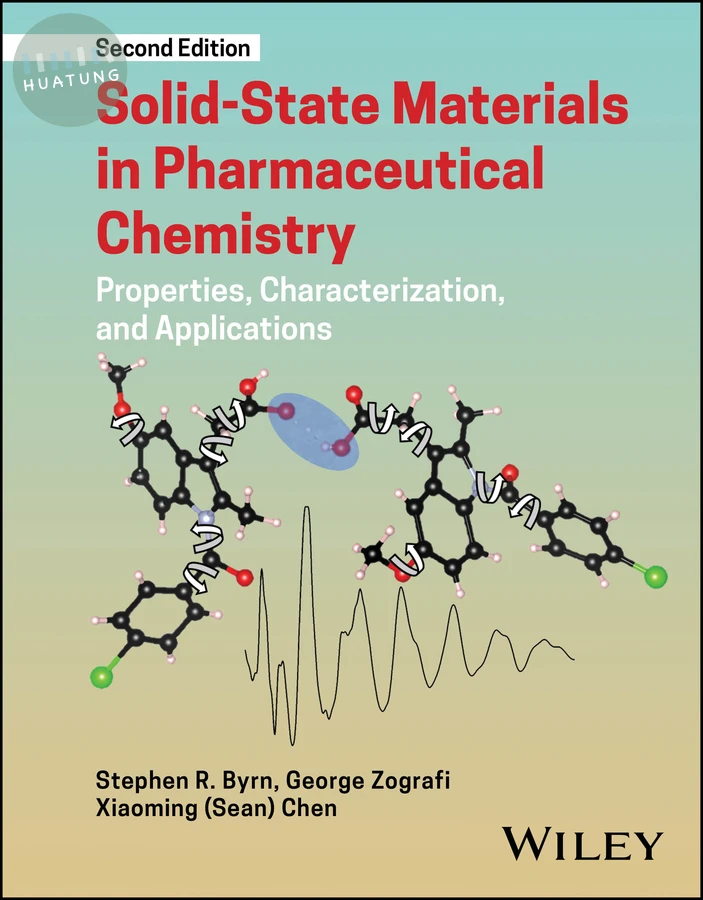

Solid-State Materials in Pharmaceutical Chemistry
$5853元 定價: $6503 9折 可訂購
簡介
Updated and expanded information on the properties of pharmaceutical solids and their impact on drug product performance, quality, and stability Solid-State Materials in Pharmaceutical Chemistry provides readers with a comprehensive and up-to-date resource for understanding and controlling the solid-state properties of pharmaceutical materials, enabling the development of safe and effective medicines including small molecule compounds, peptides, proteins, and nucleotides. This new edition covers the significant transformations in the landscape of pharmaceutical research, development, and manufacturing since the previous edition was published, presenting both novel challenges and unprecedented opportunities. New chapters in this edition cover physical and chemical properties of RNA therapeutics, a frontier to many life-saving medicines and vaccines including Covid vaccines, and final stage drug substance manufacturing and control, addressing challenges in API process development including impurity purging, chiral separation, final form preparation, particle size reduction, and nitrosamine control. Readers will also find other updated topics including bulk and surface properties of solids, lipid nanoparticles, applications of pharmaceutical solvates in impurity purging and final form preparation, pharmaceutical cocrystal engineering to enable chiral separation, the emerging technique of microcrystal electron diffraction in solid form characterization, poor wettability of APIs, oral delivery of peptides such as semaglutide, injectable drug-device combination products, and N-nitrosamine control in drug product. This updated and revised Second Edition still features: Physical and chemical properties of solid-state pharmaceuticals such as amorphous forms, mesophases, polymorphs, hydrates/solvates, salts, co-crystals, nano-particles, and solid dispersions
Characterization techniques for solid form identification and physical attribute analysis such as X-Ray powder diffraction, thermal analysis, microscopy, spectroscopy, solid state NMR, particle analysis, water sorption, mechanical property testing, solubility, and dissolution
Applications of pharmaceutical chemistry and physical characterization techniques in developing and testing drug substances and drug products for small molecules and biopharmaceuticals
This book is an essential resource on the subject for formulation scientists, process chemists, medicinal chemists, and analytical chemists. The book will also appeal to quality control, quality assurance, and regulatory affair specialists and advanced undergraduate and graduate students in pharmaceutical chemistry, drug delivery, material science, crystal engineering, pharmaceutics, and biopharmaceutics.
目錄
Biography of Authors xv
Preface xvii
Preface to the First Edition xvii
Acknowledgment xix
1 Solid-State Properties and Pharmaceutical Development 1
1.1 Introduction 1
1.2 Solid-state Forms 1
1.3 Bulk and Surface Properties of Solids 6
1.4 ICH Q6A Decision Trees 7
1.5 “Big Questions” for Drug Development 8
1.6 Accelerating Drug Development 10
1.7 Solid-state Chemistry in Preformulation and Formulation 12
1.8 Solid–Lipid Nanoparticles 15
1.9 Learning Before Doing and Quality by Design 16
1.10 Performance and Stability in Pharmaceutical Development 19
1.11 Moisture Uptake 20
1.12 Solid-state Reactions 21
1.13 Noninteracting Formulations – Physical Characterizations 21
2 Polymorphs 27
2.1 Introduction 27
2.2 How Are Polymorphs Formed? 27
2.3 Structural Aspect of Polymorphs 29
2.3.1 Configurational Polymorphs 29
2.3.2 Conformational Polymorphs 30
2.4 Physical, Chemical, and Mechanical Properties 32
2.4.1 Solubility 33
2.4.2 Chemical Stability 34
2.4.3 Mechanical Properties 34
2.5 Thermodynamic Stability of Polymorphs 35
2.5.1 Monotropy and Enantiotropy 36
2.5.2 Burger and Ramberger’s Rules 37
2.5.3 van’t Hoff Plot 37
2.5.4 ∆G/temperature diagram 38
2.6 Polymorph Conversion 39
2.6.1 Solution-mediated Transformation 40
2.6.2 Solid-state Conversion 40
2.7 Control of Polymorphs 42
2.8 Polymorph Screening 43
2.9 Polymorph Prediction 44
3 Pseudopolymorphs: Hydrates and Solvates 49
3.1 Introduction 49
3.2 Pharmaceutical Importance of Hydrates 49
3.3 Classification of Pharmaceutical Hydrates 51
3.4 Water Activity 52
3.5 Stoichiometric Hydrates 53
3.6 Nonstoichiometric Hydrates 54
3.7 Emerging Interests in Organic Solvates 55
3.8 Isostructural Solvates 57
3.9 Dehydration and Desolvation 59
3.10 Preparation and Characterization of Hydrates and Solvates 61
4 Pharmaceutical Salts 65
4.1 Introduction 65
4.2 Importance of Pharmaceutical Salts 65
4.3 Weak Acid, Weak Base, and Salt 66
4.4 pH Solubility Profiles of Ionizable Compounds 69
4.5 Solubility, Dissolution, and Bioavailability of Pharmaceutical Salts 71
4.6 Physical Stability of Pharmaceutical Salts 75
4.7 Strategies for Salt Selection 76
5 Pharmaceutical Cocrystals 81
5.1 Introduction 81
5.2 Cocrystals and Crystal Engineering 81
5.3 Solubility Phase Diagrams for Cocrystals 83
5.4 Preparation of Cocrystals 85
5.5 Dissolution and Bioavailability of Cocrystals 88
5.6 Pharmaceutical Applications of Cocrystals 90
5.7 Comparison of Pharmaceutical Salts and Cocrystals 92
5.7.1 Formation 93
5.7.2 Preparation 93
5.7.3 Polymorphism and Pseudopolymorphism 93
5.7.4 Characterization 93
5.7.5 Stability 93
5.7.6 Formulation 94
5.7.7 Regulatory 94
6 Amorphous Solids 97
6.1 Introduction 97
6.2 The Formation of Amorphous Solids 98
6.3 Methods of Preparing Amorphous Solids 99
6.4 The Glass Transition Temperature 100
6.5 Structural Features of Amorphous Solids 103
6.6 Molecular Mobility 105
6.6.1 Overview of Molecular Mobility 105
6.6.2 Viscosity and Molecular Mobility 106
6.6.3 Relaxation Time 107
6.6.4 Fragility in Supercooled Liquids 108
6.6.5 Diffusive Relaxation Time in the Glassy State 110
6.6.6 Secondary Relaxations in Amorphous Solids 112
6.7 Mixtures of Amorphous Solids 114
6.7.1 Overview 114
6.7.2 Thermodynamics of Molecular Mixing in Amorphous Solids 115
6.7.3 The Glass Transition Temperature and Molecular Mobility of Miscible Amorphous Mixtures 116
7 Crystal Mesophases and Nanocrystals 121
7.1 Introduction 121
7.2 Overview of Crystal Mesophases 121
7.3 Liquid Crystals 122
7.4 Conformationally Disordered (Condis) Crystals 127
7.5 Plastic Crystals 127
7.6 Nanocrystals 128
8 X-Ray Crystallography and Crystal-Packing Analysis 131
8.1 Introduction 131
8.2 Crystals 131
8.3 Miller Indices and Crystal Faces 131
8.4 Determination of the Miller Indices of the Faces of a Crystal 133
8.5 Determination of Crystal Structure 134
8.5.1 Diffraction of X-Rays 134
8.5.2 Experimental Measurements 135
8.5.3 Determination of Space Group Symmetry 136
8.5.4 Calculation of the Density of the Crystal 136
8.5.5 Structure Determination 136
8.5.6 Crystal-packing Drawings 137
8.5.7 Atomic Displacement Parameters and Molecular Mobility 137
8.6 Variable-Temperature X-ray Studies 138
9 X-Ray Powder Diffraction 139
9.1 Introduction 139
9.2 XRPD of Crystalline Materials 139
9.3 Qualitative Analysis of Crystalline Materials 141
9.4 Phase Transformations 143
9.5 Quantitative Phase Analysis Using XRPD 143
9.6 Solving Crystal Structures Using XRPD 147
9.7 X-ray Diffraction of Amorphous and Crystal Mesophase Forms 149
9.8 Pair Distribution Function 149
9.9 X-ray Diffractometers 152
9.10 Variable Temperature XRPD 156
10 Differential Scanning Calorimetry and Thermogravimetric Analysis 159
10.1 Introduction 159
10.2 The Basics of DSC 159
10.3 Thermal Transitions of Pharmaceutical Materials 160
10.3.1 Melting 160
10.3.2 Glass Transition in Amorphous Solids 161
10.3.3 Enthalpy Relaxation for Amorphous Solids 161
10.3.4 Crystallization 162
10.3.5 Crystal Form Transitions 162
10.3.6 Desolvation/Dehydration 163
10.3.7 Chemical Degradation 163
10.4 DSC Instrumentation 163
10.4.1 Heat-flux DSC 163
10.4.2 Power-compensated DSC 164
10.4.3 Modulated DSC 164
10.4.4 Fast-scan DSC 165
10.4.5 Operation of DSC Instrumentation 165
10.5 Thermogravimetric Analysis 168
10.6 Operating a TGA Instrument 169
10.7 Evolved Gas Analysis 169
10.8 Applications of DSC and TGA 169
10.8.1 The Study of Polymorphs, Solvates, and Hydrates 169
10.8.2 Polymer Characterization 171
10.8.3 Characterization of Amorphous Forms and Amorphous Solid Dispersions 172
10.8.4 Dehydration and Desolvation Kinetics 172
10.8.5 Optimization of the Freezing–Drying Cycle in Lyophilization 173
10.8.6 Melting-point Depression Method for Purity Analysis and Drug–Polymer Miscibility Assessment 174
10.8.7 Study of Solid-state Chemical Stability 176
10.8.8 Characterization of Macromolecules and Their Interactions 176
10.9 Summary of Using DSC and TGA 178
11 Microscopy 181
11.1 Introduction 181
11.2 Light Microscopy 181
11.3 Polarized Light Microscopy 183
11.4 Thermal Microscopy 183
11.5 Functionality of Light Microscopy 184
11.6 Digital Microscope 185
11.7 Application of Light Microscopy to Pharmaceutical Materials 186
11.7.1 Differentiation of Amorphous and Crystalline Materials 186
11.7.2 Characterization of Polymorphs, Hydrates, and Solvates 186
11.7.3 Polymorph Conversion 189
11.7.4 Control of Crystallization 190
11.7.5 Screening for Cocrystals 191
11.7.6 Analysis of Particle Size 192
11.7.7 Contaminant Analysis 192
11.8 Scanning Electron Microscope 193
11.9 Environmental SEM 195
11.10 TEM and ED 196
11.11 Atomic Force Microscopy 198
12 Vibrational Spectroscopy 203
12.1 Introduction 203
12.2 The Nature of Molecular Vibrations 204
12.3 FT-IR Spectroscopy 205
12.4 Material Characterization by FT-IR Spectroscopy 206
12.5 FT-IR Instrumentation 208
12.6 Diffuse Reflectance FT-IR 209
12.7 Atr Ft-ir 211
12.8 FT-IR Microscopy 212
12.9 NIR Spectroscopy 213
12.10 Raman Spectroscopy 215
12.11 Raman Instrumentation and Sampling 217
12.12 Raman Microscopy 219
12.13 Terahertz Spectroscopy 220
12.14 Comparison of FT-IR, NIR, Raman, and Terahertz Spectroscopy 222
12.14.1 Spectral Information 222
12.14.2 Spectral Resolution 223
12.14.3 Sampling 223
12.14.4 Environmental Control 223
12.14.5 Microscopy 223
12.14.6 Fluorescence and Photodamage 224
13 Solid-State NMR Spectroscopy 227
13.1 Introduction 227
13.2 An Overview of Solid-state 13C CP/MAS NMR Spectroscopy 227
13.2.1 Dipolar Decoupling 228
13.2.2 Magic-Angle Spinning 231
13.2.3 Cross Polarization 232
13.3 Solid-state NMR Studies of Pharmaceuticals 232
13.4 Phase Identification in Dosage Forms 233
13.5 Other Basic Solid-state NMR Experiments Useful for Pharmaceutical Analysis 237
13.5.1 Interrupted Decoupling for Protonated Carbon Atoms 237
13.5.2 Block-Decay Experiments for Screening Submolecular Mobility 239
13.6 Determination of the Domain Structure of Amorphous Dispersions Using Solid-state NMR 241
13.7 Solid-state NMR of Amorphous Materials 242
13.8 Summary 244
14 Particle and Powder Analysis 247
14.1 Introduction 247
14.2 Particles in Pharmaceutical Systems 247
14.2.1 Micelles 247
14.2.2 Protein Aggregates 248
14.2.3 Liposomes 248
14.2.4 Microemulsions 248
14.2.5 Nanoemulsions 248
14.2.6 Nanosuspensions 249
14.2.7 Nanoparticles 249
14.2.8 Aerosols 249
14.2.9 Emulsions 249
14.2.10 Suspensions 249
14.2.11 Powders 249
14.2.12 Granules 250
14.2.13 Pellets 250
14.3 Particle Size and Shape 250
14.4 Particle Size Distribution 251
14.5 Dynamic Light Scattering 252
14.6 Zeta Potential 254
14.7 Laser Diffraction 256
14.8 Acoustic Spectroscopy 258
14.9 Dynamic Image Analysis 259
14.10 Sieve Analysis 260
14.11 Bulk Properties of Pharmaceutical Particulates and Powder 260
14.12 Surface Area Measurement 262
15 Hygroscopic Properties of Solids 267
15.1 Introduction 267
15.2 Water Vapor Sorption–Desorption 268
15.3 Water Vapor Sorption Isotherms, Relative Humidity, and Water Activity 268
15.4 Measurement of Water Content and Water Vapor Sorption–Desorption Isotherms 270
15.4.1 Measurement of Water Content 270
15.4.2 Measurement of Water Vapor Sorption–Desorption Isotherms 271
15.5 Modes of Water Vapor Sorption 272
15.5.1 Introduction 272
15.5.2 Adsorption 273
15.5.3 Deliquescence 277
15.5.4 Capillary Condensation 278
15.5.5 Absorption by Amorphous Solids 280
16 Mechanical Properties of Pharmaceutical Materials 287
16.1 Introduction 287
16.2 Stress and Strain 287
16.3 Elasticity 288
16.4 Plasticity 289
16.5 Viscoelasticity 290
16.6 Brittleness 291
16.7 Hardness 293
16.8 Powder Compression 294
16.9 Powder Compression Models and Compressibility 295
16.10 Compactibility and Tensile Strength 296
16.11 Effect of Solid Form on Mechanical Properties 297
16.12 Effect of Moisture on Mechanical Properties 299
16.13 Methods for Testing Mechanical Properties 301
16.13.1 Beam Bending 301
16.13.2 Thermomechanical Analyzer 302
16.13.3 Dynamic Mechanical Analyzer 303
16.13.4 Nanoindentation 304
17 Solubility and Dissolution 307
17.1 Introduction 307
17.2 Principal Concepts Associated with Solubility 307
17.3 Prediction of Aqueous Drug Solubility 308
17.4 Solubility of Pharmaceutical Solid Forms 310
17.5 Solubility Determination Using the Shake-Flask Method 311
17.6 High-throughput Screening of Solubility 312
17.7 Solubility Measurement of Metastable Forms 313
17.8 Kinetic Solubility Measurement 314
17.9 Solubility Determination of Drugs in Polymer Matrices 315
17.10 Dissolution Testing 316
17.11 Nonsink Dissolution Test 320
17.12 Biorelevant Dissolution Test 321
17.13 Intrinsic Dissolution Studies 324
17.14 Summary 325
18 Physical Stability of Solids 329
18.1 Introduction 329
18.2 Underlying Basis for Physical Instability in Pharmaceutical Systems 330
18.3 Disorder in Crystals 331
18.4 Quantitative Determination of Partially Amorphous Material in Crystals 333
18.5 Phase Transformation 335
18.5.1 Solid-state Crystallization 335
18.5.2 Solvent-mediated Phase Transformations 338
18.6 Examples of the Role of Process-induced Disorder in Solid-state Physical Instability in Pharmaceutical Systems 339
18.7 Poor Wettability of Solids During Dosage Form Processing and Administration 341
18.8 Considerations in Evaluating Solid-state Physical Stability 345
19 Chemical Stability of Solids 349
19.1 Introduction 349
19.2 Examples of Chemical Reactivity in the Solid State 349
19.3 Some General Principles That Establish the Rate of Chemical Reactions in Solution 352
19.4 Some General Principles Governing the Rates of Solid-state Reactions 355
19.5 The Role of Crystal Defects in Solid-state Reactions 356
19.6 Chemical Reactivity in the Amorphous Solid State 360
19.7 Chemical Reactivity and Processed-induced Disorder 363
19.8 The Effects of Residual Water on Solid-state Chemical Reactivity 364
19.9 Drug–Excipient Interactions 369
19.10 Summary 371
20 Solid-State Properties of Proteins 375
20.1 Introduction 375
20.2 Solution Properties of Proteins 375
20.3 Amorphous Properties of Proteins 379
20.4 Crystalline Properties of Proteins 381
20.5 Local Molecular Motions and the Dynamical Transitional Temperature, T d 382
20.6 Solid-state Physical and Chemical Stability of Proteins 384
20.7 Cryoprotection and Lyoprotection 385
21 Physical and Chemical Properties of RNA Therapeutics 389
21.1 Introduction 389
21.2 Mode of Action 389
21.2.1 Antisense RNA 390
21.2.2 Small Interference RNA 390
21.2.3 Messenger RNA 391
21.2.4 Crispr 392
21.3 Building Blocks and Primary Structure 392
21.4 RNA Structure in Solution 394
21.4.1 Hydrogen Bonding 395
21.4.2 Stacking Interaction 395
21.4.3 Ionic Interaction 395
21.4.4 RNA Secondary and Tertiary Structure 396
21.5 RNA Stability in Solution 398
21.6 Solid-state Properties 400
21.7 Pharmaceutical Development 402
21.7.1 Drug Delivery Challenges and Current Platforms 402
21.7.2 How to Make RNA Therapeutics 403
21.7.3 Characterization of mRNA LNPs 404
21.7.4 Stability of mRNA LNPs 406
21.7.5 Lyophilization of mRNA LNPs 407
21.8 Summary 408
22 Solid Form Selection of Active Pharmaceutical Ingredients 411
22.1 Introduction 411
22.2 Solid Form Selection 411
22.3 Amorphous Form Screening 413
22.4 Salt Selection 414
22.5 Cocrystal Screening 417
22.6 Polymorph Screening 419
22.7 Slurrying 420
22.8 High-Throughput Screening 421
22.9 Crystallization in Confined Space 422
22.10 Nonsolvent-based Polymorph Screening 423
22.11 Polymer-induced Heteronucleation 424
22.12 Physical Characterization 425
22.13 Thermodynamic Stability and Solid Form Selection 426
22.14 Summary 427
23 Final Stage Drug Substance Manufacturing and Control 431
23.1 Introduction 431
23.2 Crystallization and Impurity Purge 431
23.3 Removal of Residual Solvents 434
23.4 Control of Genotoxic Impurities 436
23.5 Control of N-Nitrosamines 437
23.6 Chiral Separation Through Salt and Cocrystal Formation 438
23.7 Preparation of the Final Solid Form 441
23.8 Particle Size and Shape Control During Crystallization 444
23.9 Powder Agglomeration and Caking 447
23.10 Milling and Micronization 448
23.11 Impact of Process Impurities on Crystallization 449
23.12 Summary 450
24 Solid-State Mixture Analysis 455
24.1 Introduction 455
24.2 Limitations of Wet Chemistry 455
24.3 Pharmaceutical Analysis in the Solid State 456
24.3.1 Sample Preparation 456
24.3.2 Data Collection 456
24.3.3 Data Transformation 457
24.3.4 Calibration Model Development and Validation 457
24.4 Measurement of Amorphous Content 459
24.5 Detection of Crystallinity 462
24.6 Quantification of Mixtures of Polymorphs 464
24.7 Salt and Free Form Composition 466
24.8 Analysis of Particulate Contaminants in Drug Products 467
24.9 Process Analytical Technology 470
24.9.1 Physical and Chemical Attributes of a Process 471
24.9.2 Selection of Process Analyzers 471
24.9.3 Location of the Process Analyzer 473
24.9.4 Development of Analytical Models for Process Monitoring 474
24.9.5 Validation 475
24.10 Summary 476
25 Drug Product Development 479
25.1 Chemistry, Manufacture, and Control 479
25.2 Preformulation 481
25.3 Drug–Excipient Compatibility 482
25.4 Solid Dispersions 484
25.5 Abuse-Deterrent Dosage Forms 489
25.6 Drug-Eluting Stents 491
25.7 Dry Powder Inhalers 494
25.8 Lyophilization of Biopharmaceutical Products 497
25.9 Oral Delivery of Peptides 500
25.10 Injectable Drug–Device Combination Products 502
25.11 Control of N-Nitrosamine in Drug Product 504
25.12 Summary 506
26 Quality by Design 511
26.1 Introduction 511
26.2 QbD Wheel 511
26.3 Learning Before Doing 514
26.4 Risk-based Orientation 516
26.5 API Attributes and Process Design 517
26.6 Development and Design Space 517
26.7 Process Design – Crystallization 520
26.8 Phase Transformations During Wet Granulation 521
26.9 Dissolution Tests with an IVIVC for QbD 522
26.10 Summary 525
Index 527