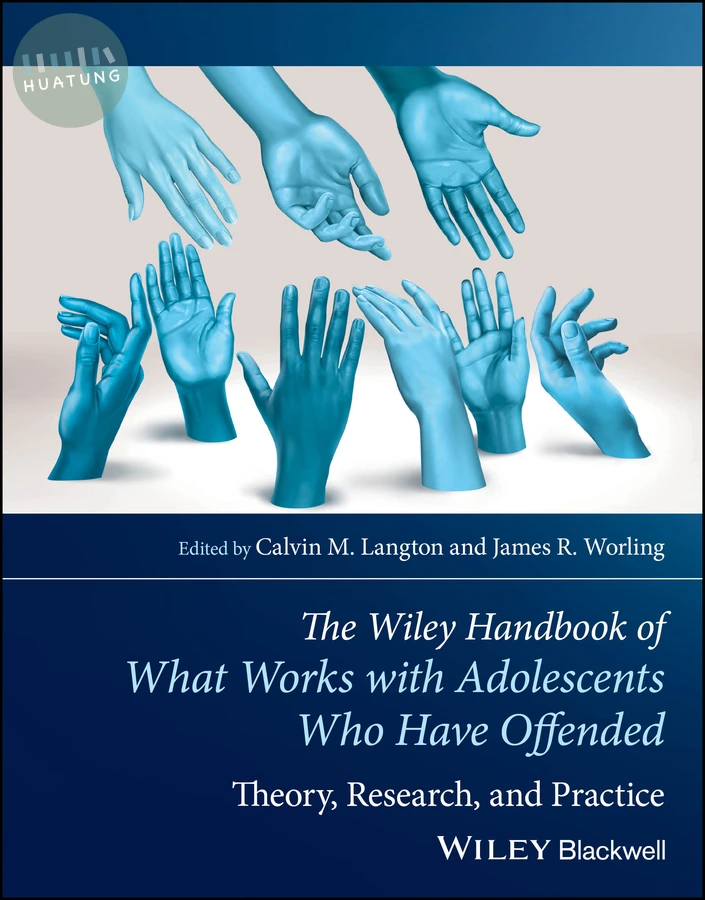

The Wiley Handbook of What Works with Adolescents Who Have Offended
$1542元 定價: $1713 9折 可訂購
簡介
Promising, evidence-based practices in prevention and intervention work with adolescents involved with the youth justice system With scholarly discussions of theory, policy, and research defining the field, What Works with Adolescents Who Have Offended delivers the latest evidence-based practices in prevention and intervention work with adolescents involved with the youth justice system. This book explicitly addresses the evidence bases for best practices in applied work and covers influential jurisprudence, policies, and programs implemented across geographical jurisdictions. The book is divided into four sections. The first section covers clinical presentations and disorders, such as substance use, ADHD, intellectual disabilities, autism, PTSD, and Fetal Alcohol Spectrum Disorders (FASD). The second section covers distinct groups including adolescent girls, gangs, sexual offenders, and firesetters, along with general race, ethnicity, and cultural considerations. The third section covers the nature of interventions, with information on family therapy approaches, dialectical behavior therapy, and cognitive-behavioral interventions. The last section covers broad considerations and approaches in the field. With contributions from internationally renowned authorities in the field, What Works with Adolescents Who Have Offended includes discussion on: Key conceptual issues, methodological approaches and innovations, diversity of contributions on aetiology, and lifespan perspectives
Major contributions from major theoretical models, neuroscience, and research in developmental criminology
Ethical and professional issues in healthcare work with youth-justice involved youth
Critical reviews of the extant literatures and future directions in the field
Priorities for research, policy, and practice based on lessons learned throughout the text
The expansive selection of contents and organization of What Works with Adolescents Who Have Offended makes the work valuable to a broad readership, including researchers and academics, practitioners, and legal scholars and policy makers.
目錄
List of Contributors xi
Biographical Statements xv
Section 1 Clinical Presentations and Disorders 1
1 Mental Health Needs in Adolescents Who Have Offended: Implications for What Works 3
Sarah Cusworth Walker, Asia S. Bishop, and Kathryn A. Cunningham
2 Substance Use and Delinquent Behavior 27
Lourah M. Kelly, Kristyn Zajac, Tess K. Drazdowski, Ashli J. Sheidow, Michael R. McCart, and Phillippe B. Cunningham
3 Oppositional Defiant Disorder, Conduct Disorder, Psychopathic Traits, and Youth Crime: What Works 41
Eva R. Kimonis and Bryan Neo
4 Attention- Deficit/Hyperactivity Disorder and Youth Crime: What Works 61
Steffen Barra, Daniel Turner, and Wolfgang Retz
5 Intellectual Disabilities and Youth Crime: What Works 75
Clare L. Melvin
6 Evidence- and Experientially- Based Interventions in Justice- Involved Adolescents with Fetal Alcohol Spectrum Disorders (FASD) 95
Natalie Novick Brown, Karen Steele, Dan Dubovsky, Richard A. Adler, and Paul D. Connor
7 Justice-Involved Youth with Autism and the Search for Best Practices: Scholarly Consensus, Practitioner Awareness, and Emerging Applications of Existing Paradigms for Those on the Spectrum 119
Laurie A. Drapela
8 Posttraumatic Stress Disorder and Complex Trauma- Related Disorders Among Youth Involved in Juvenile Justice: What Works 133
Julian D. Ford, Patricia K. Kerig, and Keith R. Cruise
9 The Implications of Neuroscience for What Works with Justice- Involved Youth 151
Jessica L. Garcia and Elena L. Grigorenko
Section 2 Distinct Groups 171
10 Adolescent Girls and Crime: What Works 173
Claire Fitzpatrick
11 Race, Ethnicity, and Cultural Considerations with Justice- Involved Youth: Implications for What Works 183
Eyitayo Onifade and Kwanele Shishane
12 What Works for Youth Involved in Both the Child Welfare and Juvenile Justice Systems 199
Karen M. Kolivoski and Sherri Y. Simmons- Horton
13 What Works with Gangs and Preventing Gang Crimes 211
James C. Howell, Celeste Wojtalewicz, and Jay Franklin
14 What Works: Assessment and Treatment with Adolescents Who Have Sexually Offended 223
James R. Worling and Calvin M. Langton
15 Firesetting Behavior in Children and Adolescents: What Works to Extinguish It? 243
Ian Lambie and Kahn Tasker
Section 3 Nature of Interventions 259
16 Prevention of Youth Crime and Delinquency: What Works 261
Abigail A. Fagan
17 Restorative Justice with Adolescents Who Have Offended: What Works 275
Yvon Dandurand and Megan Capp
18 Family Therapy Approaches with Adolescents Who Have Offended: What Works 289
Phillipa Evans and Chris Trotter
19 Cognitive- Behavioral Interventions with Adolescents Who Have Offended: What Works 303
Eva L. Feindler and Stefanie M. Iwanciw
20 The Use of Dialectical Behavior Therapy in Juvenile Justice Settings 319
Michele Galietta, Emma Singer Covey, and Aidan Collins
21 Risk Reduction Models, Strengths- based Approaches, and Some Questions Raised in Positive Psychology for Interventions with Justice- involved Individuals 335
Calvin M. Langton, Daniel Pillersdorf, Meredith Awrey, Maryam Salih, and James R. Worling
Section 4 Broad Considerations and Approaches 375
22 Ethical and Professional Issues in Applied Work with Adolescents Who Have Offended 377
Sara A. Hofmann
23 What Meta- analyses Tell Us About What Works for Adolescents Who Have Offended 391
Laceé N. Pappas
24 “Whole Youth Approach” to Juvenile Justice Transformation: Integrating Sexual Orientation, Gender Identity, Gender Expression, and Race 403
Aisha Canfield, Angela Irvine-Baker, and Carolyn Reyes
25 A Quiet Revolution: What Worked to Create a “Whole- Systems Approach” to Juvenile Justice in Scotland 415
Lesley McAra and Susan McVie
26 Does the Law Work in Youth Justice? The Role of Law for a “What Works” Approach, With Belgium- Flanders as a Case Study 433
Johan Put, Stefaan Pleysier, and Katrijn Veeckmans
27 Priorities for Research, Policy, and Practice with Adolescents Who Have Offended: Lessons Learned and Goals for Implementation 449
Kirk Heilbrun, Amanda NeMoyer, David DeMatteo, Naomi E. Goldstein, Heidi Zapotocky, Kellie Wiltsie, Chelsea Jackson, Hailey Fasone, Lea Parker, Tierney Huppert, Nivedita Anjaria, Lena DeYoung, and Rena Kreimer
Index 463