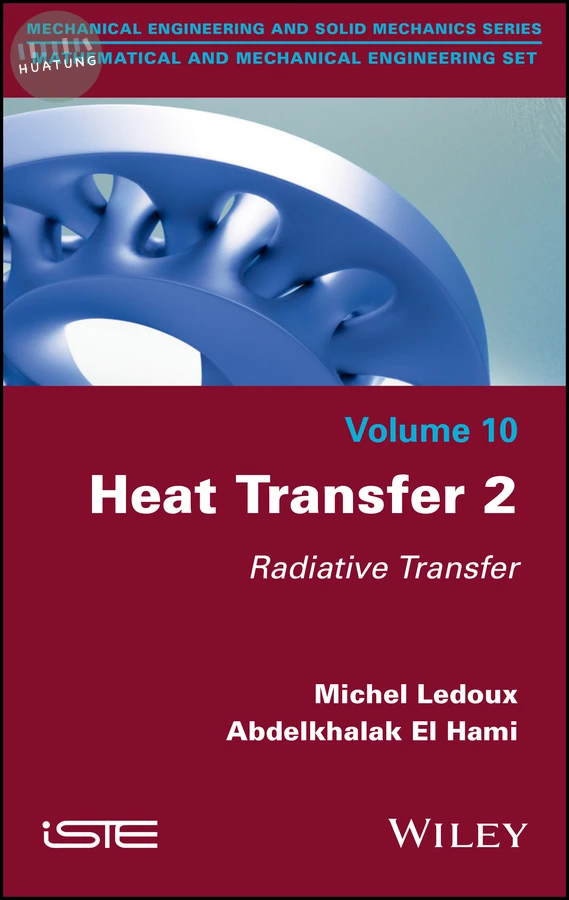
Heat Transfer 2
$5182元 定價: $5758 9折 可訂購
簡介
Heat is a branch of thermodynamics that occupies a unique position due to its involvement in the field of practice. Being linked to the management, transport and exchange of energy in thermal form, it impacts all aspects of human life and activity. Heat transfers are, by nature, classified as conduction, convection (which inserts conduction into fluid mechanics) and radiation. The importance of these three transfer methods has resulted justifiably in a separate volume being afforded to each of them. This second volume is dedicated to radiation. After recalling photometry, the calculation of luminance is addressed using the theory of the black body and associated laws: Stefan, Wien. The reciprocal radiation of two surfaces in total influence is discussed extensively, and the case of finished surfaces is also considered. Heat Transfer 2 combines a basic approach with a deeper understanding of the discipline and will therefore appeal to a wide audience, from technician to engineer, from doctoral student to teacher-researcher.
目錄
Preface ix
Introduction xiii
Chapter 1. General Remarks 1
1.1. Introduction 1
1.2. Propagation of a sinusoidal electromagnetic wave 1
1.2.1. Frequencies and wavelengths 1
1.2.2. Radiation spectrum 4
1.3. The concept of photometry 6
1.3.1. Geometric parameters 6
1.3.2. Radiance 9
1.3.3. Bouguer–Lambert law 12
1.3.4. Intensity 13
1.3.5. Lambert’s law – a surface’s emissivity 14
Chapter 2. Calculating Luminances 17
2.1. Introduction 17
2.2. The black body: concept, luminance, Planck’s law and approximations 18
2.2.1. Paradoxically, the black body is defined with reference to its absorption 18
2.2.2. Black body luminance 19
2.2.3. Emittance from the black body 22
2.2.4. Approximations of the luminance of the black body 23
2.2.5. Writing the luminance in terms of frequency 25
2.3. Stefan–Boltzmann law 27
2.3.1. Establishing the law 27
2.3.2. A direct application 29
2.4. Wien’s laws 32
2.4.1. Wien’s displacement law 32
2.4.2. Wien’s second law 34
2.4.3. Greenhouse effect 35
2.5. Fraction of the total emittance of a black body radiated in a spectral band 38
2.5.1. An important tool: G0−λT functions 38
2.5.2. An application 42
2.6. Emissivity of any body: a general case of a non-black body 43
2.6.1. Definition of monochromatic emissivity 43
2.6.2. Definition of global emissivity: a tricky concept 45
2.6.3. Emissivity of a gray body: a particular case 45
2.7. Simple applications 48
Chapter 3. Emission and Absorption 53
3.1. Introduction 53
3.2. Absorption, reflection, transmission 53
3.3. Kirchhoff’s law 56
3.4. Recap on the global absorption coefficient 57
3.4.1. General case 57
3.4.2. Case of the gray body 58
3.5. General case: multiple transfers 59
3.6. Absorption: the Beer–Lambert law 61
3.6.1. Radiation transfer 61
3.6.2. Beer’s law 62
Chapter 4. Radiation Exchanges Between Surfaces 65
4.1. Introduction 65
4.2. Classification 65
4.3. The case of total influence 66
4.3.1. The case of two parallel plates. Lambert’s law 66
4.3.2. Total influence between two black body surfaces, of temperatures Tw and Ta 68
4.3.3. Total influence between two surfaces 68
4.3.4. Total influence between two surfaces 69
4.3.5. Wall in total influence in an enclosure 71
4.3.6. Important note on the “thermal balance” 72
4.3.7. A practical approximation 72
4.3.8. Complex system of radiant finished surfaces: geometric form factor 75
4.3.9. Application 79
Chapter 5. Analytic Applications 89
5.1. Introduction 89
5.2. Radiators, convectors and radiating fins 89
5.3. Radiation and oven 114
5.4. Radiation and metrology 123
5.4.1. Measuring a thermal conductibility 137
5.5. General problems 148
Chapter 6. Modeling and Simulations under ANSYS 169
6.1. Conduction, convection and radiation 169
6.2. Conduction and convection using ANSYS software 172
6.2.1. Representation of the temperature field 174
6.3. Radiation using ANSYS software 175
6.4. Examples of modeling and analysis with ANSYS 177
6.4.1. Simple thermal conduction 177
6.4.2. Mixing conduction/convection/isolation 180
6.4.3. Transient thermal conduction 182
6.4.4. Study of thermal transfers from a brick wall and a cement wall (application to an oven) 186
6.4.5. Study of stationary thermal conduction in a reservoir intersected by a tube 191
6.4.6. Stationary thermal conduction on a cylinder 196
6.4.7. Cooling of a puck in transitory thermal 199
6.4.8. Study of a heat exchanger 202
6.5. Study of a thermal exchanger on ANSYS 204
6.5.1. Effectiveness of the PCM 204
6.5.2. Parameterizing the analysis 204
6.5.3. Thermal exchanger without an PCM 207
6.5.4. Thermal exchanger with hydrated salt 207
6.5.5. Thermal exchanger with paraffin 210
6.5.6. Influence of heat flux 212
6.5.7. Comparing PCM 213
6.6. Conclusion 214
Appendix. G0−λT Function Table 217
References 223
Index 225
