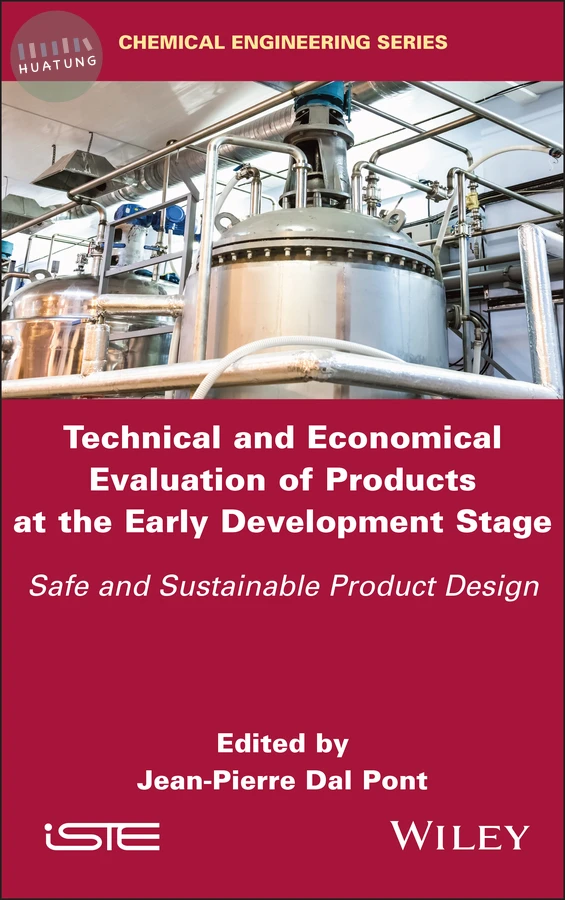

Technical and Economical Evaluation of Products at the Early Development Stage
$4951元 定價: $5501 9折 可訂購
簡介
A company’s ability to innovate is challenged every day. It must constantly accelerate the time-to-market for its products in the face of unbridled global competition, all starting with an initial design and research stage. At this stage, the entrepreneur needs to know, as early as possible, the product's level of acceptability on the market, as well as its profitability. They must also comply with current health and environmental regulations and anticipate potential hazards. The entrepreneur also needs to swiftly assess technical and economic factors, such as the cost price of the new product, its profit margin, the amount of the investment and the time required for implementation.
This collective work by the SECF (Société des Experts Chimistes de France) is aimed at process developers, whether industrial or academic, students or anyone interested in industrial and societal issues relating to products.
Technical and Economical Evaluation of Products at the Early Development Stage is divided into three independent parts: eco-chemistry for sustainable products, toxicology and ecotoxicology, and product industrialization.
目錄
Foreword by Jean-Luc Fugit xvii
Jean-Luc FUGIT
Foreword by Ignasi Palou-Rivera xxi
Ignasi PALOU-RIVERA
Foreword by Magali Smets xxiii
Magali SMETS
Acknowledgments xxv
Jean-Pierre DAL PONT
General Introduction xxix
Jean-Pierre DAL PONT
Part 1 Eco-Chemistry for Sustainable Products®: Solutions for a Chemical Transition 1
Introduction to Part 1 3
Philippe GIRARDON and Valérie LUCAS
Chapter 1 Our Home: The Earth 7
Philippe GIRARDON
1.1 Current situation 7
1.2 Climate change 7
1.3 Greenhouse gas emissions 8
1.4 Finite resources 8
1.5 Consumption of raw materials (excluding water and energy) 9
1.6 Energy resources 11
1.7 Strategic minerals and materials 12
1.8 Water: the most precious commodity; a source of strategic challenges 14
1.9 References 15
Chapter 2 Toward a Holistic Approach to the Chemical Industry Cycle 17
Ismahane REMONNAY
2.1 Transparency, traceability, sustainability, a new collaboration for sustainable and responsible chemistry 18
2.2 A new European strategy to support the “zero pollution” ambition of the European Green Deal 19
2.3 New concepts to support the creation of sustainable products: safe and sustainable by design 20
2.3.1 Toward progressive phasing out of harmful substances 20
2.3.2 Toward an approach to “convenience” chemistry versus essential and sustainable chemistry: the concept of essential and nonessential use 22
2.4 Toward a better understanding of harmful pollutants through the acquisition of robust scientific data 22
2.4.1 Pollutants of concern: a constantly evolving list and increasingly precise criteria 22
2.4.2 Reaffirming the chemical iceberg concept 23
2.4.3 Mixtures and cocktail effects 24
2.4.4 A substance, an assessment and the grouping approach 24
2.4.5 An ambitious roadmap 26
2.5 The new international framework 28
2.6 Conclusion and prospects 30
2.7 References 31
Chapter 3 How Can Action Be Managed? The Fundamentals: Ecodesign, Life Cycle Assessment and Circular Economy 33
Guy-Noël SAUVION
3.1 Taking stock of existing technologies 34
3.2 Shifting from a linear to a circular economy 38
3.3 Ecodesign 45
3.3.1 Ecodesign or ecoinnovation? 49
3.3.2 Creating environmental value 51
3.3.3 Sustainability in the broadest sense 52
3.4 Lifecycle assessment 53
3.4.1 Principle and general information 54
3.4.2 Applications for the chemical industry 60
3.4.3 Points to consider when implementing LCA 62
3.4.4 Applying the LCA results 63
3.5 Tools more specific to the chemical industry 65
3.6 Carbon footprint and carbon content of products 70
3.6.1 Connection with the company’s GHG balance sheet 76
3.7 Conclusion 77
3.8 References 77
Chapter 4 Greenhouse Gases and Climate Change 79
Quentin TIZON
4.1 Greenhouse gases? 79
4.2 What effects do greenhouse gases have on the climate? 80
4.2.1 Pros and cons of the greenhouse effect 81
4.3 Measuring and assessing greenhouse gases 83
4.4 The bilan carbone ® : principle and method 84
4.5 What the bilan carbone ® could mean for the chemical industry 86
4.6 Sector transition strategy: the example of ammonia 87
4.6.1 The example of ammonia 87
4.7 References 90
Chapter 5 Ecodesigned Products: Issues and Solutions 93
Valérie LUCAS
5.1 Plant-based chemistry: a source of biobased raw materials 93
5.1.1 Plant-based chemistry 93
5.1.2 Biobased chemical synthons and intermediates 94
5.1.3 Bioprocesses and biotechnologies 94
5.1.4 Biorefineries 95
5.1.5 Biofuels 96
5.1.6 Bioproducts: biosolvents, biosurfactants, biolubricants and bioplasticizers 96
5.1.7 Biopolymers and plant-based plastics 96
5.2 Biomimicry 97
5.3 Impact on health and the environment 98
5.4 An example case study: biobased paints 98
5.5 References 100
Chapter 6 Paints and Durability 101
Bernard CHAPUIS
6.1 Components of paint 102
6.2 Paint production 104
6.3 Industrial hygiene 104
6.4 Norms and regulations 104
6.5 Certification 106
6.6 References 107
Chapter 7 A Few Case Studies 109
Philippe GIRARDON
7.1 Fashion and apparel 109
7.2 Cosmetics 110
7.3 Packaging materials: recycling challenges 111
7.4 Waste: recycling plastics and other materials 111
7.5 References 114
Chapter 8 Packaging and Tracers for the Industry of the Future 115
Claude LAMBERT
8.1 Purpose of packaging? Product protection and traceability 116
8.2 Why trace packages? 116
8.3 Principle and definitions: the marker/tracer procedure 117
8.4 Strategy and selection, ecodesign 118
8.4.1 Surface marking 118
8.4.2 Mass marking 119
8.4.3 Compatibility of different markers used simultaneously 119
8.5 Applications 119
8.5.1 Plastics 119
8.5.2 Packages 120
8.5.3 Recycling: new materials 120
8.6 Tracers and 3D printers 120
8.7 Health: harmless – food safety 121
8.8 Tracers and society 121
8.9 References 122
Conclusion to Part 1 Between Contradictions, Challenges and Opportunities 123
Jean-Pierre DAL PONT
Part 2 Toxicology and Ecotoxicology: A Contribution to the Design of New Chemical Substances 127
Introduction to Part 2 Aim of the Technical Guide 129
Alain LOMBARD
Chapter 9 Methodology at the Research Stage of New Molecules, New Substances and New Ingredients 131
Alain LOMBARD, Philippe LEMAIRE, Jacques L’HARIDON,Michel ROYER and Paule VASSEUR
9.1 Process for defining the target chemical structure 134
9.1.1 Defining alerts based on potential hazards: using in silico models 134
9.1.2 Detection of CMR (carcinogenic, mutagenic or reprotoxic) potential using in silico methods 135
9.2 Physical–chemical properties of substances 137
9.3 Modeling strategy and acceptability of health, environment and safety alert levels 142
9.4 Persistence and bioaccumulation (P–B) properties 143
9.4.1 Persistence (P) 144
9.4.2 Bioaccumulation (B) 145
9.5 Ecotoxicology and environmental toxicity 145
9.5.1 Rapid screening tests in ecotoxicology 145
9.5.2 Screening tests for potential endocrine disrupting effects for the environment 148
9.6 Human toxicology 149
9.6.1 Strategy for local tolerance tests on cell cultures 149
9.6.2 Acute, subchronic and chronic systemic toxicity studies 151
9.6.3 Identification of CMR properties: carcinogenic, mutagenic and reprotoxic 152
9.6.4 Detection of endocrine disrupting properties 156
9.7 Conclusion to the technical guide 158
9.7.1 Drawing up a summary table 158
9.7.2 How to use the summary table 159
9.7.3 Practical uses of the guide 159
9.8 References 160
Chapter 10 Detailed Test Explanations: Decision Support for Hazard Assessment of New Substances 163
Alain LOMBARD, Philippe LEMAIRE, Jacques L’HARIDON and Paule VASSEUR
10.1 Applying models: in silico testing 163
10.1.1 Quantitative structural activity/quantitative structural activity relationship (QSAR) 163
10.1.2 Trend analysis, read across 164
10.1.3 Dose‒response models 165
10.1.4 Rule-based models 165
10.1.5 The OECD toolbox model 166
10.2 Ecotoxicology 167
10.2.1 Definitions 167
10.2.2 Ecotoxicological impact assessment 168
10.2.3 Ecotoxicity tests 170
10.3 Toxicology 174
10.3.1 Ocular corrosion 174
10.3.2 Cutaneous irritation 174
10.3.3 Ocular irritation 175
10.3.4 Cutaneous sensitization 176
10.4 Assessing toxic potential 178
10.4.1 Cytotoxicity studies 178
10.4.2 Software for chemical molecule design from the Swiss Institute of Bioinformatics (SIB) 178
10.5 Risk models based on uncertainty factors (UF models) 179
10.6 Rapid tests for the detection of mutagenicity 179
10.6.1 First option: two regulatory micromethod tests 180
10.6.2 Second option: high-throughput biomarker method 183
10.6.3 Add-and-read test strategy 186
10.7 Detection of in vitro carcinogenic potential 189
10.7.1 Tests on human organoids 189
10.8 Tests to determine the reprotoxic potential of substances 190
10.8.1 Reproductive toxicity 190
10.8.2 Embryonic development toxicity 191
10.9 Detection of in silico and in vitro endocrine disruptors 196
10.9.1 Endocrine disruptors (EDs): a general overview 196
10.9.2 Nuclear and membrane receptors and cytochrome P450 197
10.9.3 Detection of ED potential via in silico testing 201
10.9.4 Detection of ED potential via in vitro tests 202
10.9.5 Testing for effects not mediated by nuclear receptors 205
10.9.6 In vitro cellular methods and bioluminescent lines 206
10.9.7 In vitro tests under development 206
10.10 List of acronyms 207
10.11 Contributor backgrounds 209
10.12 References 210
Chapter 11 Contributions from Guest Experts 217
Alain LOMBARD with contributions by guest experts Stéphane PIRNAY, Patrick BALAGUER and Philippe HUBERT
11.1 The expert toxicologist expertise in service to the safety of all! 217
11.1.1 Further reading 221
11.2 Study of interactions between environmental compounds and nuclear receptors 222
11.2.1 EDC action on hormones 223
11.2.2 Nuclear receptors 223
11.2.3 Nuclear receptor detection methods 225
11.2.4 Examples 226
11.2.5 MELN (luciferase-transfected human breast cancer cell line gene-reporter assay) 227
11.2.6 Automation of the luciferase method 228
11.2.7 Interactions with environmental compounds 230
11.2.8 In conclusion 232
11.3 PEPPER, accelerating the fight against endocrine disruptors 233
11.3.1 PEPPER: accelerating the fight against endocrine disruptors through validation of tests 234
11.3.2 Endocrine disruptors 236
11.3.3 The need to escape the world of doubt 239
11.3.4 PEPPER’s works and governance 242
11.3.5 The future of PEPPER in Europe: achievements and challenges 248
11.4 References 249
Part 3 Product Industrialization 251
Introduction to Part 3 253
Jean-Pierre DAL PONT, Patrick DUCOURET, Michel ROYER and Mongi SAKLY
Chapter 12 The Company and Its Manufacturing Facilities 255
Michel ROYER and Patrick DUCOURET
12.1 The founding fathers 256
12.2 The four pillars of a company 258
12.3 Anatomy of a company: functions 258
12.4 Manufacturing facilities 260
12.4.1 Anatomy of a factory: its functions 260
12.4.2 Typology of the means of production: VAT analysis 261
12.4.3 The company and industrial production as seen through flows 262
12.5 The company’s industrial strategy 263
12.6 References 267
Chapter 13 From Research to the Factory: The Industrialization Process 269
Jean-Pierre DAL PONT
13.1 Basic concepts 269
13.2 Organization of a project, from the laboratory to completion 271
13.3 Organization of a project in the execution phase 272
13.4 Project management 273
13.5 The pitfalls of project management 273
13.6 References 274
Chapter 14 Working by Project 275
Jean-Pierre DAL PONT, Patrick DUCOURET and Michel ROYER
14.1 Industrialization: steps for the process engineer 275
14.2 Simulation and modeling in the age of artificial intelligence (AI) 277
14.3 Project engineering 280
14.3.1 A series of stages 280
14.3.2 Project engineering: basic concepts and engineering companies 281
14.4 Credit application: investment file 285
14.5 References 286
Chapter 15 Understanding Margins 287
Jean-Pierre DAL PONT
15.1 Notions of product cost price 287
15.2 Profit and loss accounting as a decision-making tool, limited to gross margin 289
15.2.1 Sales figures 289
15.2.2 The contribution margin 289
15.2.3 The gross profit margin 290
15.2.4 Depreciation and amortization 291
15.3 Other margins 292
15.3.1 The workshop 292
15.3.2 Cash flow 293
15.4 A few aphorisms 294
15.5 References 294
Chapter 16 Technology Management 295
Jean-Pierre DAL PONT and Patrick DUCOURET
16.1 Nature and the importance of technology 295
16.2 Technology, know-how and knowledge management 296
16.3 Enterprise and ecosystem, technology and industrial enterprise 298
16.4 Strategic analysis and framework for progress 300
16.5 Existing and incremental improvements 301
16.6 Breakthrough research 302
16.7 Serendipity and innovation: the barriers to change, the research and development function (innovation) 303
16.8 Technological readiness 305
16.9 Japanese methods 305
16.10 Intellectual property 306
16.11 References 307
Chapter 17 Choosing Industrial Sites 309
Jean-Pierre DAL PONT
17.1 Building “new” on a new site 310
17.1.1 Site 310
17.1.2 Resources 310
17.1.3 Regulations 311
17.1.4 Financial aspects 311
17.2 Building “new” on an existing site 311
17.2.1 Governance aspects 311
17.2.2 Resource availability and costs 312
17.3 Relationship between existing factory and new workshop 312
17.3.1 Cultural aspects: comparing two modes of industrial operation 313
17.4 Building abroad 314
17.5 References 315
Chapter 18 The Factory of the Future: A New Paradigm 317
Jean-Pierre DAL PONT, Patrick DUCOURET and Michel ROYER
18.1 The digital revolution and digital tools 320
18.1.1 Internet of Things (IoT) and Industrial Internet of Things (IIoT) 321
18.1.2 Digital twins 321
18.1.3 3D printers and additive manufacturing (AM) 322
18.1.4 The augmented operator 323
18.1.5 Cognitive assistance, augmented reality and virtual reality 324
18.1.6 Physical assistance: robots and people 324
18.1.7 The human/machine interface and human/machine interaction (HMI) in the digital age 326
18.1.8 Corporate IT management and factory IT management 327
18.2 The process at the heart of industrialization 329
18.2.1 Process efficiency and intensification 329
18.2.2 CAPEX-OPEX optimization 331
18.2.3 Sustainability approach 331
18.3 The fundamentals 332
18.3.1 Operations management 332
18.3.2 The transparent factory, a customer-oriented factory 333
18.3.3 The pursuit of resilience, robustness and dependability 333
18.3.4 Toward the factory and company of the future 335
18.4 References 338
Chapter 19 Generative Intelligence: A Revolution on Our Doorstep 339
Willi MEIER
19.1 Addressing challenges and seizing opportunities: a snapshot of the global chemical industry in 2024 340
19.2 Transforming the global chemical industry: the role of AI and ChatGPT in 2024 342
19.3 Optimization of reaction conditions for chemical synthesis 343
19.4 Supply chain and operations 345
19.5 Scenario: compliance with REACH regulations 347
19.6 Scenario: detection and intervention in the event of a toxic gas leak 349
19.7 Scenario: development of a biodegradable plastic for food packaging 352
19.8 Application of ChatGPT to a liquid/liquid separation problem 354
19.9 References 356
Conclusion to Part 3 357
Jean-Pierre DAL PONT
Glossary For Further Information 361
Jean-Pierre DAL PONT
General Conclusion What Does the Future Hold? 365
Jean-Pierre DAL PONT, Philippe LEMAIRE, Alain LOMBARD and Valérie LUCAS
List of Authors 379
Index 381