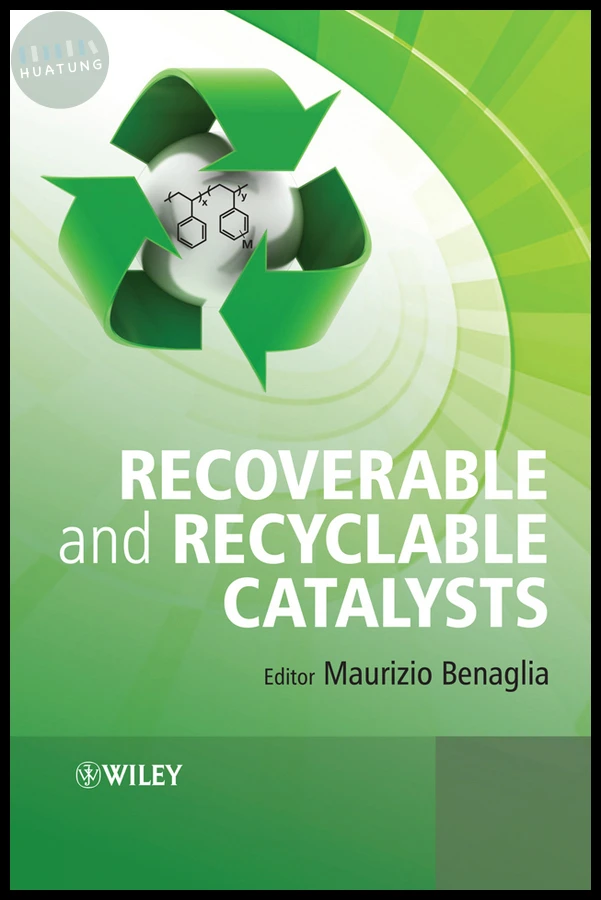
Recoverable and Recyclable Catalysts
$5442元 定價: $6047 9折 可訂購
簡介
Recoverable and Recyclable Catalysts
There is continued pressure on chemical and pharmaceutical industries to reduce chemical waste and improve the selectivity and efficiency of synthetic processes. The need to implement green chemistry principles is a driving force towards the development of recoverable and recyclable catalysts.
The design and synthesis of recoverable catalysts is a highly challenging interdisciplinary field combining chemistry, materials science engineering with economic and environmental objectives. Drawing on international research and highlighting recent developments, this book serves as a practical guide for both experts and newcomers to the field.
Topics covered include:
An introduction to the principles of catalyst recovery and recycling
Catalysts on insoluble and soluble support materials
Thermomorphic catalysts, self-supported catalysts and perfluorous catalytic systems
The development of reusable organic catalysts
Continuous flow and membrane reactors
Each chapter combines principles with practical information on the synthesis of catalysts and strategies for catalyst recovery. The book concludes with a comparison of different catalytic systems, using case studies to illustrate the key features of each approach.
Recoverable and Recyclable Catalysts is a valuable reference source for academic researchers and professionals from a range of pharmaceutical and chemical industries, particularly those working in catalysis, organic synthesis and sustainable chemistry.
目錄
Preface xiii
Acknowledgements xv
Contributors xvii
1 The Experimental Assay of Catalyst Recovery: General Concepts 1
John A. Gladysz
1.1 Introduction 1
1.2 Catalyst Precursor vs Catalyst 2
1.3 Catalyst vs Catalyst Resting State 3
1.4 Catalyst Inventory: Loss Mechanisms 5
1.5 Evaluation of Catalyst Recovery 8
1.6 Prospective 13
2 Surface-functionalized Nanoporous Catalysts for Renewable Chemistry 15
Brian G. Trewyn, Hung-Ting Chen and Victor S.-Y. Lin
2.1 Introduction 15
2.2 Immobilization Strategies of Heterogeneous Catalysts 17
2.3 Efficient Heterogeneous Catalysts with Enhanced Reactivity and Selectivity with Functionality 26
2.4 Other Heterogeneous Catalyst Systems on Nonsilica Supports 44
2.5 Conclusion 45
3 Insoluble Resin-supported Catalysts 49
Gang Zhao and Zhuo Chai
3.1 Introduction 49
3.2 Transition Metal catalyzed c c Bond Formation Reactions 50
3.3 Oxidation 56
3.4 Reduction 61
3.5 Organocatalyzed Reactions 62
3.6 Annulation Reactions 66
3.7 Miscellaneous 70
3.8 Conclusion 72
4 Catalysts Bound to Soluble Polymers 77
Tamilselvi Chinnusamy, Petra Hilgers and Oliver Reiser
4.1 Introduction 77
4.2 Soluble Supports – General Considerations 78
4.3 Recent Developments of Soluble Polymer-supported Catalysts 79
4.4 Recent Examples for Reactions Promoted by Catalysts Bound to Soluble Polymers 81
4.5 Conclusion 98
5 Polymeric, Recoverable Catalytic Systems 101
Qiao-Sheng Hu
5.1 Introduction 101
5.2 Polymeric Catalyst Systems 102
5.3 Summary 114
6 Thermomorphic Catalysts 117
David E. Bergbreiter
6.1 Introduction 117
6.2 Thermomorphic Catalyst Separation Strategies 118
6.3 Hydrogenation Reactions Under Thermomorphic Conditions 122
6.4 Hydroformylation Reactions Under Thermomorphic Conditions 126
6.5 Hydroaminations Under Thermomorphic Conditions 129
6.6 Pd-catalyzed Reactions Under Thermomorphic Conditions 130
6.7 Polymerization Reactions Under Thermomorphic Conditions 138
6.8 Organocatalysis Under Thermomorphic Conditions 142
6.9 Cu(I)-catalyzed 1,3-Dipolar Cycloadditions Under Thermomorphic Conditions 144
6.10 Thermomorphic Hydrosilylation Catalysts 144
6.11 Thermomorphic Catalytic Oxidations 145
6.12 Conclusions 147
7 Self-supported Asymmetric Catalysts 155
Wenbin Lin and David J. Mihalcik
7.1 Introduction 155
7.2 Self-supported Asymmetric Catalysts Formed by Linking Catalytically Active Subunits via Metal–Ligand Coordination 156
7.3 Self-supported Asymmetric Catalysts Formed by Post-synthetic Modifications of Coordination Polymers 163
7.4 Self-supported Asymmetric Catalysts Formed by Linking Multitopic Chiral Ligands with Catalytic Metal Centers 168
7.5 Conclusions and Outlook 172
8 Fluorous Chiral Catalyst Immobilization 179
Tibor Soos
8.1 Introduction 179
8.2 Fluorous Chemistry and its Basic Recovery Concepts 180
8.3 Application of Fluorous Chiral Catalysts 181
8.4 Summary 196
9 Biphasic Catalysis: Catalysis in Supercritical CO2 and in Water 199
Simon L. Desset and David J. Cole-Hamilton
9.1 Introduction 199
9.2 Biphasic Catalysis 200
9.3 Aqueous Biphasic Catalysis 202
9.4 Supercritical Carbon Dioxide 229
9.5 Conclusion 246
10 Asymmetric Catalysis in Ionic Liquids 259
Lijin Xu and Jianliang Xiao
10.1 Introduction 259
10.2 Metal-catalyzed Asymmetric Reactions in ILs 261
10.3 Asymmetric Organocatalytic Reactions in ILs 287
10.4 Concluding Remarks 294
11 Recoverable Organic Catalysts 301
Maurizio Benaglia
11.1 Introduction 301
11.2 Achiral Organic Catalysts 304
11.3 Chiral Organic Catalysts 311
11.4 Catalysts Derived from Amino Acids 319
11.5 General Considerations on Recyclable Organocatalysts 334
11.6 Outlook and Perspectives 336
12 Organic Polymer-microencapsulated Metal Catalysts 341
Jun Ou and Patrick H. Toy
12.1 Introduction 341
12.2 Non-cross-linked Polymer-microencapsulated Catalysts 342
12.3 Cross-linked Polymer-microencapsulated Catalysts 355
12.4 Summary Table 374
12.5 Conclusions 375
13 Organic Synthesis with Mini Flow Reactors Using Immobilised Catalysts 379
Sascha Ceylan and Andreas Kirschning
13.1 Introduction 379
13.2 Catalysis in Mini Flow Reactors with Immobilised Catalysts 382
13.3 Miscellaneous Enabling Techniques for Mini Flow Systems 404
13.4 Perspectives and Outlook 406
14 Homogeneous Catalysis Using Microreactor Technology 411
Johan C. Brandt and Thomas Wirth
14.1 Introduction 411
14.2 Acid-catalysed Reactions 411
14.3 Liquid–liquid Biphasic Systems 413
14.4 Photocatalysis 418
14.5 Asymmetric Catalytic Reactions 421
14.6 Unusual Reaction Conditions 421
15 Catalyst Immobilization Strategy: Some General Considerations and a Comparison of the Main Features of Different Supports 427
Franco Cozzi
15.1 Introduction 427
15.2 General Considerations on Catalyst Immobilization 428
15.3 Comparison of Different Supports Employed for the Immobilization of Proline 442
15.4 Comparison of Different Supports Employed for the Immobilization of Bis(oxazolines) 452
15.5 Conclusions 458
References 458
Index 463


