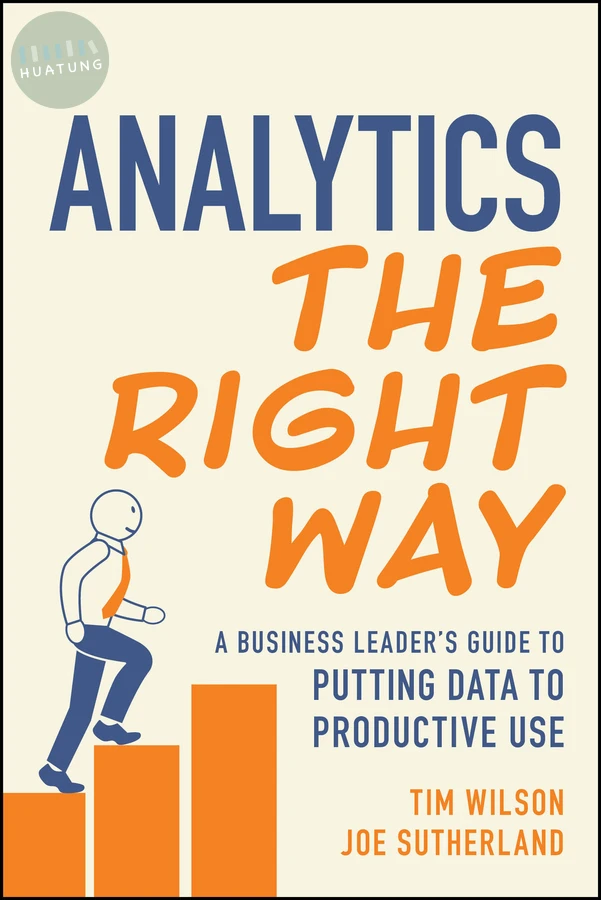
Analytics the Right Way
$1020元 定價: $1133 9折 可訂購
簡介
CLEAR AND CONCISE TECHNIQUES FOR USING ANALYTICS TO DELIVER BUSINESS IMPACT AT ANY ORGANIZATION Organizations have more data at their fingertips than ever, and their ability to put that data to productive use should be a key source of sustainable competitive advantage. Yet, business leaders looking to tap into a steady and manageable stream of “actionable insights” often, instead, get blasted with a deluge of dashboards, chart-filled slide decks, and opaque machine learning jargon that leaves them asking, “So what?” Analytics the Right Way is a guide for these leaders. It provides a clear and practical approach to putting analytics to productive use with a three-part framework that brings together the realities of the modern business environment with the deep truths underpinning statistics, computer science, machine learning, and artificial intelligence. The result: a pragmatic and actionable guide for delivering clarity, order, and business impact to an organization’s use of data and analytics. The book uses a combination of real-world examples from the authors’ direct experiences—working inside organizations, as external consultants, and as educators—mixed with vivid hypotheticals and illustrations—little green aliens, petty criminals with an affinity for ice cream, skydiving without parachutes, and more—to empower the reader to put foundational analytical and statistical concepts to effective use in a business context.
目錄
Acknowledgments xiii
About the Authors xvii
Chapter 1 Is This Book Right for You? 1
The Digital Age = The Data Age 3
What You Will Learn in This Book 6
Will This Book Deliver Value? 7
Chapter 2 How We Got Here 9
Misconceptions About Data Hurt Our Ability to Draw Insights 11
Misconception 1: With Enough Data, Uncertainty Can Be Eliminated 12
Having More Data Doesn’t Mean You Have the Right Data 13
Even with an Immense Amount of Data, You Cannot Eliminate Uncertainty 16
Data Can Cost More Than the Benefit You Get from It 18
It Is Impossible to Collect and Use “All” of the Data 18
Misconception 2: Data Must Be Comprehensive to Be Useful 19
“Small Data” Can Be Just As Effective As, If Not More Effective Than, “Big Data” 20
Misconception 3: Data Are Inherently Objective and Unbiased 21
In Private, Data Always Bend to the User’s Will 23
Even When You Don’t Want the Data to Be Biased, They Are 24
Misconception 4: Democratizing Access to Data Makes an Organization Data-Driven 26
Conclusion 28
Chapter 3 Making Decisions with Data: Causality and Uncertainty 29
Life and Business in a Nutshell: Making Decisions Under Uncertainty 30
What’s in a Good Decision? 32
Minimizing Regret in Decisions 33
The Potential Outcomes Framework 34
What’s a Counterfactual? 34
Uncertainty and Causality 36
Potential Outcomes in Summary 42
So, What Now? 43
Chapter 4 A Structured Approach to Using Data 45
Chapter 5 Making Decisions Through Performance Measurement 53
A Simple Idea That Trips Up Organizations 54
“What Are Your KPIs?” Is a Terrible Question 58
Two Magic Questions 60
A KPI Without a Target Is Just a Metric 68
Setting Targets with the Backs of Some Napkins 72
Setting Targets by Bracketing the Possibilities 74
Setting Targets by Just Picking a Number 78
Dashboards as a Performance Measurement Tool 80
Summary 82
Chapter 6 Making Decisions Through Hypothesis Validation 85
Without Hypotheses, We See a Drought of Actionable Insights 88
Breaking the Lamentable Cycle and Creating Actionable Insight 89
Articulating and Validating Hypotheses: A Framework 91
Articulating Hypotheses That Can Be Validated 92
The Idea: We believe [some idea] 95
The Theory: …because [some evidence or rationale]… 96
The Action: If we are right, we will… 98
Exercise: Formulate a Hypothesis 101
Capturing Hypotheses in a Hypothesis Library 101
Just Write It Down: Ideating a Hypothesis vs. Inventorying a Hypothesis 104
An Abundance of Hypotheses 105
Hypothesis Prioritization 106
Alignment to Business Goals 107
The Ongoing Process of Hypothesis Validation 108
Tracking Hypotheses Through Their Life Cycle 109
Summary 110
Chapter 7 Hypothesis Validation with New Evidence 113
Hypotheses Already Have Validating Information in Them 115
100% Certainty Is Never Achievable 116
Methodologies for Validating Hypotheses 118
Anecdotal Evidence 119
Strengths of Anecdotal Evidence 120
Weaknesses of Anecdotal Evidence 121
Descriptive Evidence 122
Strengths of Descriptive Evidence 123
Weaknesses of Descriptive Evidence 124
Scientific Evidence 128
Strengths of Scientific Evidence 129
Weaknesses of Scientific Evidence 135
Matching the Method to the Costs and Importance of the Hypothesis 137
Summary 139
Chapter 8 Descriptive Evidence: Pitfalls and Solutions 141
Historical Data Analysis Gone Wrong 142
Descriptive Analyses Done Right 146
Unit of Analysis 146
Independent and Dependent Variables 149
Omitted Variables Bias 151
Time Is Uniquely Complicating 153
Describing Data vs. Making Inferences 154
Quantifying Uncertainty 156
Summary 163
Chapter 9 Pitfalls and Solutions for Scientific Evidence 165
Making Statistical Inferences 166
Detecting and Solving Problems with Selection Bias 168
Define the Population 168
Compare the Population to the Sample 168
Determine What Differences Are Unexpectedly Different 169
Random and Nonrandom Selection Bias 169
The Scientist’s Mind: It’s the Thought That Counts! 170
Making Causal Inferences 171
Detecting and Solving Problems with Confounding Bias 172
Create a List of Things That Could Affect the Concept We’re Analyzing 173
Draw Causal Arrows 173
Look for Confounding “Triangles” Between the Circles and the Box 174
Solving for Confounding in the Past and the Future 175
Controlled Experimentation 176
The Gold Standard of Causation: Controlled Experimentation 177
The Fundamental Requirements for a Controlled Experiment 179
Some Cautionary Notes About Controlled Experimentation 184
Summary 185
Chapter 10 Operational Enablement Using Data 187
The Balancing Act: Value and Efficiency 189
The Factory: How to Think About Data for Operational Enablement 191
Trade Secrets: The Original Business Logic 192
How Hypothesis Validation Develops Trade Secrets and Business Logic 193
Operational Enablement and Data in Defined Processes 194
Output Complexity and Automation Costs 196
Machine Learning and AI 199
Machine Learning: Discovering Mechanisms Without Manual Intervention 199
Simple Machine-learned Rulesets 200
Complex Machine-learned Rulesets 202
AI: Executing Mechanisms Autonomously 203
Judgment: Deciding to Act on a Prediction 204
Degrees of Delegation: In-the-loop, On-the-loop, and Out-of-the-loop 204
Why Machine Learning Is Important for Operational Enablement 209
Chapter 11 Bringing It All Together 211
The Interconnected Nature of the Framework 212
Performance Measurement Triggering Hypothesis Validation 212
Level 1: Manager Knowledge 213
Level 2: Peer Knowledge 214
Level 3: Not Readily Apparent 215
Hypothesis Validation Triggering Performance Measurement 216
Did the Corrective Action Work? 216
“Performance Measurement” as a Validation Technique 216
Operational Enablement Resulting from Hypothesis Validation 220
Operational Enablement Needs Performance Measurement 222
A Call Center Example 223
Enabling Good Ideas to Thrive: Effective Communication 225
Alright, Alright: You Do Need Technology 226
What Technology Does Well 227
What Technology Doesn’t Do Well 228
Final Thoughts on Decision-making 230
Index 233