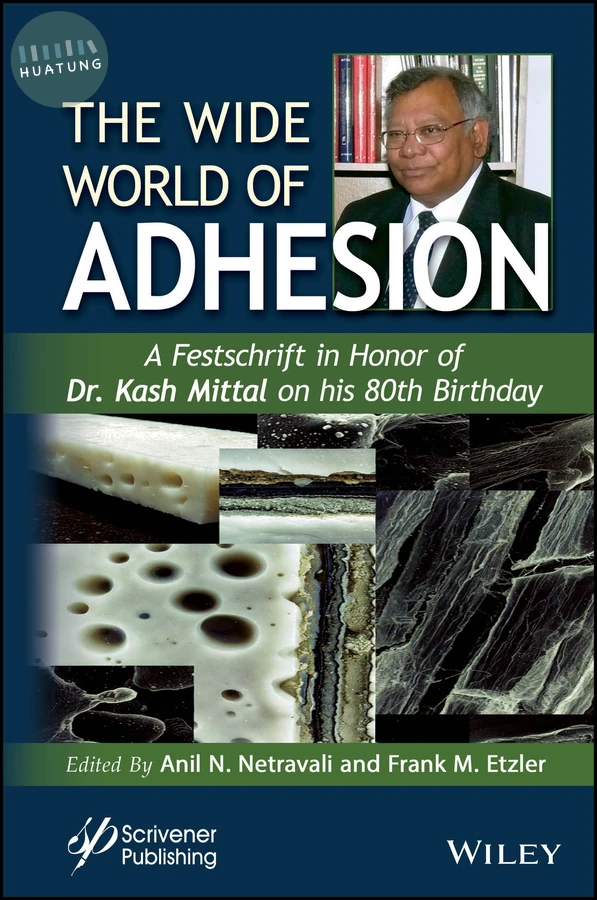
The Wide World of Adhesion
$10807元 定價: $12008 9折 可訂購
簡介
Packed with cutting-edge insights from leading experts, this celebratory work honoring Dr. Kash Mittal, is an essential guide for anyone looking to master both temporary and permanent bonding to drive the next generation of adhesive innovations. In the broad field of materials, there are many cases where two or more materials are bonded together to achieve properties that cannot be obtained from any single material. While in most cases these materials need to be bonded to each other permanently, in a few cases they need to be bonded temporarily so that they can be separated easily when needed. This volume, celebrating the 80th birthday of Dr. Kash Mittal, is an extension of the discussions at the 2022 meeting of the American Chemical Society. It covers a wide range of topics in the field of adhesion, such as dermatological applications, the role of surface topography in engineering interfacial adhesion, and critical adhesion in color cosmetics. With expert insights and informative illustrations, this volume serves as an essential guide for anyone looking to innovate the next generation of adhesive technology. Readers will find the volume: Provides in-depth discussions on various critical aspects of adhesion science and technology;
Discusses various aspects of wettability and how the theory can be applied in varying applications such as flow through porous media and release of active substances from ointments;
Shows how plasma technology can be used to improve polymer adhesion and how substrate surfaces can be engineered to promote adhesion;
Demonstrates the multi-industry flexibility of adhesives for a wide range of applications, presented in three parts.
Audience Academics, industry and government laboratories, and researchers interested in bonding, packaging, printing, composite materials, and construction for the automotive, aerospace, polymer composites, cosmetics, biomedical materials, and fiber manufacturing industries.
目錄
Preface xxiii
Dedication 1
A Personal Tribute to Dr. Kash Mittal 21
Half-a-Century Romance with Adhesion Science 49
Part 1: Contact Angle, Wettability and Adhesion 71
1 Application of Tadmor Equations to the Description of Wettability of Solid Surfaces 73
Salvador Pérez-Huertas and Konrad Terpilowski
1.1 Introduction 74
1.2 Surface Preparation and Plasma Activation 77
1.3 Impact of Hysteresis on Contact Angle Measurement 90
1.4 Conclusions 91
2 Spreading and Adhesion - The Two Sides of Wettability and Their Role in Multiphase Flow through Porous Media of Petroleum Reservoirs 97
Dandina N. Rao and Bikash D. Saikia
2.1 Background: Surface Science and Zisman's Seminal Contribution 98
2.2 Evidence of Zisman-Type Spreading in Solid-Liquid-Liquid (S-L-L) Systems 100
2.3 The Need for Exploration of Zisman-Type Spreading in S-L-L Systems 103
2.4 Consequences of Zisman-Type Spreading in Rock-Oil-Brine (S-L-L) Systems 104
2.5 Fluid-Fluid Spreading Phenomenon in S-L-L Systems 105
2.6 Summary and Conclusions 111
3 Application of Integrated Analytical Approach (IAA) to the Investigation of Release and Permeation Processes of Active Substances from Ointments Using the Contact Angle Methodology 115
D. Rossi, S. Banella, E. Vettorato, E. Franceschinis, G. Lazzari, S. Dall'Acqua and N. Realdon
3.1 Introduction 116
3.2 Experimental 117
3.4 Summary and Conclusions 140
4 Coffee-Stain Effect ‒ Evaporation of Wetting and Nonwetting Liquid Drops: A Critical Review 145
Andrew Terhemen Tyowua, Augusta Ijeoma Ezekwuaku and Msugh Targema
4.1 Introduction 145
4.2 Evaporation of Wetting Liquid Drops: Mechanism of Coffee-Stain Formation 146
4.3 Detrimental Effects and Suppression of Coffee-Stain Phenomenon 148
4.4 Applications of Coffee-Stain Phenomenon 161
4.5 Summary 164
Part 2: Adhesion Aspects 173
5 Controlling the Way Surfaces Interact and Adhere in Cosmetics. From Polymers to Biophysical and Dermatological Applications 175
Gustavo S. Luengo
5.1 Introduction 176
5.2 Hair Care and Surface Forces 177
5.3 Skin Care and Adhesion 181
5.4 Summary 187
5.5 Acknowledgments 189
6 Role of Surface Topography in Engineering Interfacial Adhesion: Fundamentals, Advancements and Prospects 195
Anubha Jaiswal and Ravi P. Jaiswal
6.1 Introduction 196
6.2 Basics of Surface Topography 197
6.3 Fundamentals of Adhesion Involving Solid Surfaces 204
6.4 Experimental Measurements 214
6.5 Applications of Topographical Modifications to Engineer Interfacial Adhesion 220
6.6 Challenges and Future Perspectives 223
6.7 Summary 224
7 Adhesion Aspects in Color Cosmetics 231
Hy Si Bui
7.1 Introduction 232
7.2 Principles of Adhesion in Cosmetics 233
7.3 Factors Affecting Cosmetic Adhesion - The Role of Substrate 237
7.4 Factors Affecting Cosmetic Adhesion – Cosmetic Ingredients 247
7.5 Techniques to Measure Cosmetic Product Adhesion and Performance 254
7.6 Factors Affecting Cosmetic Adhesion – Cosmetic Formulation 261
7.7 Challenges and Future Directions for Long-Wear Color Cosmetics 286
7.8 Summary 287
8 Investigation on the Adhesion of Electrospun Polyacrylonitrile (PAN) Nanofiber Mats to Polypropylene (PP) Nonwoven Substrate 299
Zaynab Daneshzand, Somaye Akbari, Parastoo Saeedi and Mohsen Mohseni
8.1 Introduction 300
8.2 Materials and Methods 303
8.3 Results and Discussion 305
8.4 Conclusions 307
9 Microplastic Adhesion at Secondary Minimum in Porous Media: The Role of Hydration Forces 313
Gang Chen
10 Use of Plasma Technology to Improve Polymer Adhesion Part 1 Plasma Surface Modification to Enhance Polymer Adhesion 323
Jörg Florian Friedrich
10.1 Introduction 324
10.2 Ways to High and Durable Adhesion by Polymer Surface Modification 329
10.3 Principles of Metal-Polymer Adhesion 333
10.4 Grafting of Molecules and Polymers on Monosort-Equipped Polyolefin Surfaces for Flexibilization of Interface 353
10.5 Which Plasma Treatment Gives Maximum Adhesion? 365
10.6 Summary 374
11 Use of Plasma Technology to Improve Polymer Adhesion Part 2 Plasma Polymers as Adhesion Promoters 385
Jörg Florian Friedrich
11.1 Introduction 385
11.2 Possible Uses of Plasma Polymers Despite Their Chemically Irregular Structure 406
11.3 Efficiency of Plasma Polymers as Adhesion Promoters 411
11.4 Summary 420
12 Surface Engineering for Enhanced Adhesion in Polymer Materials 429
Ankit Rawal, Dipankar Pal and Sudarsan Neogi
12.1 Introduction 430
12.2 Fundamentals of Adhesion in Polymers 431
12.3 Case Studies and Applications 447
12.4 Prospects 463
12.5 Summary 464
12.6 Acknowledgements 465
13 Interfacial Studies on Cellulose/Biopolymer Composites 469
Merin Sara Thomas, Surya S. Nair, Sathaiah Gunaseelan, Prasanth K. S. Pillai, Gayathry Sreekumar, Sabu Thomas and Laly A. Pothen
13.1 Introduction 469
13.2 Biopolymer/Cellulose Composites 471
13.3 Interfacial Properties 473
13.4 Strategies for Interfacial Enhancement 480
13.5 Applications 482
13.6 Summary 484
14 Fiber/Resin Interfacial Shear Strength (IFSS) in Composites: A Brief Review of Micromechanical Methods of IFSS Measurement 489
Anil N. Netravali
14.1 Introduction 490
14.2 Fiber/Resin Interface Studies 493
14.3 Single Fiber Composite (SFC) or Fragmentation Test 494
14.4 Single Fiber Pull-Out Test 503
14.5 Microbond Test (Microbead Test) 507
14.6 Fiber Push-Out and Push-In Tests 510
14.7 Summary and Concluding Remarks 514
Part 3: Adhesives and Adhesive Joints 521
15 Switchable Thermosets in the World of Adhesives 523
Natanel Jarach, Rachel Avshalomov and Hanna Dodiuk
15.1 Introduction 524
15.2 Covalent Adaptable Networks – A Quick Overview 524
15.3 Switchable Adhesives 530
15.4 Summary 556
16 Investigation of Pressure-Sensitive Adhesives Solely from Epoxidized Soybean Oil 565
Yunfei Liang and Kaichang Li
16.1 Introduction 566
16.2 Experimental 567
16.3 Testing 570
16.4 Results and Discussion 572
16.5 Conclusions 581
16.6 Acknowledgement 581
17 Wood Adhesion and Wood Adhesives: What Remains to Be Investigated? 585
Manfred Dunky
17.1 Introduction 585
17.2 Basics of Wood Bonding 586
17.3 Bio-Based Wood Adhesives 600
17.4 "Ecologically-Correct" (Synthetic) Adhesives, such as Aminoplastic Wood Adhesives Based on "Green Hydrogen" 601
17.5 Activation of the Surface, Binderless Boards, Activation of Wood-Inherent Chemicals as Adhesives (Lignin, Carbohydrates/Hemicellulose) 602
17.6 Binderless Boards, Activation of Wood-Inherent Adhesives (Lignin, Carbohydrates = Mainly Hemicellulose) 606
17.7 Covalent Chemical Bonding between Wood Surface and Adhesive 607
17.8 Citric Acid 608
17.9 Simulation of the Hot-Press Process 609
17.10 Use of Wood-Based Panels (WBPs) in Construction, Resistance against Swelling and Shrinking, Elasticity of the Bondline 610
17.11 Denaturation and Thermal Treatment of Proteins 611
17.12 Tailor-Made Wooden Products (Functional Boards) 612
17.13 Recycling and Debonding 614
17.14 Summary 615
18 Soy Protein Structures and Wood Adhesive Performance Properties 623
Charles R. Frihart
18.1 Background 624
18.2 Protein Structure 624
18.3 Wood Adhesive Bond Strength 627
18.4 Soy Dispersion Rheology 630
18.5 Protein Structure Revisited 633
18.6 Conclusion 635
18.7 Summary 636
19 Advances in Dental Adhesives: Current Innovations, Challenges, and Future Directions 643
Isadora Martini Garcia, Lamia Sami Mokeem, Abdulrahman A. Balhaddad, Fabrício Mezzomo Collares and Mary Anne S. Melo
19.1 Introduction 644
19.2 Understanding the Challenges of Dental Adhesives inside the Mouth 646
19.3 A Brief History of Dental Adhesives: From Innovation to Evolution 648
19.4 Classification and Composition of Adhesive Systems 649
19.5 New Approaches Targeting the Longevity of Adhesive-Dentin Interfaces 657
19.6 Dental Adhesives Loaded with Antibacterial Properties 658
19.7 Recent Strategies for Antibacterial Dental Adhesives 660
19.8 Summary 662
20 Bioadhesives: Recent Advances and Biomedical Applications 669
Megha Goyal and Nitu Bhatnagar
20.1 Introduction 669
20.2 Classification of Bioadhesives 672
20.3 Bio-Inspired Adhesives Derived from Plants and Animals 674
20.4 Mechanisms of Adhesion 676
20.5 Applications 678
20.6 Challenges and Limitations 683
20.7 Future Directions 684
21 Surface Matters: The Role of Treatment Techniques in Multi-Material Adhesive Bonding 691
Mani Mohan Tiwari, Saleema Noormohammed, Dilip Kumar Sarkar and X.-Grant Chen
21.1 Introduction 692
21.2 Materials and Methods 694
21.3 Structural Adhesive Bonding 696
21.4 Conclusions 708
21.5 Acknowledgments 709
22 Properties of Adhesives for High-Temperature Applications: A Critical Review 713
Momin Urooj Ahmed and S.K. Panigrahi
22.1 Introduction 714
22.2 Properties of Adhesives at Elevated Temperature 715
22.3 Methodology 718
22.4 Results and Discussion 727
22.5 Summary and Conclusions 743
23 Methods to Enhance the Mechanical Performance of FRP Composite Adhesive Joints 749
Henrique F.M. de Queiroz and Mariana D. Banea
23.1 Introduction 750
23.2 Factors Affecting the Performance of Composite Adhesive Joints 751
23.3 Methods to Increase the Mechanical Performance of FRP Composite Adhesive Joints 753
23.4 Summary and Future Prospects 767
Acknowledgements 768
References 768
Index 775


