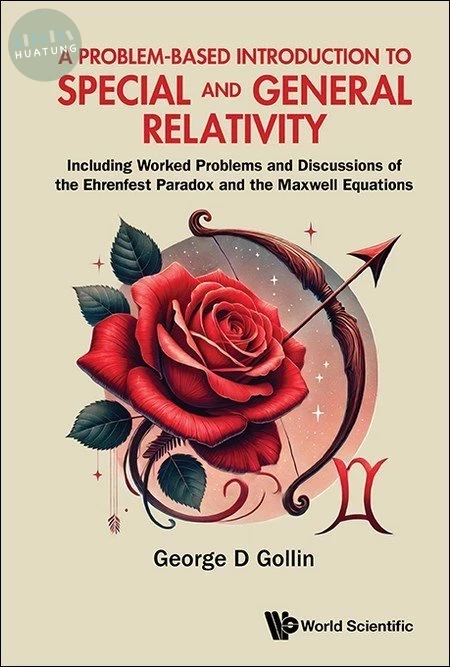


A Problem-Based Introduction to Special and General Relativity
$1850元現貨: 1
It is Einstein's Theory of Relativity that braids space and time into a thread from which the fabric of existence is woven; it is Relativity that forces the existence of magnetism, and the Pauli Principle, and the biochemistry of living things. A Newtonian universe would be sterile.
There is a fever-dream alienness to Einstein's theory, which offers students a first opportunity to see how profoundly different physical reality is from our familiar (and grossly inaccurate) classical picture. This divergence springs inescapably from a single, simple observation: the speed with which a beam of light travels through empty space is always, always, always 299,792,458 meters per second. It does not matter if the source of light is moving with respect to the measuring apparatus. The speed of light never changes.
This book comprises fourteen units spanning Special and General Relativity.
If used as a course textbook, the material can serve as the backbone of weekly meetings in which students work together in small groups (closely supervised by the instructor) to solve a number of simple problems, then to discuss the conclusions one can draw from the results. In this way, students will derive for themselves some of the surprising features of our post-classical reality.
We will review mathematical techniques as required. Students will be expected to become comfortable using calculus to solve problems as necessary.
Completion of each of the four longer problems presented at the end of each unit will require two or three hours.
Request Inspection Copy
Sample Chapter(s)
Preface
Unit 1: Special Relativity: Time Dilation and Lorentz Contraction
Contents:
Special Relativity: Time Dilation and Lorentz Contraction
Special Relativity — Non-Simultaneity: The Lorentz Transformations
The Origin of the Magnetic Field as a Consequence of Special Relativity
Developing the Mathematical Tools of Relativity — Scalars, Four Vectors, Lorentz Tensors, the Metric Tensor, Covariant Notation; "The Ehrenfest Paradox"
Doppler Shifts, World Lines, Energy–Momentum Four-Vector
Conservation Laws, Relativistic Kinematics, and a Start on Dynamics
Massless Particles, Relativistic Dynamics, the Electromagnetic Field
An Introduction to General Relativity: Non-Euclidean Geometry, the Metric Tensor, Space-time Curvature
The Riemann Curvature Tensor, the Einstein Field Equations, the Schwarzschild and Kerr Metrics, and "Frame Dragging." and Just for Fun, LIGO
Motion in Curved Space–Time
Fields, Fluids, Line Integrals, and Curl
Gradient, Divergence, Surface Integrals, the Divergence Theorem, and Gauss's Law
The Maxwell Equations
A Covariant Formulation of Electrodynamics
Readership: Undergraduate students enrolled in a first course on relativity or an intermediate electrodynamics course; graduate students seeking a practical, geometry-based approach to general relativity; and researchers and practitioners in the fields of particle physics, cosmology, astronomy and astrophysics — both theoreticians and experimentalists.