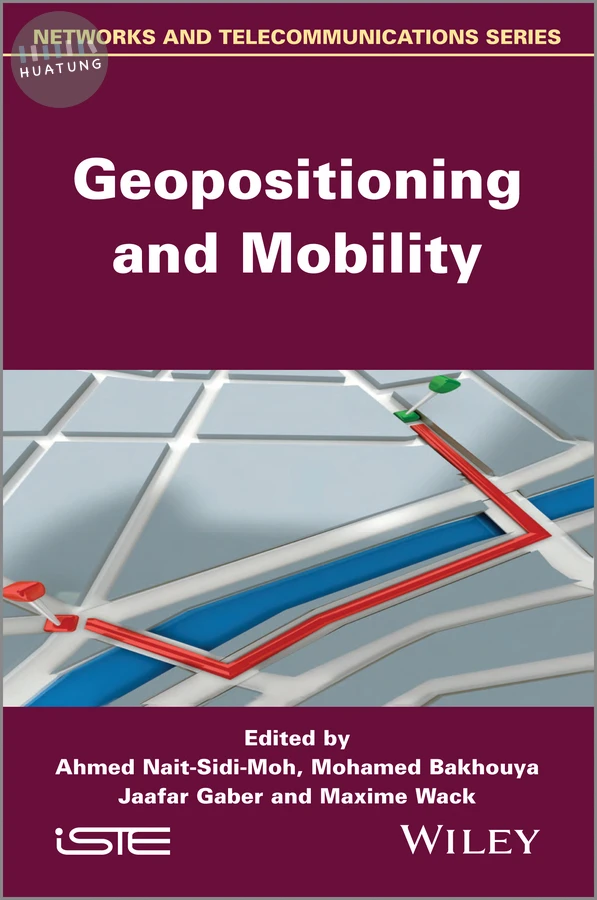

Geopositioning and Mobility
$5182元 定價: $5758 9折 可訂購
簡介
Geopositioning and Mobility
This book presents a general overview of the applications and use of geopositioning and GNSS for assisting the supervision and management of mobile terrestrial professions, information, traffic regulation, multimodal information, pedestrian mobility and indoor geopositioning, etc. It especially focuses on the field of mobility and terrestrial transport, the automotive industry and tourism (on foot, by bicycle or motorcycle, by car, by professional vehicles or by public transport, etc.). This book explores the many possibilities, developmental and organizational factors, as well as new paradigms, which will contribute to an essential part of GNSS’s civil economy, especially to Galileo in the mid-term and to Egnos in the short-term.
Several of GNSS's integration structuring aspects in sustainable terrestrial mobilities will be analyzed; for example in terms of system architecture, data safety or legal constraints. Numerous diverse points of view will be presented regarding subjects such as dynamic cartography and new computing architectures of: mobility systems, interconnection, service quality, regulation or supervision functions of individual freedoms.
目錄
Foreword xi
Introduction xvii
Ahmed NAIT-SIDI-MOH, Mohamed BAKHOUYA, Jaafar GABER and Maxime WACK
Chapter 1. The Geopositioning Concept 1
Yves ALEXANDRE
1.1. A revolution is announced 1
1.2. The basis of powerful technological systems 2
1.3. The fundamentals of geopositioning development 6
1.4. Prospective visions of large geopositioning markets in transport and land transport 11
1.5. The challenge for the future of the European GNSS incubation services 22
1.6. Bibliography 28
Chapter 2. Functions and Performance of the Egnos System 31
Jérôme LEGENNE and Daniel BROCARD
2.1. Introduction 31
2.2. Operating principles of Egnos 35
2.3. Improving GPS performance with Egnos 37
2.4. The behavior of Egnos faced with a GPS breakdown 42
2.5. Conclusion 43
2.6. Links 45
Chapter 3. Information, Modeling and Traffic Reconstruction 47
Arnaud DE LA FORTELLE, Jean-Marc LASGOUTTES and Fabien MOUTARDE
3.1. New technologies and development 48
3.2. Modeling and algorithms 52
3.3. Analysis and overall traffic prediction 59
3.4. Realizations and experiments 63
3.5. Perspectives 69
3.6. Bibliography 71
Chapter 4. Geopositioning and Legal Issues 75
Thierry PIETTE-COUDOL
4.1. General legal framework of geopositioning 76
4.2. Operating a geopositioning service 82
4.3. Authentication and anonymity 97
4.4. Bibliography 102
Chapter 5. Location-based Services: Platforms and Applications 103
Wafaa AIT-CHEIK-BIHI, Ahmed NAIT-SIDI-MOH, Mohamed BAKHOUYA, Jaafer GABER and Maxime WACK
5.1. Introduction 103
5.2. Technologies for LBS-based systems 104
5.3. Fields of application of LBS 111
5.4. Conclusions 122
5.5. Bibliography 123
Chapter 6. Geofencing 127
Fabrice RECLUS
6.1. General presentation 127
6.2. Fields of application 131
6.3. Tracking and geofencing system 133
6.4. Geofences 135
6.5. Errors and false alarms 139
6.6. Possible applications 149
6.7. Applications to road transport 150
6.8. Conclusion 153
6.9. Bibliography 154
Chapter 7. Pedestrian Navigation for the Benefit of Mobility 155
Pierre-Yves GILLIÉRON, Véronique CHAZAL, Michael FLAMM, Dominique VON DER MÜHLL and Monique RUZICKA-ROSSIER
7.1. Context 155
7.2. Preamble – Pedestrians 156
7.3. Current state of pedestrian navigation technologies 162
7.4. Modeling of traffic areas accessible to pedestrians 176
7.5. User needs and contexts of use 182
7.6. Summary and conclusion 196
7.7. Bibliography 198
Chapter 8. The Application of Satellite Positioning Systems in Travel Analysis 203
Patrick GENDRE, Alexis BACELAR and Philippe MARCHAL
8.1. Introduction 203
8.2. Use of geopositioning for travel surveys 204
8.3. Travel time via GPS: the Cap Vista application 210
8.4. Presentation of the Cap Vista application 212
8.5. Conclusions and perspectives 218
8.6. Bibliography 219
Conclusion 223
Ahmed NAIT-SIDI-MOH, Mohamed BAKHOUYA, Jaafar GABER and Maxime WACK
Glossary 227
List of Authors 235
Index 237