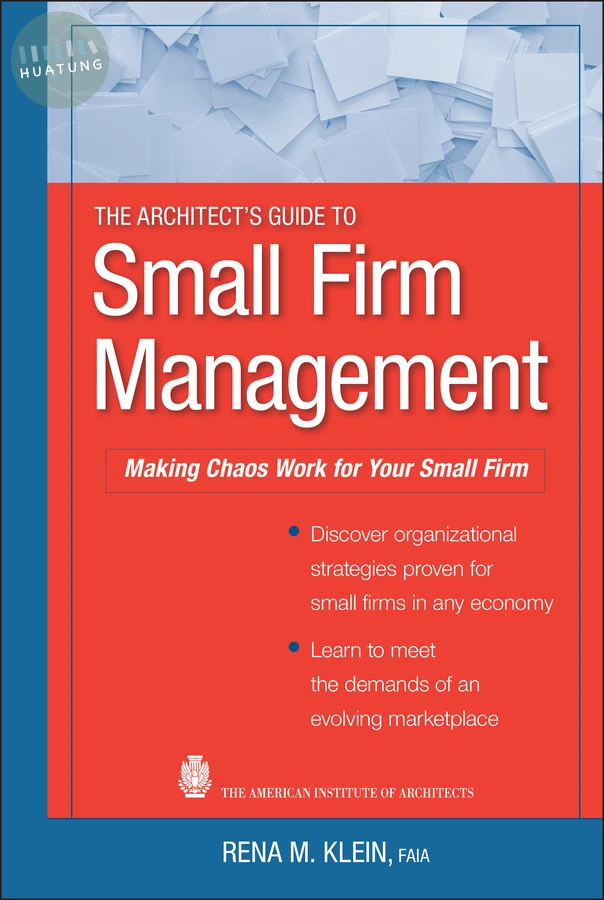

The Architect's Guide to Small Firm Management
$2649元 定價: $2943 9折 可訂購
簡介
The definitive guide to management success for sole practitioners and leaders of small design firms Owning and operating a small architectural design firm can be challenging, with tight project deadlines, on-the-fly meetings, rush proposals, and fluctuating workloads as part of the firm’s day-to-day activities. To help small firm owners cope with the chaos and prepare for the unexpected, here is The Architect’s Guide to Small Firm Management, a no-nonsense guide to repurposing daily demands into workable, goal-directed solutions.Crucial topics such as self-aware leadership, people management, technology, financial health, scenario planning, sustainable practice, and future trends are examined using real-life case studies and business model paradigms. This definitive text explores the whole system experience of a small firm practice to deliver organizational strategies proven to keep a firm’s creative mission on a steady, productive path. The Architect’s Guide to Small Firm Management addresses how small firm owners can:
Deal effectively with unexpected circumstances and shifting work requirements
Meet the demands of the marketplace while creating a satisfying workplace
Set and achieve goals in an environment of constant change
This book is a must-have for those facing the often harsh reality of managing small design firms in a difficult and changing economy. Entrepreneurial architects and designers will discover how to define their own personal and professional meanings of success, as well as how to refocus their business approach to replace long, unrewarding hours with manageable, satisfying ones.
目錄
Acknowledgments xi
Introduction xiii
Part I: Managing In An Unpredictable Environment 1
Chapter 1: Bringing Order Out of Chaos 3
Profit and Satisfaction 4
Design Firm Business Models 6
Efficiency-Based Firms 6
Experience-Based Firms 8
Expertise-Based Firms 10
Any Project That Comes Through The Door 13
Small Firm Archetypes 14
Archetype One: Everyone is Dissatisfied 14
Archetype Two: Administrative Breakdown 16
Archetype Three: Unintentional Enmity 18
Chapter 2: Whole Firm System 21
Linear Thinking and Systems Thinking 22
Recognizing Patterns 24
Tracking Trends 25
Symptomatic and Fundamental Solutions 26
Summary 28
Core Incompetence 28
Whole Firm System Diagram 29
Time Management 31
Communication Effectiveness 32
Job Satisfaction 33
Chapter 3: Routinize The Routine 35
Operational Effectiveness 35
The Typology of Work 37
Analyzability and Variety 38
Situational Leadership 39
Match Management Style, Staffing, and Work Types 40
How To Routinize 41
Project Management/Accounting Software 42
Project Startup Process 47
Capacity Utilization 50
Chapter 4: Leadership Matters 53
Firm Culture 53
Field Theory 55
Self-Aware Leadership 55
Control Versus Trust 56
Career Contentment 58
Working With Creative People 61
Effective Firm Retreats 62
Plan Nonbillable Hours 64
Partnerships 65
Why Partner? 65
What Makes Partnerships Work 66
Rules of The Road 67
What Makes Partnerships Fail 68
“Unintentional Enmity” Revisited 69
Success In Group Work 70
Part II: Best Laid Plans 73
Chapter 5: Lifecycle of A Small Firm 75
Wealth or Control 75
The Principals’ Dilemma 76
Getting To The Next Level 78
Be What You Want To Become 79
The Pyramid Problem 79
The Matrix Solution 79
Transforming Mental Models 81
Everyone is Dissatisfied Revisited 81
Chapter 6: Transition Times 83
The 10-Year Itch 83
When Partners Grow Apart: J/H Architects 84
A Cautionary Tale 86
Approaching Retirement 87
10-Year Rule 88
Expanded Choices 89
Narrow Choices 89
Ownership Transition Options 92
Internal Sale At Retirement 92
Taking On A Minority Partner 97
Chapter 7: Financial Management: Beyond Intuition 99
Macroeconomic Influences 100
Economic Indicators 100
The Construction Business Cycle 101
How Small Firms Survive An Economic Slowdown 103
Financial Terminology 107
Financial Performance Indicators and Benchmarks 108
Financial Management Tasks 109
Track Firm Profitability 110
Track Chargeable Ratio and Direct Labor Expense 110
Track Break-Even Multiplier and Multiplier Achieved 111
Track Overhead Expense and Budget Variance 112
Track Backlog and Outstanding Proposals 114
Year-End Financial Checkup 114
Additional Financial Checks 117
Chapter 8: Scenario Planning 121
Influences On Profitability 122
Client Expectations 123
Overhead Expense 125
Strategies For Increasing Profitability 125
Realizable Revenue 126
Increase Hours? 127
Increase Billing Rates (Fees)? 128
Increase Billable Hours? 128
Add Intern To Staff? 129
Add Skilled Staff? 130
Scenario Planning Story Problem 131
Story Problem Challenge 132
Move To A Larger Office? 133
Planning Firm Growth 134
Part III: Looking Toward The Future 137
Chapter 9: Strategic Thinking 139
Business Planning For Small Design Firms 139
Marketing Plans 142
Value of Participatory Process 144
Sample Business Plan Template 145
Learning is Job One 155
Learning By Design 155
Learning As Competitive Advantage 157
Chapter 10: Small Design Firm Practice Models 159
Solo Practice 159
Economies of Small Scale 160
Challenges and Opportunities For Solo Practitioners 162
Firms Owned By Married Couples 164
Complementary Skills 164
Ease of Communication 165
Lessons Learned 165
Small Firms In International Practice 166
Firm Size is No Barrier 167
Another Calling 168
The Virtual Office Option 169
Twenty-First Century Opportunity 170
Consider The Possibilities 171
Chapter 11: Technology and Integrated Practice In Small Firms 173
Adopting Building Information Modeling 173
Integrated Practice and Integrated Project Delivery 177
Architect-Led Design-Build 178
Architect Developer 181
Creating Pocket Neighborhoods: Ross Chapin, Aia 181
Green Development: Tony Case, Aia 183
Chapter 12: Big-Picture Trends 187
Diversity In Practice 188
Generation Gaps 189
Boomers Out, Millennials In 190
Technological Tethering 190
A Mixed Bag 191
How To Manage Millennials 192
Women In Design Firm Leadership 193
“Brain Drain” Revealed 194
Labyrinth To The Top 195
Twenty-First-Century Workplace 197
The Teleworking Option 197
Chapter 13: Sustainable Economics 203
Triple Bottom Line 204
Sustainable Design Firm Practice 206
Greening The Workplace 206
Values-Based Practice 207
Another Point of View 208
Sustainable Economics Applied 208
Construction Industry Impact 209
Turn Red Business Blue 209
Final Words 210
Index 213