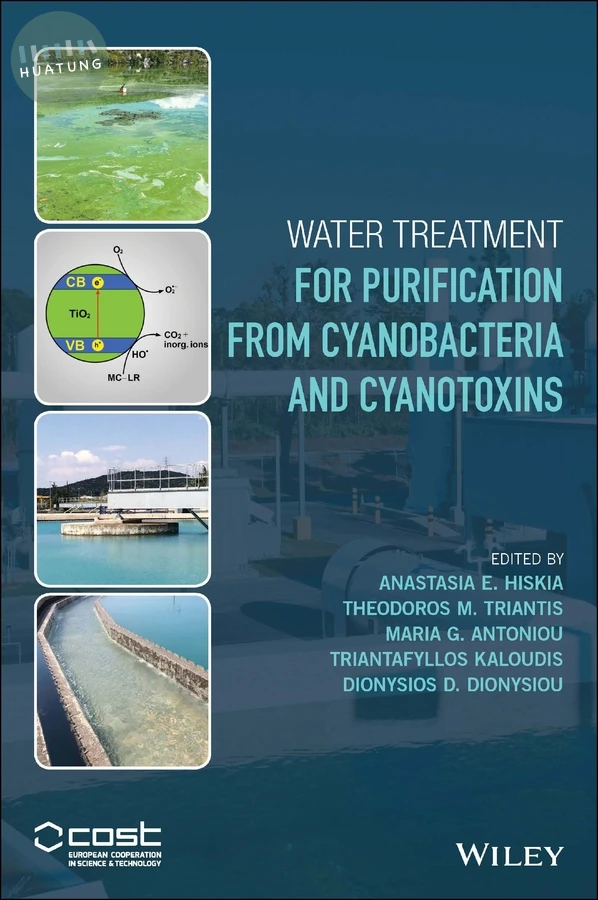
Water Treatment for Purification from Cyanobacteria and Cyanotoxins
$5532元 定價: $6147 9折 可訂購
簡介
Provides a comprehensive overview of key methods for treating water tainted by cyanobacteria and cyanotoxins
Toxigenic cyanobacteria are one of the main health risks associated with water resources. Consequently, the analysis, control, and removal of cyanobacteria and cyanotoxins from water supplies is a high priority research area. This book presents a comprehensive review of the state-of-the-art research on water treatment methods for the removal of cyanobacteria, taste and odor compounds, and cyanotoxins.
Starting with an introduction to the subject, Water Treatment for Purification from Cyanobacteria and Cyanotoxins offers chapters on cyanotoxins and human health, conventional physical-chemical treatment for the removal of cyanobacteria/cyanotoxins, removal of cyanobacteria and cyanotoxins by membrane processes, biological treatment for the destruction of cyanotoxins, and conventional disinfection and/or oxidation processes. Other chapters look at advanced oxidation processes, removal/destruction of taste and odour compounds, transformation products of cyanobacterial metabolites during treatment and integrated drinking water processes.
Provides a comprehensive overview of key methods for treating water tainted by cyanobacteria and cyanotoxins
Bridges the gap between basic knowledge of cyanobacteria/cyanotoxins and practical management guidelines
Includes integrated processes case studies and real-life examples
Developed within the frame of the European Cooperation in Science and Technology (COST)–funded CYANOCOST
A must-have resource for every water treatment plant, Water Treatment for Purification from Cyanobacteria and Cyanotoxins is a valuable resource for all researchers in water chemistry and engineering, environmental chemistry as well as water companies and authorities, water resource engineers and managers, environmental and public health protection organizations.
目錄
List of Contributors xi
Preface xvii
Acknowledgments xix
1 Introduction to Cyanobacteria and Cyanotoxins 1
Armah A. de la Cruz, Neill Chernoff, James L. Sinclair, Donna Hill, Deacqunita L. Diggs, and Arthur T. Lynch
1.1 An Overview of Cyanobacteria 1
1.2 General Environmental Impact: Ecological and Human Health Effects 6
1.3 Health Effects of Cyanotoxins 8
1.4 Current Guidelines for Cyanotoxins 14
1.5 Taste and Odor Compounds Related to Cyanobacteria 18
1.6 Management Strategies of Cyanobacteria, Cyanotoxins, and Related Compounds in Water Treatments 19
References 21
2 Cyanobacteria, Cyanotoxins, and Human Health 37
Geoffrey A. Codd, Emanuela Testai, Enzo Funari, and Zorica Svirèev
2.1 Introduction 37
2.2 Exposure Routes, Exposure Media, and Human Health 39
2.3 Cyanobacterial Cells and Cyanotoxins as Human Health Hazards and Risks 43
2.4 Reported Investigations of Roles of Cyanobacteria and Cyanotoxins in Human Health Incidents 52
2.5 Recognition and Reporting of Role(s) of Cyanobacteria/Cyanotoxins in Health Incidents 57
2.6 Role of Human Health Incidents in Contributing to Cyanobacterial and Cyanotoxin Risk Management Policies 58
2.7 Importance of Contingency Plans and Outreach Activities 58
References 59
3 Removal of Cyanobacteria and Cyanotoxins by Conventional Physical-chemical Treatment 69
Margarida Ribau Teixeira, Maria João Rosa, Sabrina Sorlini, Michela Biasibetti, Christophoros Christophoridis, and Christine Edwards
3.1 Introduction 69
3.2 Chemical Treatment 71
3.3 Coagulation and Flocculation 75
3.4 Dissolved Air Flotation 76
3.5 Rapid Sand/Gravity Filtration 80
3.6 Slow Sand Filtration 81
3.7 Bank Filtration 83
3.8 Activated Carbon Adsorption 85
3.9 Conclusions 88
References 89
4 Removal of Cyanobacteria and Cyanotoxins by Membrane Processes 99
Mike B. Dixon, Lionel Ho, and Maria G. Antoniou
4.1 Introduction 99
4.2 Microfiltration and Ultrafiltration 100
4.3 Nanofiltration 101
4.4 Nanofiltration for the Combined Removal of Various Cyanobacterial Metabolites 102
4.5 Reverse Osmosis 108
4.6 Integrated Studies: Ultrafiltration Combined with PAC and Coagulants 108
Acknowledgement 114
References 114
5 Biological Treatment for the Destruction of Cyanotoxins 117
Dariusz Dziga, Sonja Nybom, Ilona Gagala, and Marcin Wasylewski
5.1 Introduction 117
5.2 Overview of Microbial Degradation 118
5.3 The Mechanisms of Biodegradation 124
5.4 Biological Methods of Cyanotoxin Elimination 129
5.5 Guide to Evaluating Biodegradation 133
5.6 Microbial Water Treatment – Application and Case Studies 142
5.7 Conclusions 145
Acknowledgements 145
References 146
6 Conventional Disinfection and/or Oxidation Processes for the Destruction of Cyanotoxins/Cyanobacteria 155
Sylvain Merel, Shuwen Yan, and Weihua Song
6.1 Reaction of Chlorine and its Derivatives with Cyanotoxins 155
6.2 Reaction of Ozone with Cyanotoxins 162
6.3 Reaction of Permanganate (KMnO4) with Cyanotoxins 166
References 167
7 Advanced Oxidation Processes 173
Geshan Zhang, Xuexiang He, Xiaodi Duan, Ying Huang, Changseok Han, Mallikarjuna N. Nadagouda, Kevin O’Shea, Duk Kyung Kim, Virender K. Sharma, Natalie Johnson, Bangxing Ren, Vasileia Vogiazi, Theodora Fotiou, Christophoros Christophoridis, Anastasia E. Hiskia, and Dionysios D. Dionysiou
7.1 Introduction 173
7.2 UV 174
7.3 UV/H2O2 175
7.4 O3/H2O2 176
7.5 UV/O3 177
7.6 Catalytic Ozonation 178
7.7 Fenton/Photo-Fenton Reagent 179
7.8 TiO2-Based Photocatalysis/Visible Light Sensitized TiO2 180
7.9 Radiolysis 182
7.10 Ultrasonic Degradation 184
7.11 Ferrate 186
7.12 Other Iron-based Processes 187
7.13 Sulfaten Radical-based AOPs 189
7.14 Polyoxometalate Photocatalysis 191
7.15 Conclusion 195
Acknowledgments 195
References 196
8 Removal and/or Destruction of Cyanobacterial Taste and Odour Compounds by Conventional and Advanced Oxidation Processes 207
Carlos J. Pestana, Linda A. Lawton, and Triantafyllos Kaloudis
8.1 Introduction 207
8.2 Conventional Water Treatment 210
8.3 Advanced Treatment Methods 218
8.4 Side Note: T&O Compound Concentrations and Customer Perception 224
References 224
9 Transformation Products (TPs) of Cyanobacterial Metabolites During Treatment 231
Theodora Fotiou, Theodoros M. Triantis, Anastasia E. Hiskia, Dariusz Dziga, Sylvain Merel, Christine Edwards, and Maria G. Antoniou
9.1 Introduction 231
9.2 TPs Formed in the Natural Environment 233
9.3 Transformation Products of Microcystins and Nodularins with Advanced Oxidation Processes/ Technologies and Conventional Chemical Oxidation 236
9.4 Transformation Products of Microcystins and Nodularins with Biological Treatment 279
9.5 Transformation Products of Cylindrospermopsin 287
9.6 Transformation Products of Odor Compounds 292
9.7 Conclusions 298
Acknowledgements 298
References 298
10 Integrated Drinking Water Processes: Case Studies 307
Tomasz Jurczak, Andrzej Jodlowski, Sabrina Sorlini, Michela Biasibetti, and Francesca Gialdini
10.1 Introduction 307
10.2 Pilot Plant Studies for Optimization of Water Treatment Processes in Microcystins Removal 308
10.3 Removal of Cyanobacterial Cells and Microcystin-LR with a Microfiltration Pilot Plant (Lake Garda, Italy) 312
10.4 Removal of Cyanobacterial Cells and Cyanotoxins in a Conventional Full-scale DWTP (Lake Vico, Italy) 314
10.5 Efficiency of Water Treatment Processes in Elimination of Microcystins – Polish Examples 317
10.6 Conclusions 324
References 324
Index 327