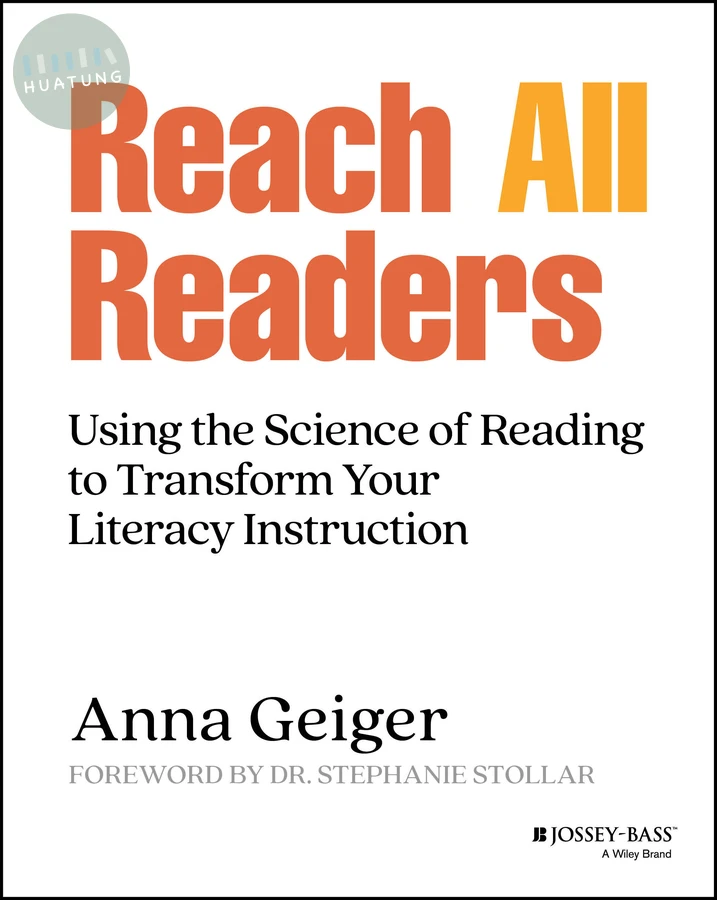

Reach All Readers
$932元 定價: $1036 9折 可訂購
簡介
The essential guide to teaching literacy skills to K-3 students Reach All Readers is filled with practical tools for every kindergarten and early grade educator. This book addresses the science behind how students learn to read and how educators can apply this information in their classrooms every day. It is jam packed with research on literacy, spelled out in an easy-for-anyone-to-understand way. You'll also find evidence-based routines and activities to apply in the classroom. Learn the “how” of teaching literacy, and gain an understanding of why these approaches work. Charts and graphics illustrate concepts, so you can visualize how the big picture connects to practical applications and approaches. With Reach All Readers, teaching literacy is a breeze! This reader-friendly guide to the science of reading education will help you improve your reading instruction with research-backed strategies. Literacy expert Anna Geiger breaks down complex concepts and presents them in an easy-to-digest format. Then, she offers concrete ideas you can implement immediately. Get all the must-know information about K-3 literacy education in one place
Understand the latest research on how students learn and get tools for putting that research into practice
Follow concrete lesson plans and practical tips to level up your literacy teaching
Develop a big-picture understanding of literacy education so you know how best to help each and every student
Anyone responsible for teaching K-3 students reading, writing, and literacy skills—including teachers, homeschoolers, tutors, parents, and administrators—will want a copy of Reach All Readers.
目錄
Foreword xiii
Acknowledgments xv
About the Author xvii
Introduction 1
How This Book Is Organized 1
Chapter 1 The Big Picture 3
The Whole Word Method 3
Why Johnny Can’t Read 3
Jeanne Chall’s Research 4
Whole Language 4
The Report of the National Reading Panel 5
Balanced Literacy’s Beginnings 5
Emily Hanford’s Reporting 5
Scientifically-Based Research 7
The Simple View of Reading 9
Scarborough’s Reading Rope 11
How the Brain Learns to Read 12
How We Learn Words 14
Key Things to Remember 18
Learn More 19
Notes 19
Chapter 2 The Science of Learning 23
What’s Memory Got to Do with It? 23
Explicit Instruction 25
How to Ensure Your Students Remember What You Teach 35
Key Things to Remember 38
Learn More 38
Notes 38
Chapter 3 Oral Language 41
The Five Domains of Oral Language 41
Oral Language Routines 43
Make Your Classroom Language- Rich 49
Key Things to Remember 53
Free Resources 53
Learn More 54
Notes 54
Chapter 4 Phonemic Awareness and the Alphabetic Principle 57
Phonological Awareness 57
Phonemic Awareness: An Overview 60
Teaching Phonemic Awareness 67
Key Things to Remember 80
Free Resources 80
Learn More 80
Notes 81
Chapter 5 Phonics 83
Code Emphasis Versus Meaning Emphasis 83
Types of Phonics Instruction 86
Guidelines for Effective Phonics Instruction 90
The Debate Between Print-to-Speech and Speech-to-Print 131
Key Things to Remember 132
Free Resources 133
Learn More 133
Notes 134
Chapter 6 Fluency 141
The Components of Fluency 141
Fluency and Comprehension 143
Developing Automaticity at the Letter and Word Level 143
Developing Fluency at the Text Level 146
Key Things to Remember 154
Free Resources 155
Learn More 155
Notes 155
Chapter 7 Vocabulary 159
How to Decide Which Words to Teach: The Three Word Tiers 160
Teaching Individual Tier Two Words 162
Teaching Tier Three Words 165
Teaching Word-Learning Strategies 168
Key Things to Remember 172
Free resources 172
Learn More 172
Notes 172
Chapter 8 Comprehension 175
What Is Comprehension? 175
Teaching Sentence Comprehension 180
Reading Comprehension Strategies 185
Putting It All Together 195
Key Things to Remember 197
Learn More 197
Free Resources 197
Notes 198
Chapter 9 Linking Reading and Writing 201
Teach Handwriting 202
Teach Spelling 203
Teach Students to Write About What They Read 206
Teach That Sentences Contain a “Who” and a “Do” 206
Teach Students to Expand Simple Sentences 207
Teach Students to Combine Sentences 210
Teach Students to Connect Sentences 210
Teach Students to Write Paragraphs 212
Other Ways for Students to Respond to Text in Writing 214
Key Things to Remember 214
Free Resources 214
Learn More 215
Notes 215
Chapter 10 Dyslexia 217
What Is Dyslexia? 217
Help for Dyslexia 222
Key Things to Remember 223
Learn More 223
Notes 224
Chapter 11 Using MTSS to Reach All Readers 225
Multi-tiered Systems of Support (MTSS) 225
Delivering Tier 1 Instruction 231
Designing Your Daily Schedule 237
Key Things to Remember 238
Free Resources 239
Learn More 239
Notes 239
Conclusion 241
Glossary 243
Index 249