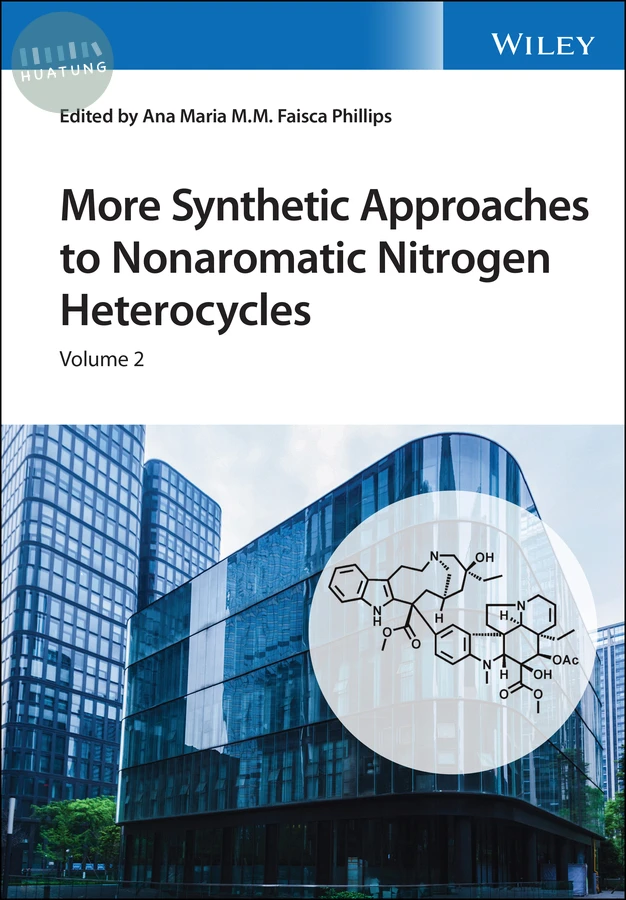

More Synthetic Approaches to Nonaromatic Nitrogen Heterocycles, 2 Volume Set
$10250元 定價: $11389 9折 可訂購
簡介
More Synthetic Approaches to Nonaromatic Nitrogen Heterocycles An authoritative collection of resources discussing the latest trends in the synthesis of nonaromatic nitrogen heterocycles Widely distributed in nature, nitrogen heterocycles are extremely common in synthetic substances found in pharmaceuticals, agrochemicals, and materials. The literature is evolving rapidly and explores newly emerging structures and medicines. More Synthetic Approaches to Nonaromatic Nitrogen Heterocycles offers R&D professionals the opportunity to easily access a collection of the latest relevant research in the area. In the second two-volume set of this practical reference distinguished researcher Dr. Ana Maria M. M. Faisca Phillips delivers a collection of resources focusing on the newest and most widely applicable trends emerging in synthetic strategies for nonaromatic nitrogen heterocycles. With coverage of topics including organocatalysis, cascade reactions, flow chemistry in synthesis, cycloaddition reactions, metathesis, cross-coupling reactions, and electrochemistry, the book provides quick access to critical new avenues of synthesis. More Synthetic Approaches to Nonaromatic Nitrogen Heterocycles: Volume 1 and 2 also offers readers: A thorough introduction to recent advances in the design and synthesis of cyclic peptidomimetics
Comprehensive explorations of fused heterocycles and transition metal promoted synthesis of isoindoline derivatives
Practical discussions of 1,4-diazepane ring-based systems and recent advances in the synthesis of azepane-based compounds
In-depth examinations of strained aziridinium ions, asymmetric organocatalysis in alternative media, and the electrochemical synthesis of non-aromatic N-heterocycles
Perfect for academic and industrial researchers in organic chemistry and synthesis, organometallic chemistry, pharmaceutical chemistry catalysis, and sustainable chemistry, More Synthetic Approaches to Nonaromatic Nitrogen Heterocycles: Volume 1 and 2 is an indispensable reference for anyone seeking an authoritative source of information on new and emerging trends in synthesis.
目錄
List of Contributors
Preface
List of Common Abbreviations
PART 1: CASCADE REACTIONS
1 Unity is Strength: The Case of Cascade Reactions Combined with C–H Activation 1
Emanuele Casali, Ervis Saraci and Giuseppe Zanoni
1.1 Introduction
1.2 Rhodium Promoted Reactions
1.3 Palladium Promoted Reactions
1.4 Ruthenium Promoted Reactions
1.5 Cobalt Promoted Reactions
1.6 Miscellaneous
References
2 Chemo-enzymatic Cascade Reactions for the Synthesis of Chiral Intermediates
and Nonaromatic Nitrogen Heterocycles
Rodrigo O.M.A. de Souza, Raquel A.C. Leão, Marcelo A. Nascimento, Alexandre de S. França, Amanda S. de Miranda, Ivaldo I. Junior
2.1 Introduction
2.2 C–N Bond Construction Enzymes
2.3 C–N Deracemization Enzymes
2.4 Cascade Reactions
2.4.1 Enzymatic Cascade Reactions
2.4.2 Chemoenzymatic Cascade Reactions
References
3 Asymmetric Organocatalytic Cascade Reactions for the Synthesis of Nitrogen Heterocycles
A. M. M. M. Faisca Phillips
3.1 Introduction
3.2 Three-membered Ring Heterocycles: Aziridines
3.3 Four-membered Ring Heterocycles: The β-lactams
3.4 Five-membered Rings
3.4.1 Pyrrolidines
3.4.2 Pyrrolidinones (-Lactams)
3.4.3 Isoindolinones and Spirooxindoles
3.5 Six-membered Rings
3.5.1 Piperidines, Dihydropyridines and Tetrahydropyridines
3.5.2 Piperidinones (-lactams)
3.5.3 Dihydropyridinones
3.5.4 Tetrahydroquinolines, Dihydroquinolines and Related Substances
3.5.5 Hexahydropyridazines and Pyrimidinones
3.6 Pyrrolo[3,2,1-ij]quinolines
3.7 Cyclic Sulfamidates
3.8 Miscellaneous
Conclusion
References
PART 2: SELECTED REACTIONS FOR THE SYNTHESIS OF NITROGEN HETEROCYCLES
4 Synthesis of Nitrogen-Heterocycles Based on N-Heterocyclic Carbene Organocatalysis
Hideto Miyabe
4.1 Introduction
4.2 NHC-catalyzed Cyclization
4.3 NHC-catalyzed Annulation
4.3.1 [3 + 2] Annulation
4.3.2 [4 + 2] Annulation
4.3.3 [3 + 3] Annulation
4.3.4 [4 + 3] Annulation
4.3.5 [2 + 2] Annulation
4.4 Oxidative NHC-catalyzed Annulation
4.4.1 Oxidative [3 + 2] Annulation
4.4.2 Oxidative [4 + 2] Annulation
4.4.3 Oxidative [3 + 3] Annulation
4.4.4 Oxidative [4 + 3] Annulation
4.4.5 Oxidative [2 + 2] Annulation
4.5 Asymmetric Dearomatization
4.6 Cooperative Catalysis of NHC and Transition-Metal Catalysts
4.7 Other NHC-catalyzed Reactions
4.8 Conclusion and Outlook
References
5 Synthesis of N-Heterocycles via [3 + n] Cycloaddition Reactions of Vinyl Metal Carbene Intermediates
Ming Bao, Su Zhou, and Xinfang Xu
5.1 Introduction
5.2 [3 + 1]-Cycloaddition
5.3 [3 + 2]-Cycloaddition
5.4 [3 + 3]-Cycloaddition
5.4.1 [3 + 3]-Cycloaddition with Nitrone
5.4.2 [3 + 3]-Cycloaddition with Azomethine Imines
5.4.3 [3 + 3]-Cycloaddition with Other 1,3-Dipoles
5.5 [3 + 4]-Cycloaddition
5.5.1 [3 + 4]-Cycloaddition with N-Heterocycles
5.5.2 [3 + 4]-Cycloaddition with α,-Unsaturated Imines
5.5. Other Types of [3 + 4]-Cycloadditions
5.6 [3 + 5]-Cycloaddition
5.7 Intramolecular Cyclization via Carbene/Alkyne Metathesis Process
5.8 Summary and Outlook
References
6 Recent Progress in the Synthesis of Amine-containing Heterocycles by Metathesis Reactions
Zeyue Zhang, Damien Hazelard, and Philippe Compain
6.1 Introduction
6.2 Five-membered Cyclic Amines
6.3 Six-membered Cyclic Amines
6.3.1 Natural Products and Related Compounds
6.3.2 Sugar Mimetics
6.3.3 RCM of Phenylamines and Related Analogues
6.3.4 Miscellaneous
6.4 Seven-membered to Macrocyclic Amines
6.5 Tandem Reactions
6.6 Conclusion
References
7 Metal-Catalyzed Synthesis of N-Heterocycles Via Borrowing-Hydrogen Annulation
A. Sofia Santos, Daniel Raydan, Nuno Viduedo, M. Manuel B. Marques, and Beatriz Royo
7.1 Introduction
7.2 Metal-Catalyzed Borrowing Hydrogen Annulation Reactions
7.2.1 Rh-Catalyzed Borrowing Hydrogen Reactions
7.2.2 Ru-Catalyzed Borrowing Hydrogen Reactions
7.2.3 Ir-Catalyzed Borrowing Hydrogen Reactions
7.2.4 Fe-Catalyzed Borrowing Hydrogen Reactions
7.2.5 Ni-Catalyzed Borrowing Hydrogen Reactions
7.3 Conclusions
References
8 Synthesis of N-Heterocycles Via Metal-Catalyzed Intramolecular Buchwald-Hartwig C-N Cross Coupling Reactions
Auxiliadora Prieto
8.1 Introduction
8.2. Applications of Intramolecular Pd-Catalyzed N-Arylation of amine in the Synthesis of Nonaromatic Heterocycles.
8.2.1. Synthesis of Five-membered N-Heterocycles.
8.2.2. Synthesis of Six-membered N-Heterocycles.
8.2.3. Applications in the Synthesis of both Five- and Six-membered N-Heterocycles
8.2.4. Synthesis of Seven-membered N-Heterocycles
8.3. Applications of Intramolecular Pd-Catalyzed N-arylation of amide in the Synthesis of Nonaromatic Heterocycles.
8.3.1. Applications in the Synthesis of Five-membered N-Heterocycles.
8.3.2. Application in the Synthesis of Six-membered N-Heterocycles
8.3.3. Application in the Synthesis of Seven-membered N-Heterocycles
8.4. Intramolecular Pd-Catalyzed Arylation of Sulfonamides.
8.5 Applications of the Intramolecular Buchwald-Hartwig Amination in the Synthesis of Natural Products.
8.6 Conclusion
References
9 Synthesis of Nonaromatic Nitrogen Heterocycles Via Singlet Oxygen
João Tomé, Kelly A.D.F. Castro, Leandro M. O. Lourenço, Roberto Santana Da Silva,
9.1 Introduction
9.2 Singlet Oxygen on Organic Synthesis
9.2.1 Oxidation of Bipyrroles
9.2.2 Synthesis of (R)-methylnaltrexone
9.2.3 Synthesis of Glochidine and Glochidicine
9.2.4 Synthesis of γ-lactams via One-pot Synthesis
9.2.5 Synthesis of the Melohenine B
9.2.6 Synthesis of Pyrrolidine Derivatives by [2 + 3] Cycloaddition, via 1O2 Mediated 1,3-dipole
9.2.7 Synthesis of Pandamarine
9.2.8 Preparation of Bicyclic Lactam
9.2.9 Synthesis of Alkaloids
9.2.10 Synthesis of Azaspiro Frameworks
9.2.11 Preparation of Tetrahydropyranopyrrolones
9.2.12 Synthesis of 2-oxindoles
9.2.13 Synthesis of Several Natural Products from an Amino Furan Derivative
9.2.14 Synthesis of Peptide-fluorescent Probes
9.2.15 Synthesis of Tetrahydroquinoline
9.3 Conclusion
References
10 Cobalt-catalysed Carbonylation for the Synthesis of N-Heterocyclic Compounds
Anup Paul and Armando J.L. Pombeiro
1. Introduction
2. Cobalt-catalysed Carbonylation for the Synthesis of N-heterocyclic Compounds Using CO Gas as CO source
3. Cobalt-catalysed Carbonylation for the Snthesis of N-heterocycles Using CO Surrogates
4. Conclusions
References
11 Enantioselective Synthesis of Nitrogen Heterocycles Using Chiral Hypervalent Iodine Reagents
Ana Maria Faisca Phillips and Armando J.L. Pombeiro
11.1 Introduction
11.2 The Historical Development of Chiral Hypervalent Iodine Reagents
11.3 Synthesis with Chiral Hypervalent Iodine Reagents
11.3.1 Difunctionalization of Alkenes
11.3.2 Dearomatization Reactions
11.3.3 α-Functionalization of Carbonyl Compounds
11.4 Conclusion
References
PART III. SPECIAL TECHNIQUES
12 Continuous Flow Chemistry
Marcus Baumann
12.1 Introduction To Modern Flow Chemistry
12.2 Value of Heterocyclic Chemistry for Modern Drug Discovery Programs
12.3 Case Studies of Flow Chemistry Applied to Heterocyclic Targets
12.3.1 Flow Synthesis of Three-membered Saturated Heterocycles
12.3.2 Flow Synthesis of Four-membered Saturated Heterocycles
12.3.3 Flow Synthesis of Five-membered Saturated Heterocycles
12.3.4 Flow Synthesis of Six-membered Saturated Heterocycles
12.3.5 Flow Synthesis of Seven-membered Saturated Heterocycles
12.3.6 Flow Synthesis of Macrocyclic Saturated Heterocycles
12.4 Assessment of the Merits of Continuous Flow Processing for Heterocycle Synthesis
12.5 Summary and Conclusions
References
13 The Electrochemical Synthesis of Non-Aromatic N-Heterocycles
Oana R. Luca
13.1 Introduction
13.2 Laws of Organic Electrosynthesis
13.2.1 Types of Electrolyses
13.2.2 Diagnostic Analytical Methods: Voltammetry
13.3. Construction of Three- and Four Membered Non-Aromatic Heterocycles
13.3.1 Aziridines
13.3.2 Epoxides
13.3.3 Azetidines
13.4 Construction of Five Six and Seven Membered Non-Aromatic Heterocycles
13.4.1 Pyrrolidines
13.4.2 Indolines and dihydrobenzofurans
13.4.3 Pyrrolidinones, 5-membered Cyclic Carbamates and Derivatives
13.4.4 Tetrahydrooxazole and Tetrahydrooxazine Derivatives
13.4.5 6-membered Amides, Carbamates, and Derivatives
13.5 Construction of Nonaromatic Heterocycles with Fused Polycyclic Systems
13.5.1 Nonaromatic Heterocycles from Phtalimides and Succinimides
13.5.2 Polyciclic Peptides
13.5.3 Polyclic Ureas
13.5.5 Ring-fused Quinones
Conclusion
References
14 Asymmetric Organocatalysis in Alternative Media
Luis C. Branco, Verônica Diniz, Karolina Zalewska, and Miguel M. Santos
14.1 Introduction
14.2 Water as Reaction Medium
14.3 Ionic Liquids as Alternative Media
14.4 Miscellaneous Alternative Reaction Media
14.5 Conclusions
References
PART IV. SYNTHETIC METHODS FOR SPECIAL COMPOUND CLASSES
15 The Strained Aziridinium Ion
Jala Ranjith and Hyun-Joon Ha
15.1 Introduction
15.2 Formation of Aziridinium Ions
15.3 Ring Opening of Aziridinium Ion
15.4 Synthetic Applications
15.5 Bicyclic Aziridinium Ion and its Application
Ackowledgments
References
16 Recent advances on the synthesis of azepane-based compounds
Maria Assunta Chiacchio, Laura Legnani, Ugo Chiacchio, and Daniela Iannazzo
16.1 Introduction
16.2 Azepane Synthesis
16.2.1 Synthesis of Substituted Azepanes
16.2.2 Synthesis of Ring-fused Azepanes
16.2.3 Synthesis of Azepane-based Alkaloids
Conclusion
17 1,4-Diazepane Ring-based Systems
Eduarda M.P. Silva, Pedro A.M.M. Varandas, and Artur M.S. Silva
17.1 Introduction
17.2 Reductive Amination
17.3 Mitsunobu Amination
17.4 1,3-Dipolar Cycloaddition
17.5 Multicomponent Reactions
17.6 Other Methods
Conclusions
References
18 Transition Metal Promoted Synthesis of Isoindoline Derivatives
Laura A. Aronica and Gianluigi Albano
18.1 Introduction
18.2 Synthesis of Isoindolines
18.2.1 [2+2+2] Cycloaddition Reactions
18.2.2 Transition Metal-promoted Diels-Alder reactions
18.2.3 Transition Metal-promoted Cyclization of Ortho-substituted Benzyl Amines (and Derivatives)
18.2.4 Transition Metal-promoted 5-exo-dig Cyclization by C-C Bond Formation
18.2.5 Miscellaneous
18.2.6 Conclusions and Perspectives
References
19 1,2-Benzisothiazole 1,1-Dioxide (Saccharinate)-Based Compounds: Synthesis, Reactivity and Applications
Luís M.T. Frija, André L. Fernandes, Bruno Guerreiro, and M. Lurdes S. Cristiano
19.1 Introduction
19.2 Synthesis of Saccharinate-based Conjugates
19.3 Applications
19.3.1 Ionic Liquids
19.3.2 Coordination Chemistry
19.3.3 Biological Activity and Medical Uses
19.4 Concluding Remarks
References
20 Fused Heterocycles
Arruje Hameed, Muhammad Abdul Qayyum, Abdur Rehman, Touseef Ur Rehman, Anwar Ahmad, and Tahir Farooq
20.1 Introduction
20.1 Recent Developments for Facile Synthesis and Applications of 1,2,4-Triazole Fused Heterocycles
20.1.1 1,2,4-Triazole-fused Heterocycles as Energetic Materials
20.1.2 1,2,4-Triazole-fused Heterocycles as Building Blocks
20.2 Recent Developments for Facile Synthesis of 1,2,3-Triazole-fused Heterocycles
20.2.1 1,2,3-Triazole-fused Heterocycles as Bioactive Scaffolds
20.2.2 1,2,3-Triazole-fused Heterocycles as Functional Materials
20.3 Conclusion
References
21 Recent Advances in the Design and Synthesis of Cyclic Peptidomimetics
Arruje Hameed, Amjad Hameed, Ghulam Hussain, Hafiz Abdul Qayyum, Muhammad Fayyaz Farid, and Tahir Farooq
21.1 Introduction
21.2 Click-mediated Approaches for Cyclic Peptidomimetics
21.3 Enzyme-mediated Approaches for Cyclic Peptidomimetics
21.4 Solid-phase Synthesis of Cyclic Peptidomimetics
21.5 Conclusion
References