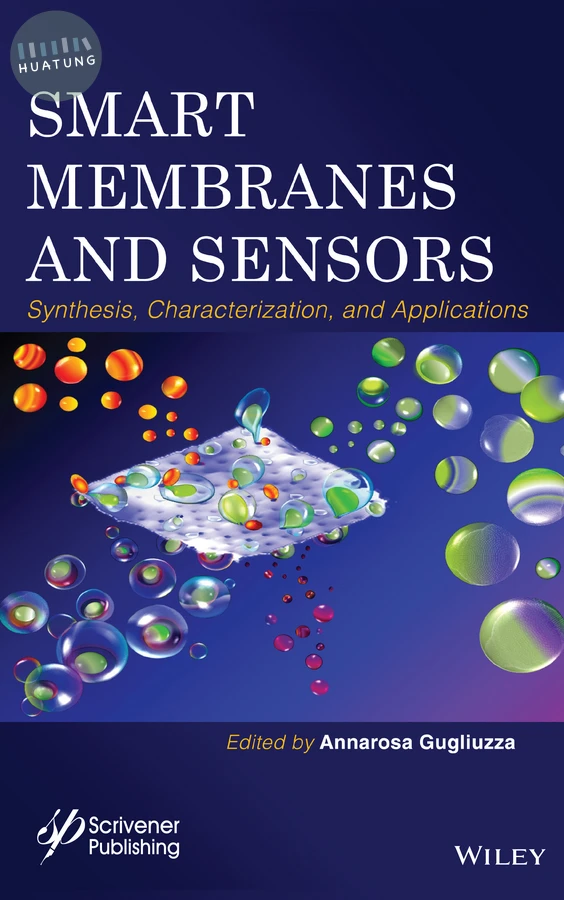

Smart Membranes and Sensors
$6901元 定價: $7668 9折 可訂購
簡介
This book addresses the reader to use synergistically the concepts of membranes and sensors materials. It contains insightful contributions from leading scientists working in both the fields. The focus is on the fabrication of smart membranes from sensor materials and related impact on many technologically sophisticated areas such as telemedicine, microfluidics, drug delivery targeting, (bio)separation, labs-on-a-chip, textiles, power storage and release, environment monitoring, agro-food safety, cosmetics, architecture, automotive and so on.
This book covers various topics, including the choice of materials and techniques for assembling responsive membranes with ability to transport mass, energy and signals on demand; the reader will find through the book an extensive description of the best techniques used to monitor molecular scale events, which are regarded as responsible for the smartness of multifunctional objects and for the conversion of chemical signals into optical, electrical, thermal and mechanical responses.
The reader is encouraged to use this cross-disciplinary discussion for his own research. Chemical, biological and physical concepts, expressed through the book, contribute to form a common language, which will allow the reader to discover causes for reflection and innovation, measuring how smart objects with desired properties can be tailored from exiting materials and used flexibly for different developed applications.
Specifically:
This book deals with materials smartness and suitable techniques to assemble and characterize them in sensor-like membranes.
This book shows how ultra-smart functional devices can be accomplished by using traditional raw materials.
This book describes particular key events, which control 'sense to react and adapt' mechanisms.
The potential of sensor-like membranes in some key strategic fields is examined with particular emphasis on biomedicine, food and textiles markets. The benefits arising from the use of smart membranes are analysed in terms of life quality, safety, and innovation.
目錄
Preface
Part 1: Sensing Materials for Smart Membranes 1
1 Interfaces Based on Carbon Nanotubes, Ionic Liquids and Polymer Matrices for Sensing and Membrane Separation Applications 3
María Belén Serrano-Santos, Ana Corres Ortega, and Thomas Schäfer
1.1 Introduction 3
1.2 Ionic Liquid-Carbon Nanotubes Composites for Sensing Interfaces 5
1.3 Ionic Liquid Interfaces for Detection and Separation of Gases and Solvents 11
1.4 Ionic Liquid-Polymer Interfaces for Membrane Separation Processes 16
1.5 Conclusions 18
Acknowledgement 19
References 19
2 Photo-Responsive Hydrogels for Adaptive Membranes 21
David Díaz Díaz and Jeremiah A. Johnson
2.1 Introduction 21
2.2 Photo-Responsive Hydrogel Membranes 23
2.3 Photo-Thermally Responsive Hydrogel Membranes 44
2.4 Summary 46
2.5 Acknowledgements 48
Abbreviations 48
References 49
3 Smart Vesicles: Synthesis, Characterization and Applications 53
Jung-Keun Kim, Chang-Soo Lee, and Eunji Lee
3.1 Introduction 53
3.2 Synthesis of Soft Vesicles 54
3.3 Synthesis of Hard Vesicles 64
3.4 Characterization of Vesicular Structures 68
3.5 Stimuli-Responsive Behaviors of Vesicular Structures 72
3.6 Application of Vesicles 78
3.7 Conclusions 91
Acknowledgment 92
References 92
Part 2: Stimuli-Responsive Interfaces 105
4 Computational Modeling of Sensing Membranes and Supramolecular Interactions 107
Giacomo Saielli
4.1 Introduction 107
4.2 Non-covalent Interactions: A Physical and a Chemical View 109
4.3 Physical Interactions 109
4.4 Chemical Interactions 114
4.5 Computational Methods for Supramolecular Interactions 117
4.6 Classical Force Fields 127
4.7 Conclusions 139
References 140
5 Sensing Techniques Involving Thin Films for Studying Biomolecular Interactions and Membrane Fouling Phenomena 145
Gabriela Diaconu and Thomas Schäfer
5.1 Introduction 145
5.2 Quartz Crystal Microbalance with Dissipation Monitoring (QCM-D) 146
5.3 Surface Plasmon Resonance (SPR) 148
5.4 Applications of SPR and QCM-D 151
5.5 Conclusions 159
Acknowledgements 160
References 160
6 Smart Membrane Surfaces: Wettability Amplification and Self-Healing 161
Annarosa Gugliuzza
6.1 Introduction 161
6.2 Basics of surface wettability 162
6.3 Amplified Wettability 164
6.4 Actuation Mechanisms 165
6.5 Self-Powered Liquid Motion 170
6.6 Self-Cleaning Mechanisms 172
6.7 Self-Healing Concepts And Strategies 175
6.8 Repairable Surface Properties 177
6.9 Conclusions and Perspectives 179
References 180
7 Model Bio-Membranes Investigated by AFM and AFS: A Suitable Tool to Unravel Lipid Organization and their Interaction with Proteins 185
Andrea Alessandrini and Paolo Facci
7.1 Introduction 186
7.2 Supported Lipid Bilayers 189
7.3 Atomic Force Microscopy (AFM) and Phase Behavior of Slbs 199
7.4 Atomic Force Spectroscopy (AFS) of Supported Lipid Bilayers 205
7.5 Lipid/Protein Interactions 213
7.6 Conclusions 218
References 218
Part 3: Directed Molecular Separation 227
8 Self-Assembled Nanoporous Membranes for Controlled Drug Release and Bioseparation 229
Dominique Scalarone, Pierangiola Bracco, and Francesco Trotta
8.1 Introduction 229
8.2 General Aspects of Block Copolymer Self-Assembly 231
8.3 Block Copolymer Based Membranes 233
8.4 Fabrication of Nanoporous Membranes Derived from Block Copolymers 234
8.5 Tunability of Surface Properties 242
8.6 Application of Block Copolymer Derived Membranes to Bioseparation and Controlled Drug Release 244
8.7 Conclusion 250
References 250
Abbreviations 253
9 Hybrid Mesoporous Silica for Drug Targeting 255
Luigi Pasqua, Piluso Rosangela, Ilenia Pelaggi, and Catia Morelli
9.1 Introduction 256
9.2 Synthesis and Characterization of Bifunctional Hybrid Mesoporous Silica Nanoparticles Potentially
Useful for Drug Targeting 257
9.3 Drug-Loaded Folic-Acid-Grafted Msns Specifically Target FR Expressing Tumour Cells [16] 260
9.4 Conclusion 266
References 268
10 Molecular Recognition-driven Membrane Processes 269
Laura Donato, Rosalinda Mazzei, Catia Algieri, Emma Piacentini, Teresa Poerio, and Lidietta Giorno
10.1 Molecular Imprinting Technique 270
10.2 Affinity Membranes 275
10.3 Cyclodextrins As Molecular Recognition Elements 281
10.4 Zeolite Membranes as Molecular Recognition Devices: Preparation and Characterization 283
10.5 Functionalized Particles-loaded Membranes For Selective Separation Based On Molecular Recognition 287
10.6 Biphasic Enzyme Membrane Systems with Enantioselective Recognition Properties ror Kinetic Resolution 291
10.7 Membrane Surface Modification 292
References 296
Part 4: Membrane Sensors and Challenged Applications 301
11 Electrospun Membranes for Sensors Applications 303
Pierangiola Bracco, Dominique Scalarone, and Francesco Trotta
11.1 Introduction 303
11.2 Basic Principles of Electrospinning 304
11.3 Control of the Electrospinning Process 306
11.4 Application of Electrospun Materials to Ultrasensitive Sensors 311
11.5 Conclusions 329
Abbreviations 330
References 330
12 Smart Sensing Scaffolds 337
Carmelo De Maria, Yudan Whulanza, Giovanni Vozzi, and Arti Ahluwalia
12.1 Introduction 337
12.2 Composite Sensing Biomaterial Preparation 339
12.3 Composite Sensing Biomaterial Characterisation 340
12.4 SWNTs-Based Composite Films Structural Properties 341
12.5 Tensile Properties of SWNTs-Based Composite Films 343
12.6 Electrical Properties of SWNTs-Based Composites Films 348
12.7 Electromechanical Characterisation and Strain-Dependence Measurement 350
12.8 Cell Sensing Scaffolds 352
12.9 Processing of CNT Composite: Microfabrication of Sensing Scaffold 360
12.10 Conclusions 361
References 362
13 Nanostructured Sensing Emulsion Droplets and Particles: Properties and Formulation by Membrane Emulsification 367
Emma Piacentini, Alessandra Imbrogno, and Lidietta Giorno
13.1 Introduction 367
13.2 Emulsions and Emulsification Methods 370
13.3 Senging Particles Produced by Membrane-Based Process 389
13.4 Conclusions 397
References 398
14 Membranes for Ultra-Smart Textiles 401
Annarosa Gugliuzza and Enrico Drioli
14.1 Introduction 401
14.2 Membranes and Comfort 403
14.3 Adaptive Membranes for Smart Textiles 407
14.4 Barrier Functions of Membranes 411
14.5 Membrane Materials for Self-cleaning Function 413
14.6 Interactive Membranes for Wearable Electronics 414
14.7 Conclusions and Prospects 415
References 416