為您推薦
類似書籍推薦給您
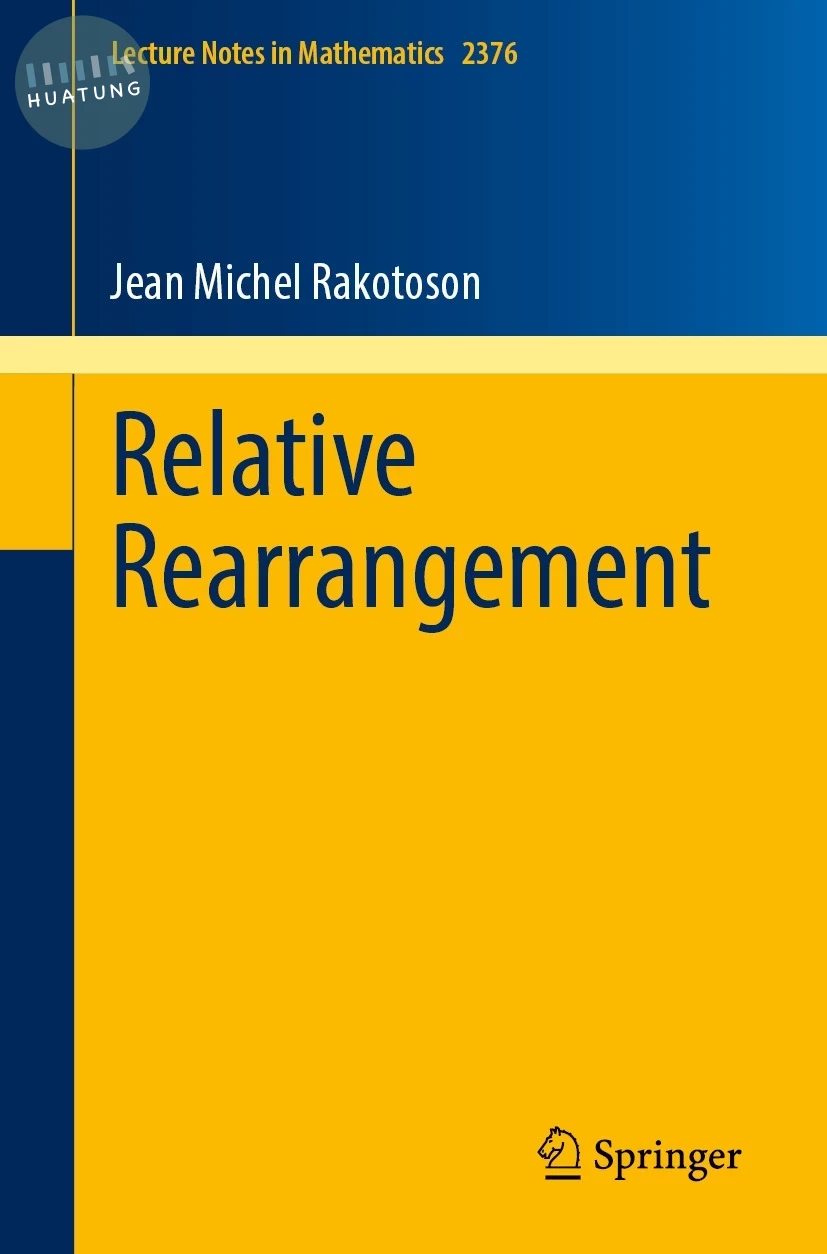
This book develops the properties of monotone rearrangement and relative rearrangement (sometimes called pseudo-rearrangement). It introduces applications to variational problems involving monotone rearrangements, a priori estimates for partial differential equations, and stationary or evolution problems associated with variable exponents. The properties of Sobolev embeddings for non-standard spaces such as BMO, VMO, Zygmung spaces and more general spaces invariant under rearrangement are also reviewed. The book is relatively self-contained – elementary details for non-specialists are covered in the first chapter, including, among other things, some punctual inequalities for the Sobolev embeddings and Pólya-Szegő type inequalities, which lead, for instance, to explicit and even precise estimates. The final chapter includes numerous exercises, with solutions. Based on the author’s Réarrangement relatif: un instrument d'estimations dans les problèmes aux limites (Springer, 2008), this edition contains additional recent results and new exercises concerning interpolation theory.
類似書籍推薦給您
類似書籍推薦給您
類似書籍推薦給您
The book aims to give a mathematical presentation of the theory of general relativity (that is, spacetime-geometry-based gravitation theory) to advanced undergraduate mathematics students. Mathematicians will find spacetime physics presented in the definition-theorem-proof format familiar to them. The given precise mathematical definitions of physical notions help avoiding pitfalls, especially in the context of spacetime physics describing phenomena that are counter-intuitive to everyday experiences. In the first part, the differential geometry of smooth manifolds, which is needed to present the spacetime-based gravitation theory, is developed from scratch. Here, many of the illustrating examples are the Lorentzian manifolds which later serve as spacetime models. This has the twofold purpose of making the physics forthcoming in the second part relatable, and the mathematics learnt in the first part less dry. The book uses the modern coordinate-free language of semi-Riemannian geometry. Nevertheless, to familiarise the reader with the useful tool of coordinates for computations, and to bridge the gap with the physics literature, the link to coordinates is made through exercises, and via frequent remarks on how the two languages are related. In the second part, the focus is on physics, covering essential material of the 20th century spacetime-based view of gravity: energy-momentum tensor field of matter, field equation, spacetime examples, Newtonian approximation, geodesics, tests of the theory, black holes, and cosmological models of the universe. Prior knowledge of differential geometry or physics is not assumed. The book is intended for self-study, and the solutions to all the 283 exercises are included. The second edition corrects errors from the first edition, and includes 60 new exercises, 10 new remarks, 29 new figures, some of which cover auxiliary topics that were omitted in the first edition. Request Inspection Copy Sample Chapter(s) Preface Chapter 1: Smooth manifolds Contents: Smooth Manifolds Tangent and Cotangent Spaces Vector Fields and 1-Form Fields Tensor Fields Lorentzian Manifolds Levi-Civita Connection Parallel Transport Geodesics Curvature Form Fields Integration Minkowski Spacetime Physics Matter Field Equation Black Holes Cosmology Readership: Advanced undergraduate and beginning graduate students in Mathematics and Physics.
資訊
工程
數學與統計學
機率與統計
自然科學
健康科學
地球與環境
建築、設計與藝術
人文與社會科學
教育
語言學習與考試
法律
會計與財務
大眾傳播
觀光與休閒餐旅
考試用書
研究方法
商業與管理
經濟學
心理學
生活
生活風格商品
參考書/測驗卷/輔材