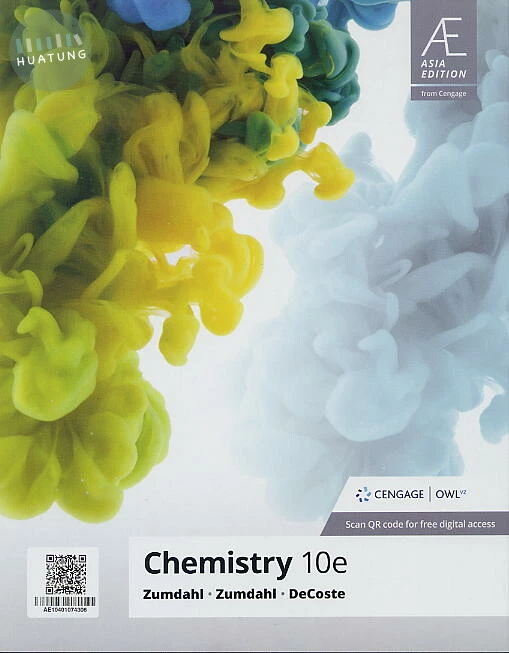


Chemistry【內含Access Code,經刮除不受退】 (10版)
$1450元 定價: $1480 9.8折 已售完
此書已為「舊版」無法下單! 請見諒在找「化學」的書嗎?
此書已有新賣場:Chemistry (11版)
為您推薦




下單選門市自取可使用文化幣
有團購需求請加官方LINE詢問
此規格目前無法購買,請見諒
書名:Chemistry 10/e Asia Edition
作者:Zumdahl
出版社:Cengage
出版日期:2019/00/00
ISBN:9789814866477
內容簡介
●We have added three new Sections to the text:
> 4.11: Simple Oxidation-Reduction Titrations
> 15.6: Polyprotic Acid TitrationK
> 17.5: Entropy Changes in Aqueous Ionic Solutions
●We have added several new subsections throughout the text:
> The Process ofHeat (in Section 6.1)
> Photoelectron Spectroscopy for Atoms (in Section 7.12)
> Photoelectron Spectroscopy for Molecules (in Section 9.3)
> Distinguishing Between Chemical and Physical Changes at the Molecular Level (in Section 10.1)
> Forces Between Polar and Nonpolar Molecules (in Section 10.1)
> Chromatography (in Section 11.2)
> Mechanisms with Past Forward and Reverse First Steps (in Section 12.5)
> Acid Catalysis (in Section 12.7)
> Nonspontaneous Reactions (in Section 17.7)
●In Chapter 3 the treatment of stoichiometry has been enhanced by a discussion of "BCA" (Before-Change-After) tables, which allow another method by which students can
conceptually understand the role coefficients play in a balanced chemicai reaction. Students are shown three methods to select a limiting reactant: comparing the amounts of
reactant present, calculating the amounts of products that can be formed by complete consumption of each reactant, and using a BCA table.
●In Chapter 4 we expanded Section 4.10 to include the halfreaction method for balancing complex oxidation-reduction reactions. This change was made to better support typical
laboratory programs.
●New end-of-chapter questions and problems have been added throughout the text.
●The art program has been modified and updated as needed, and new macro/micro illustrations have been added.
目錄
1. Chemical Foundations.
2. Atoms, Molecules, and Ions.
3. Stoichiometry.
4. Types of Chemical Reactions and Solution Stoichiometry.
5. Gases.
6. Thermochemistry.
7. Atomic Structure and Periodicity.
8. Bonding: General Concepts.
9. Covalent Bonding: Orbitals.
10. Liquids and Solids.
11. Properties of Solutions.
12. Chemical Kinetics.
13. Chemical Equilibrium.
14. Acids and Bases.
15. Acid-Base Equilibria.
16. Solubility and Complex Ion Equilibria.
17. Spontaneity, Entropy, and Free Energy.
18. Electrochemistry.
19. The Nucleus: A Chemist's View.
20. The Representative Elements.
21. Transition Metals and Coordination Chemistry.
22. Organic and Biological Molecules.
Appendix 1. Mathematical Procedures.
Appendix 2. The Quantitative Kinetic Molecular Model.
Appendix 3. Spectral Analysis.
Appendix 4. Selected Thermodynamic Data.
Appendix 5. Equilibrium Constants and Reduction Potentials.
Appendix 6. SI Units and Conversion Factors.
Appendix 7. Molecular Spectroscopy: An Introduction.
Answers to Selected Exercises.