
簡介
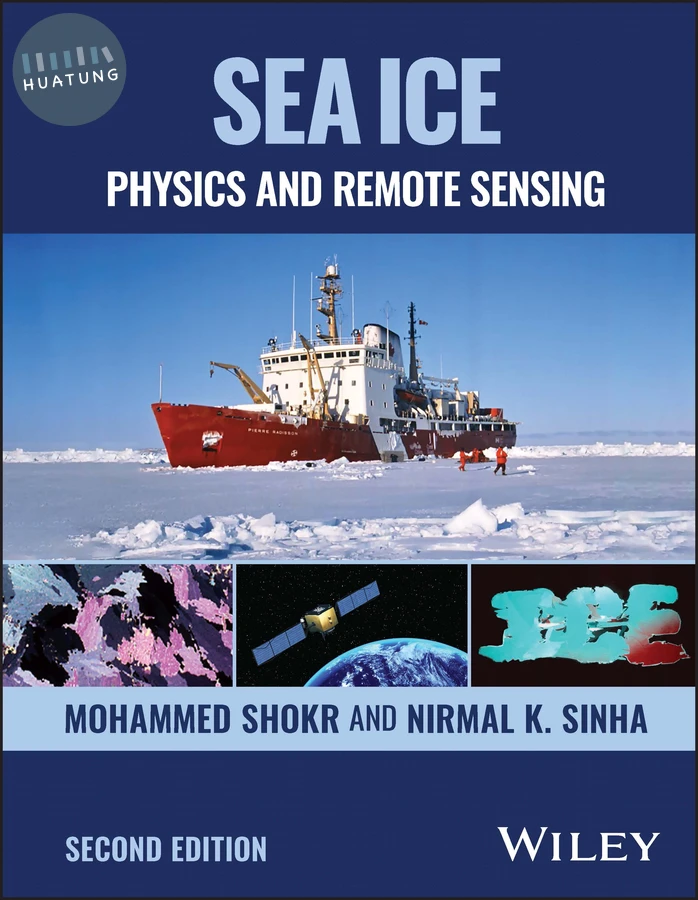
SEA ICE The latest edition of the gold standard in sea ice references In the newly revised second edition of Sea Ice: Physics and Remote Sensing, a team of distinguished researchers delivers an in-depth review of the features and structural properties of ice, as well as the latest advances in geophysical sensors, ice parameter retrieval techniques, and remote sensing data. The book has been updated to reflect the latest scientific developments in macro- and micro-scale sea ice research. For this edition, the authors have included high-quality photographs of thin sections from cores of various ice types, as well as a comprehensive account of all major field expeditions that have systematically surveyed sea ice and its properties. Readers will also find: A thorough introduction to ice physics and physical processes, including ice morphology and age-based structural features
Practical discussions of radiometric and radar-scattering observations from sea ice, including radar backscatter and microwave emission
The latest techniques for the retrieval of sea ice parameters from space-borne and airborne sensor data
New chapters on sea ice thermal microwave emissions and on the impact of climate change on polar sea ice
Perfect for academic researchers working on sea ice, the cryosphere, and climatology, Sea Ice: Physics and Remote Sensing will also benefit meteorologists, marine operators, and high-latitude construction engineers.
目錄
Preface xv
Acknowledgments and Recognitions xvii
1 Introduction 1
1.1 Background 1
1.2 Canada and the Arctic: Historical and Community Synopsis 4
1.3 The Fascinating Nature of Sea Ice 8
1.4 Sea Ice in Research and Operational Disciplines 12
1.4.1 Sea Ice in Physics 12
1.4.2 Sea Ice in Climatology 13
1.4.3 Sea Ice in Meteorology 14
1.4.4 Sea Ice in Oceanography 15
1.4.5 Sea Ice in Marine Biology 16
1.4.6 Sea Ice in Marine Navigation 17
1.4.7 Sea Ice and Offshore Structures 19
1.4.8 Sea Ice as A Transportation Platform 20
1.4.9 Sea Ice in Relation to Solid Earth Sciences: Rocks and Plate Tectonics 21
1.5 Sea Ice and Remote Sensing 22
1.6 Motivation for the Book Writing 24
1.7 Organization of the Book 25
1.8 References 27
2 Ice Physics and Physical Processes 29
2.1 Prior to Freezing: About Freshwater and Seawater 30
2.1.1 Molecular Composition of Water 30
2.1.2 Seawater Salinity 31
2.1.3 Seawater Density 32
2.2 Phase Diagram of Sea Ice 33
2.3 Initial Ice Formation 33
2.3.1 Freezing Processes in Freshwater and Seawater 33
2.3.2 Initial Formation of Ice Crystals and Frazil Ice 35
2.4 Sea Ice Growth 37
2.4.1 Lateral Ice Growth 37
2.4.2 Vertical Ice Growth (Congelation Ice) 38
2.4.3 Superimposed Ice 39
2.4.4 Thermodynamic Ice Growth 40
2.4.4.1 Simplified Models of Sea Ice Growth 41
2.4.4.2 Effect of Snow On Sea Ice 45
2.4.4.3 Effect of Oceanic Heat Flux 46
2.4.4.4 Effect of Surface Ablation 46
2.5 Processes in Ice 47
2.5.1 Compositional (Constitutional) Supercooling At the Ice–Water Interface 50
2.5.2 Dendritic Ice–Water Interface and Entrapment of Brine Within Sea Ice 51
2.5.3 Grains and Subgrains In Sea Ice 53
2.5.4 Brine Pockets Formation, Contents and Distribution In Sea Ice 54
2.5.5 Salinity Loss During Sea Ice Growth 58
2.5.5.1 Initial Rapid Salt Rejection At the Ice–Water Interface 59
2.5.5.2 Subsequent Slow Salt Rejection from the Bulk Ice 61
2.6 Ice Deformation 67
2.6.1 Rafting of Thin Ice 69
2.6.2 Ridging of Thick Ice 70
2.6.3 Formation of Ice Rubble Field 73
2.6.4 Fractures in Ice Cover 74
2.7 Ice Decay and Aging 76
2.7.1 Ice Decay 76
2.7.2 Ice Aging 80
2.8 Sea Ice Classes 84
2.9 Sea Ice Regimes 85
2.9.1 Polynyas 86
2.9.2 Pancake Ice Regime 90
2.9.3 Marginal Ice Zone and Ice Edge 92
2.9.3.1 Marginal Ice Zone 93
2.9.3.2 Ice Edge 94
2.9.4 Ice of Glacier Origin 95
2.10 References 99
3 Sea Ice Properties: Data and Derivations 107
3.1 Typical Values of Sea Ice and Snow Physical Parameters 107
3.2 Temperature Profiles in Ice and Snow 108
3.3 Bulk Salinity and Salinity Profile 113
3.3.1 Bulk Salinity 115
3.3.2 Salinity profiles 116
3.4 Density of First-Year and Multi-Year Ice 121
3.5 Volume Fraction of Sea Ice Constituents 123
3.5.1 Brine Volume Fraction 123
3.5.2 Solid Salt Volume Fraction 124
3.5.3 Pure Ice Volume Fraction 124
3.5.4 Air Volume Fraction 124
3.5.5 Temperature Dependence of Volume Fractions of Different Components 125
3.6 Thermal Properties 126
3.6.1 Thermal Conductivity of Sea Ice 126
3.6.2 Thermal Conductivity of Snow 129
3.6.3 Specific Heat of Sea Ice 131
3.6.4 Latent Heat of Sea Ice 133
3.7 Dielectric Properties 134
3.7.1 Dielectric Constant of Brine 136
3.7.2 Dielectric Mixing Models 136
3.7.3 Field Measurements of Dielectric Constant 142
3.8 References 146
4 Laboratory Techniques for Revealing the Structure of Polycrystalline Ice 149
4.1 Relevant Optical Properties 151
4.1.1 Polarized Light 151
4.1.2 Birefringence or Double Refraction of Ordinary (Ih) Ice 153
4.1.3 Optical Retardation 155
4.1.4 Interference Colors for White Light 157
4.2 Ice Thin Sectioning Techniques 158
4.2.1 Hot-plate Techniques for Thin Sectioning of Ice 159
4.2.2 Double-Microtoming Technique for Thin Sectioning of Ice 159
4.2.3 Double-Microtoming Technique for Thin Sectioning of Snow 161
4.2.4 Precautions for Thin Sectioning by DMT 163
4.2.5 Optimum Thickness for Thin Sections of Ice and Snow 163
4.3 Viewing and Photographing Ice Thin Sections 164
4.3.1 Laboratory and Hand-Held Polariscope 165
4.3.2 Cross-Polarized versus Parallel-Polarized Light Viewing 168
4.3.3 Scattered Light and Combined Cross-Polarized/Scattered Light Viewing 169
4.3.4 Circularly Polarized Light and Rapid Crystallographic Analysis 172
4.4 Advanced Techniques for Revealing Fine Crystallographic Microstructural Features 173
4.4.1 Sublimation of Ice and Sublimation Pits 173
4.4.2 Etching Processes 176
4.4.2.1 Thermal Etching of Microtomed Ice Surfaces 179
4.4.2.2 Chemical Etching and Replicating Ice Surfaces 183
4.5 References 188
5 Polycrystalline Ice Structure 191
5.1 Terms and Definitions Relevant to Polycrystalline Ice 192
5.1.1 Special Thermal State of Natural Ice 192
5.1.2 General Terms for Structural Aspects of Ice 193
5.1.3 Basic Terms and Definitions 194
5.2 Morphology of Ice 197
5.2.1 Forms of Ice Crystals 197
5.2.2 Miller Indices for Hexagonal Ice 198
5.2.3 Growth Direction of Ice Crystals 199
5.2.4 Ice Density in Relation to Crystalline Structure 199
5.3 Structure- and Texture-Based Crystalline Classification of Natural Ice 200
5.3.1 Freshwater Ice Classification of Michel and Ramseier 200
5.3.2 Extending Crystallographic Classification of Freshwater Ice to Sea Ice 202
5.3.3 Crystallographic Classes of Natural Ice 203
5.3.3.1 Granular or Snow Ice (T1 Ice) 203
5.3.3.2 Randomly Oriented (S4) and Vertically Oriented (S5) Frazil Ice 204
5.3.3.3 Columnar-Grained with c Axis Vertical (S1) Ice 205
5.3.3.4 Columnar-Grained with c Axis Horizontal and Random (S2 Ice) 207
5.3.3.5 Columnar-Grained Ice with c Axis Horizontal and Oriented (S3 Ice) 211
5.3.3.6 Agglomerate Ice with Discontinuous Columnar-Grained (R Type Ice) 211
5.3.3.7 Ice of Land-Based Origin 212
5.3.3.8 Platelet Sea Ice 213
5.3.4 Stereographical Projection (Fabric Diagram) of Natural Polycrystalline Ice 214
5.4 Examples of Crystallographic Structure of Natural Sea Ice 216
5.4.1 Crystallographic Structure of Seasonal Sea Ice 217
5.4.1.1 Frazil Ice (S5 Type) 217
5.4.1.2 Columnar-Grained Ice (S3 Type) 218
5.4.1.3 Agglomeration of Various Crystallographic Structures 220
5.4.1.4 Air Entrapment in Seasonal Ice 220
5.4.2 Crystallographic Structure of Perennial Sea Ice 221
5.4.2.1 Hummock Ice 223
5.4.2.2 Melt Pond Ice 226
5.5 Biomass Accumulation at the Bottom of the Ice 230
5.6 Information Contents in Polycrystalline Ice Structure 232
5.6.1 Geometric Characteristics of Crystalline Structure 232
5.6.2 Geometric Characteristics of Brine Pockets in First-Year Ice 236
5.6.3 Geometric Characteristics of Air Bubbles 242
5.7 References 244
6 Major Field Expeditions to Study Sea Ice 249
6.1 The Arctic Ice Dynamic Joint Experiment (AIDJEX) 250
6.2 Mould Bay Experiments 1981–1984: Stories that Were Never Told 252
6.2.1 Site, Resources, and Logistics 252
6.2.2 Sea Ice Conditions 254
6.2.3 Aging of Sea Ice: from FYI to MYI 259
6.2.4 Interface Between Old and New Ice in Second-Year Ice Profile 260
6.3 High Arctic Experience with Ice of Land Origin 262
6.3.1 Ward Hunt Ice Shelf and Hobson’s Choice Ice Island Experiment 262
6.3.2 Multi-Year Rubble Field Around the Ice Island 265
6.4 Labrador Ice Margin Experiment (LIMEX) 266
6.5 Sea Ice Monitoring and Modeling Site (SIMMS) Program 268
6.6 The Surface Heat Budget of Arctic Ocean (SHEBA) 270
6.7 The Norwegian Young Sea Ice Experiment (N-ICE) 272
6.8 Marginal Ice Zone (MIZ) Experiments 274
6.9 Ice Exercise by Us Navy 277
6.10 The Multidisciplinary Drifting Observatory for the Study of Arctic Climate (MOSAiC) 278
6.11 References 280
7 Remote Sensing Fundamentals Relevant to Sea Ice 283
7.1 General Principles of Satellite Remote Sensing 284
7.2 Electromagnetic Wave Properties and Processes 289
7.2.1 Polarization of EM Wave 290
7.2.2 Reflection, Transmission, Absorption, Scattering, and Emission 292
7.2.2.1 Reflection and Fresnel Model 293
7.2.2.2 Transmission 295
7.2.2.3 Absorption and Scattering Losses 296
7.2.2.4 Emitted Radiation (Re-radiation) 296
7.2.3 Brightness Temperature and Emissivity 297
7.2.4 Penetration Depth 299
7.3 Optical Sensing 300
7.4 Thermal Infrared Sensing 303
7.5 Microwave Remote Sensing 305
7.6 Imaging Radar Sensing 308
7.6.1 Imaging Radar Principles 308
7.6.1.1 Radar Equations and Spatial Resolutions of RAR and SAR 309
7.6.1.2 Coherency and Polarization of Radar Signals 311
7.6.1.3 Radar Scattering Mechanisms 312
7.6.2 Multichannel SAR 313
7.6.3 SAR Polarimetry: Formulation and Derived Parameters 315
7.6.3.1 Formulation of Polarimetric Measurements 316
7.6.3.2 Polarimetric Parameters Derived from the FP SAR Data 317
7.6.3.3 Linking Radar Scattering Mechanisms to Ice Features 320
7.6.3.4 Age-Based versus SAR-Based and Scattering-Based Sea Ice Classification 321
7.7 Scatterometer Systems 322
7.8 Altimeter Systems 323
7.9 Radiative Processes in Relevant Media 325
7.9.1 Atmospheric Influences 325
7.9.1.1 Influences of Atmosphere on Optical and Infrared Observations 325
7.9.1.2 Atmospheric Correction for Passive Microwave Observations 328
7.9.2 Seawater 330
7.9.2.1 Seawater in the Optical and Thermal Infrared Data 330
7.9.2.2 Seawater in the Microwave Data 331
7.9.3 Snow on Sea Ice: Physical and Radiative Processes 333
7.9.3.1 Snow in Optical and Thermal Infrared Data 335
7.9.3.2 Snow in the Microwave Data 336
7.10 References 341
8 Satellite Sensors for Sea Ice Monitoring 349
8.1 Historical Synopsis of Remote Sensing Satellites for Sea Ice 349
8.2 Optical and Thermal Infrared Sensors 352
8.3 Modern Passive Microwave Sensors 353
8.4 Modern Imaging Radar Sensors 355
8.5 Scatterometer Sensors 358
8.6 Altimeter Sensors 359
8.7 References 360
9 Radiometric and Scattering Observations from Sea Ice, Water, and Snow 363
9.1 Optical Reflectance and Albedo Data 364
9.2 Microwave Brightness Temperature Data 370
9.3 Radar Backscatter 376
9.3.1 Backscatter Databases from Single-Channel SAR 378
9.3.2 Dual Polarization Data 384
9.3.3 Fully Polarimetric Data 387
9.4 Emissivity Data in the Microwave Bands 395
9.5 Microwave Penetration Depth 403
9.6 References 407
10 Retrieval of Sea Ice Surface Information 411
10.1 Mechanically Generated Surface Deformation 412
10.1.1 Rafted Ice 412
10.1.2 Ridged, Rubble, and Brash Ice 413
10.1.3 Kinematic Processes: Convergence, Divergence, Shear, and Vorticity 417
10.1.4 Cracks and Leads 421
10.2 Thermally Induced Surface Features 428
10.2.1 Surface Melt 428
10.2.1.1 Optical Observations 428
10.2.1.2 Passive Microwave Observations 432
10.2.1.3 Active Microwave Observations 434
10.2.1.4 Airborne Photography 437
10.2.2 Frost Flowers 438
10.3 Meteorologically Driven Surface Features 442
10.3.1 Polynya Identification and Properties 442
10.3.2 Snow Depth 444
10.4 References 448
11 Retrieval of Sea Ice Geophysical Parameters 453
11.1 Sea Ice Type Classification 454
11.1.1 Ice Classification from Optical and TIR Systems 456
11.1.2 Ice Classification from Passive Microwave Data 457
11.1.3 Ice Classification from SAR 458
11.1.3.1 Ice Classification from Single-Channel SAR 460
11.1.3.2 Ice Classification from Dual-Channel SAR 461
11.1.3.3 Ice Classification from Polarimetric SAR Data 467
11.2 Sea Ice Concentration 471
11.2.1 Ice Concentration from Optical and TIR Images 472
11.2.2 Ice Concentration from Coarse-Resolution Microwave Observations 473
11.2.2.1 NASA TEAM (NT) Algorithm 475
11.2.2.2 The Enhanced NASA Team (NT2) Algorithm 476
11.2.2.3 The ASI Algorithm 478
11.2.2.4 ECICE Algorithm 479
11.2.2.5 Intercomparison of PM Algorithms 486
11.2.2.6 Sources of Error and Sensitivity of Ice Concentration Algorithms 490
11.2.2.7 Assessment of Ice Concentration Results Against Ice Charts 493
11.2.3 Ice Concentration from Fine-Resolution SAR 496
11.3 Sea Ice Extent and Area 498
11.4 Sea Ice Thickness (SIT) 501
11.4.1 SIT from TIR Observations 503
11.4.2 SIT from PM Observations 506
11.4.3 SIT from Altimeter Observations 510
11.4.4 SIT from SAR Observations 514
11.5 Ice Surface Temperature (IST) 517
11.5.1 IST from TIR Observations 517
11.5.2 IST from PM Observations 520
11.6 Sea Ice Age 522
11.7 Sea Ice Motion and Kinematics 524
11.7.1 Methods of Ice Motion Tracking 526
11.7.1.1 Motion Tracking Using Image Features 526
11.7.1.2 Motion Tracking Using Individual Sea Ice Floes 528
11.7.2 Operational Ice Motion Products 532
11.8 References 533
12 Modeling Microwave Emission and Scattering from Snow-Covered Sea Ice 541
By Rasmus Tage Tonboe
12.1 The Need for Modeling Microwave Emission and Scattering from Snow-Covered Sea Ice 541
12.1.1 The ECMWF Workshop and Large-Scale Sea Ice Modeling 542
12.1.2 Gross Features of Forward Models 542
12.2 Radiative Transfer and Modeling Approaches for Sea Ice Thermal Microwave Emission 543
12.2.1 Dense Media Volume Scattering 543
12.2.2 Sea Ice Emission Models 543
12.2.3 Sea Ice Backscatter Models for Level Ice 544
12.2.4 Sea Ice Backscatter Models for Ridged Ice 545
12.3 The Input to a Forward Model 545
12.3.1 Primary Input Parameters 545
12.3.2 Secondary Input Parameters 546
12.3.3 Tertiary Input Parameters, Volume, and Surface Scattering 546
12.4 Example of the Implementation of an Altimeter Model to Study the Impact of Saline Snow on the Backscatter 547
12.5 Example of Combining Atmospheric, Ocean, and Sea Ice Emission Models to Simulate the Noise in Sea Ice Concentration Estimates 548
12.5.1 Snow in the Emission Models 549
12.5.2 The Combined Sea Ice Thermodynamic, Atmospheric, Ocean, and Sea Ice Emission Models 549
12.6 Inverse Modeling 552
12.7 References 553
13 Impacts of Climate Change on Polar Ice 557
13.1 The Inconvenient Truth of Global Warming: How is it Manifested in The Polar Region? 560
13.2 Sea Ice Regimes in the Two Polar Regions 562
13.2.1 Geographic Differences Between the Two Polar Regions and Their Impacts on Sea Ice 562
13.2.2 Differences in Sea Ice Characteristics Between the Two Polar Regions 564
13.3 Changes of Polar Sea Ice in Response to Global Warming 565
13.3.1 The Arctic and Antarctic Ice Extent 565
13.3.2 The Arctic and Antarctic Ice Thickness and Volume 569
13.3.3 The Arctic Sea Ice Age 572
13.3.4 The Arctic Sea Ice Dynamics 575
13.3.5 The Antarctic Icebergs 576
13.4 Coupling Between Polar Sea Ice and Environmental Factors 577
13.4.1 Interaction of the Arctic Sea Ice with the Environment 578
13.4.1.1 Atmospheric Factors that Contribute to Changes in the Arctic Sea Ice 578
13.4.1.2 Enhanced Arctic Warming due to Changes of Sea Ice Cover 578
13.4.1.3 Arctic Warming due to Sea Ice Advection Out of the Arctic Basin 580
13.4.1.4 Interaction of the Arctic Sea Ice with Wind 582
13.4.1.5 Mutual Interactions Between the Arctic Sea Ice Cover and Oceanic Forcing 584
13.4.2 Interaction of the Antarctic Sea Ice with the Environment 585
13.4.2.1 Interaction of the Antarctic Sea ice with Atmospheric Factors 585
13.4.2.2 Interaction of the Antarctic Sea Ice with Oceanic Forcing 586
13.4.2.3 Interaction Between the Antarctic Sea Ice, Ice Shelves, and Icebergs 587
13.5 References 590
Index 595